Hello again, it’s me, your local craft nerd.
Did you know that all bronze statues are actually hollow? Yes, all of them. Go ahead, knock on one. Unless they’re filled with, like, concrete for some reason, but that’s really absurd. The bronze is actually only like a couple of centimeters thick. And they’re all cast in pieces and then welded together, after which the seams from the weld are worked away from the outside. But they remain on the inside, which is what made stepping into this sculpture so cool. Negative space. You can see where the people working on this mold – because they are always several – chose to put the joints.
For these kinds of sculptures there is always an original that is made in clay. So for example, the markings you see on the lips, that is the artist scratching the soft clay. After that the clay is covered in plaster, and it is the plaster that becomes the mold which receives the molten metal. It’s a long and complicated process.
If you ever get the chance to climb into someone’s head, do it! Hum a tune and take some photos. Look at the joints. Be in the negative space and fill it!
…
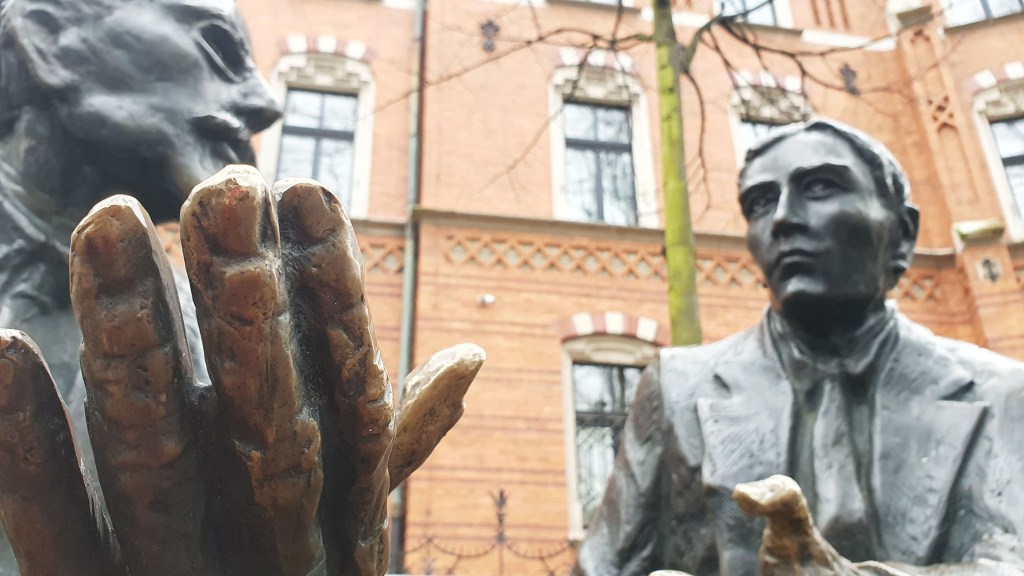
Oh and isn’t it funny how we especially like touching stuff that resembles us? How it’s sooooo satisfying to us? Look at this guy’s hands, so shiny and polished by all the human hands that have caressed them over the years! Skin polishing bronze. Covering the metal with a layer of fat that protects it from oxidation in the wet seasons. I think about the hand imprint at Ateneum in Helsinki and how we’re drawn to touch a block of stone just because we can connect to the other humans who touched it. Wood, metal, stone, glass, wool, you name it. We want to touch it more if it looks like us. We connect.
…
(This story told in pictures.)
 Hulkuv loom