In Venice, one falls,
and one falls through one’s eyes.
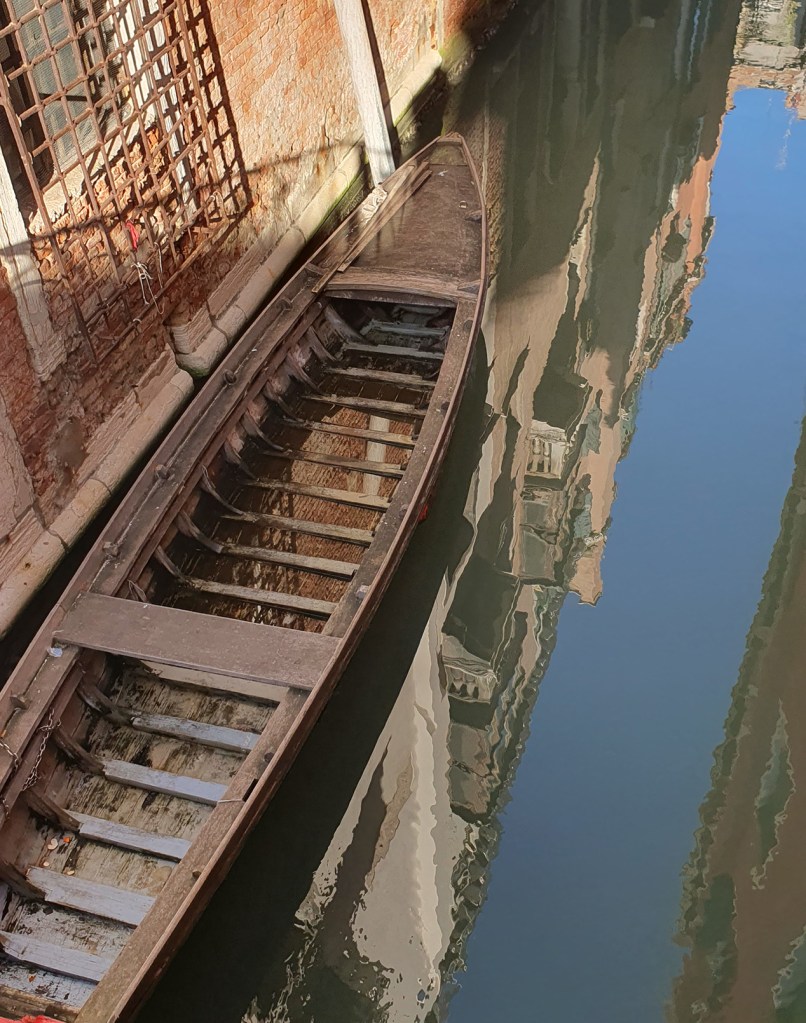
It is bustling, it is open and closed. No matter how slowly you walk, the streets change faster than you can see and so you’re left looking, perplexed and overwhelmed as the feet march on. Your gaze jumps from one object or movement to the next: from the peeling facades of the houses into the turquoise movements of the water between them, happily reflecting the sun, to the boats and gondolas splitting the water-street and the tourists lining up on the sides, waiting for their turn on the attraction. Then here is a colorful wink from a glass statue in a small shop window and now again it’s gone and instead your gaze has fallen deep into the eyes of a beggar, the only thing still in the movement.
I have not seen beggars in Mestre but I see them in Venice and I wonder where they sleep at night. They are very quiet; they only ask with their eyes.
…
The trees are also very quiet.
In Venice, trees are crammed between the lopsided houses in the small courtyards. They grow, seemingly obedient, but then viciously rip up the cobblestones with their roots and determination; not even the wind can move a single leaf.
I wonder if cities like Venice know that one day they will be overtaken by tourists, the streets pushed further and further down into the water not by the co-ordinated march of an army but the dazed, un-co-ordinated steps of tourists walking to the same places to take their selfies on the bridges, only removing the pressure when finding a seat in a gondola where they can peacefully scroll on their phones. I wonder if Venice knew that one day, its streets would be filled with stands of merchants selling identical T-shirts and trinkets all imported from China, all somehow referring to Venice yet at the same time being far detached from her.
In Venice, the November mornings smell like salt water, trash and dog piss.
The plants on the windowsills don’t grow up towards the sky, but instead they reach down, down into the water and the mud that lies beneath. It is as if in solidarity with the streets, they too are sinking.
I wonder what happens when it rains and when the water rises, and I wonder what happens to the water when one flushes the toilet, how the pipes are laid out.
I wonder what it’s like in summer heat.
…
In Venice, the streets go however they wish and they do not wish to be straight. The houses seem to simply follow their whims, taking the spaces left for them between the water and the streets.
I sneak through Venice at dawn, slowly on my sore feet. Wide-eyed, I get lost in the narrow streets and watery dead-ends. There are too many details, they all captivate and overwhelm me and I am running a fantasy dialogue in my head:
Did the first people of Venice know that they were building a city of fantasies? That describing Venice sounds like a dream?
“Hey, imagine a city. But instead of streets, there is water. And instead of carriages, we’ll have boats.”
…
(This story told in pictures.)
 Hulkuv loom