The work at the hostel is easy and effortless as there are almost no guests. My shift is every night from 20-00 and I pass the time by studying French and the Arabic alphabet. The mornings I spend on the beautiful rooftop terrace. Three days in I am asked to work from 16 because my colleague is going to his hometown to celebrate that his sister has given birth. All alone and with way more hours to kill than normally I decide to invite my new friends over for dinner, looking forward to sitting together and showing them the rooftop terrace. I am overjoyed to have access to a kitchen to cook in and to be able to invite and host, just as I have been hosted and invited.
We are all chatting together with the two only guests when the co-manager of the hostel arrives, the man who first gave me the job. He takes me to the side and asks me who my friends are and if I have asked permission to invite them. I am dumbstruck as I didn’t even think of asking permission; my colleague has had friends over almost every night. I quickly text him and say that I have invited some friends, and I ask if that is OK. My colleague replies quickly:
“Pics of passports, plz”
Again, I am dumstruck. I reply that they don’t have passports.
“Not at all?” An emoji of eyes that stare.
At that point I don’t know what would be the right move. I realize that I am in unfamiliar terrain.
“I mean I don’t know if they have them, they didn’t bring passports.”
I know very well that they don’t have the right papers, but I figure that it wouldn’t help anyone if I said that. The next text comes as a chock to me:
“They could take anything. You wouldn’t even notice.”
I freeze, because I notice worlds colliding. It is strange for me to not be trusted with the people I invite as my friends. At the same time I must admit that, sure, I don’t know my friends so well yet – am I being naive? Does my colleague know something I don’t?
On the yet other side I feel like a bad host; without anything having being said, the energy in the room has shifted and I know my friends are sensitive enough to pick up on it (and I know that the two European guests aren’t, and won’t.)
(Later they ask me what my colleague had said and my gaze, which I turn away, confirms their thoughts without me having to say much more. “We know how Moroccans are.” Joël says, and his and Jonas’ eyes are steady and soft in my silence. Maybe the racism is a chock for me, but definitely not for them.)
The next day, I am asked to leave my position as a volunteer. I’m told that it is because there are no guests, but I suspect there is more to it than that. I get to stay a few nights while I find another place, it is all calm and polite but later on the rooftop I cry over the thought of having to leave Tangier. I am sad because it’s sudden and I don’t know what to do, but mostly I cry because I am not ready to leave my tentative friendships that have just begun to grow. The thought of leaving them hurts.
(Much later, when I retell this on the phone, my dear friend laughs at me:
“Inga I have to admire your view on the world. Bringing in black, paperless rasta-men and not even thinking that it could in any way compromise your position…”
I laugh, too. When she puts it like that I see a world with unwritten rules I am not at all used to consider.
“Autism versus racism,” we conclude, and we both laugh.)
The very next day Joël and Jonas pick me up outside of the hostel and after all the hellos and how are yous have been said I tell them that I need to find a room. I have grown; when I was in a similar situation in Mozambique of unexpected homelessness, asking my friends for help felt incredibly hard and it took me several days before I could even tell them about my situation. Now, the question just slips out of me. I throw it out there without expectations, but with a careful sensation of hope.
We walk and discuss. My friends know the Medina well, they have gone through looking for housing and they ponder the alternatives. Over the following days they take me to various places to talk to people – smoky bars and men gathered around football games, women walking the streets with their babies on their backs – they exchange phone numbers and make calls, follow up leads. As I trot behind them looking at their backs sicksacking through the crowds of tourists, something between my lungs swells and hurts so bad that my eyes tear up and I have to hold on to my amulets. It feels like a balloon pressing out from my chest: I am so, so grateful.
I ask every tentative friendship I have made during the week I’ve been walking and chatting on the streets, join facebook-groups and couchsurf. In worst case, I think, I can camp outside of the city, but a bed somehow always materializes for the night.
I couchsurf, make some lovely friends and learn about Moroccan life from the perspective of two young doctors and a chef; everywhere I feel welcomed and well received as a guest. But even as I make jokes, eat tasty food, learn to write my name in the sand and join lovely forest walks, I have fallen back into the day-by-day-mindset not knowing where I’d sleep the following night or how long I’d even stay in Tangier. It stresses me emotionally. Under the weight of my backpack in the moments I am walking alone I slip into a quiet space where I, as countless times before, ponder the vulnerability and softness of the human body as it circles around fulfilling basic needs: food, water, safety, sleep.
On a Monday, exactly two weeks and a day after my arrival to Tangier, my friends bring me to see a room in a house in the Medina. We walk the winding streets and I follow dumbly, still not recognizing myself at all. Our guide is one of the sub-Saharan women with her baby on her back. I’m told that I am being taken to see a room in a house where only women are allowed and that most of them are also Africans from sub-Sahara. The woman stops by a black iron door and knocks.
“Mama Aïsha!” she calls. She calls a few times before the door opens and a quite short Moroccan woman looks out. They exchange some words and the woman looks at me. I don’t understand all the words, but I feel like I understand the conversation fluently. An explanation, a question, the situation, the presentation: I am being looked up and down, then invited up to see the room. My friends have to wait outside.
It is only up one flight of stairs, the second room on the left. A small square space, a wardrobe, a single bright light bulb. The walls and floors are white, the ceiling is high. Things piled all over the floors, but I am told it will be cleared out in a matter of fifteen minutes. My French is poor but both the women take care to speak slowly. I find myself a little scared of mama Aïsha, she looks stern but after a short while she smiles and her smile is gentle. I relax. Outside the room is a tiled counter top with gas cans where some women are cooking. A small boy runs around laughing and is lifted up by another woman passing by. The energy is vibrant and homey and the rent for a month is within what I can afford. When I return to my friends on the street, my insides are soft and I am smiling. They ask me if I want to stay there and I nod. It all feels too good to be true. We agree with mama Aïsha that I will come back tomorrow. By then she tells me she will have a copy of the keys for me.
That night I spend in Joël’s small room which he kindly lends for me and he spends the night in Jonas’ home. Under the painted ceiling, in the dark and with the sounds from the narrow street seeming very close, I try to calm my nervous system with deep, shaky breaths. I still don’t dare to hope that from tomorrow I will have a room of my own for a month if I so wish, some stability and safety for a time longer than I can imagine. I feel strangely weak and sad. Finally I fall asleep.
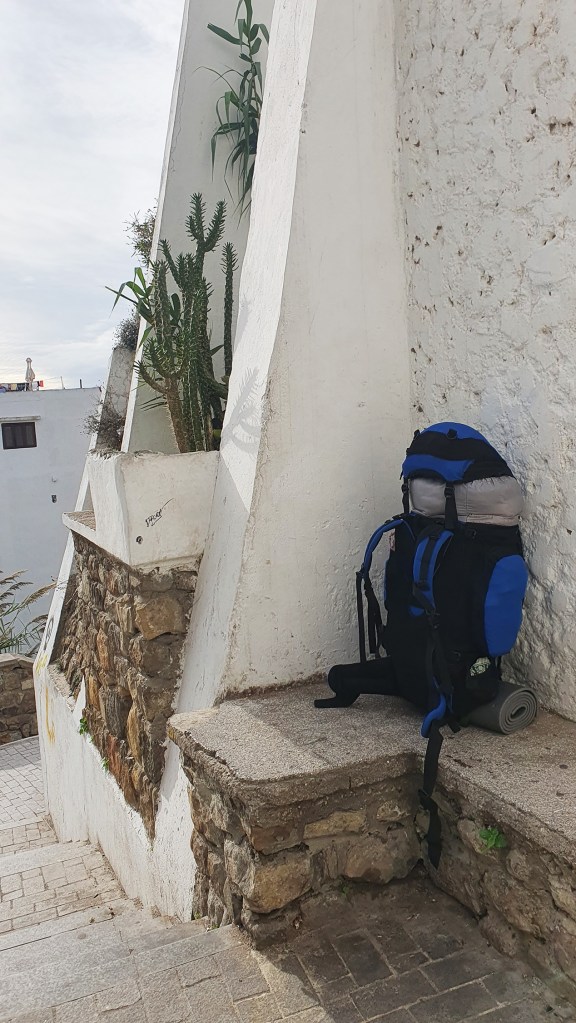
The next day comes. Joël picks me up and I pick up my backpack – my only constant home – and together with Jonas we go to my new home. I do not dare to trust that I will actually be able to rent this room, surely my luck can not be this good, surely things aren’t just going to work out this easily and arrange themselves to be just like I wish them to? But they do. When we arrive mama Aïsha hands me two keys just as promised and I hand her the money for the month. My friends leave me and I walk into the house and my room, now empty and clean. I close the door, put down my backpack and stand, clueless as to what to do next. Again, the sense of time is disrupted as I lay my things down, put up a line for clothes and hang my capulanas, put my clothes in the small wardrobe.
It happens over the next couple of days; my soul arrives, slowly.
…
(This story told in pictures.)
 Hulkuv loom