Casablanca is only a few hours away by train but it is enough for me to forget everything I have seen and done during the last month and start from zero. Un-used to the weight of my backpack I struggle with my posture. Again. The train arrives a bit off from the city center and I decide to walk the hour to the place where I am to meet my host. I am meeting unknown people and going to unknown places. Again. Only relying on hope and trust. Again, again, again. Fumbling blindly, but no, this is not from zero; you are not completely new, I have to remind myself. I do know the price of bread, as well as the name of it. I do know how to say hello and how are you. I do know that the big taxis usually operate along certain routes and that for the small ones you need to make sure that the driver will use the taximeter, unless you want to risk getting ripped off. I know, I know a lot of things, I think, as I walk. Slow and steady. I am in no hurry.
Before I arrive to the place we’ve agreed on they pick me up by car; two friends, loud n’ rowdy. My calm mood is immediately contrasted and I am thrown into the next adventure, into the car, into the busy-busy streets. Rap music plays loudly and the bass is good, I have to yell to get heard and I honestly can not hear anything that is said to me. I refuse to get dragged along with the mood, I speak even slower and take time to draw out the vowels of my questions. Stubbornly I am myself; this is who I feel like being right now. I don’t want to yell or change pace, and that is OK. To be honest I am quite enjoying myself, with the music, spacing out in the back seat.
“Casablanca is like the New York of Morocco,” my host tells me and laughs and I see what he means. It is so big. We zig-zag through busy streets and I don’t care enough to even try and memorize where we are going; I will only stay for some days anyway. Or so I think.
I have fallen ill, too; my throat hurts and my nose is runny. We eat delicious beans and lung at a restaurant by the side of the street, my hosts smoke and joke with the waiters and I don’t know, it feels almost rude to me the way they joke, but I say nothing. We dip our bread in the beans and I am told that I am Moroccan because I am eating with my hands, I slyly show off the few words I know in Darija and am quickly taught and encouraged to swear. Later I laugh at my new friends for brushing their teeth by the sidewalk and the day flashes by. Toward the evening I am tired as the grave. The next day I wake up with a fever.
Still I do quite a bit of touristing. The energy of my host is infectious but also, frankly, completely blind. He is a cannonball. He moves fast, he speaks fast, he changes his moods fast and I struggle to keep pace. For better or worse I am dragged along around the city, I mean I enjoy it because I would probably not make a tour by myself and my host really does know everything, but I feel like a wet rag. I have to laugh as I take breaks to cough and breathe. A wet rag eating delicious black olives.
…
We visit the mosque of Hassan II, the biggest mosque in Africa. I have seen the minaret from all over the city and as we approach I need to crane my neck to see it all. The patterns are exquisite: bone white and turquoise tiles laid intricately, small shifts in angles and nuance, like entering into a kaleidoscope. In the big spaces, other bodies seem distant and small as they stroll by. The spaces between the pillars fold me slowly into the courtyard and when the call to prayer echoes and bounces off the tiles, I find it the most beautiful voice I have yet heard to sing the call. I do not pay to enter but I peek over the threshold along with the sunlight and the other tourists. It’s like my eyes are stuck; I can not make sense of all the shapes.
“I wonder what it all would look like of acid,” a joking little voice whispers on my shoulder and I have to giggle to myself.
…
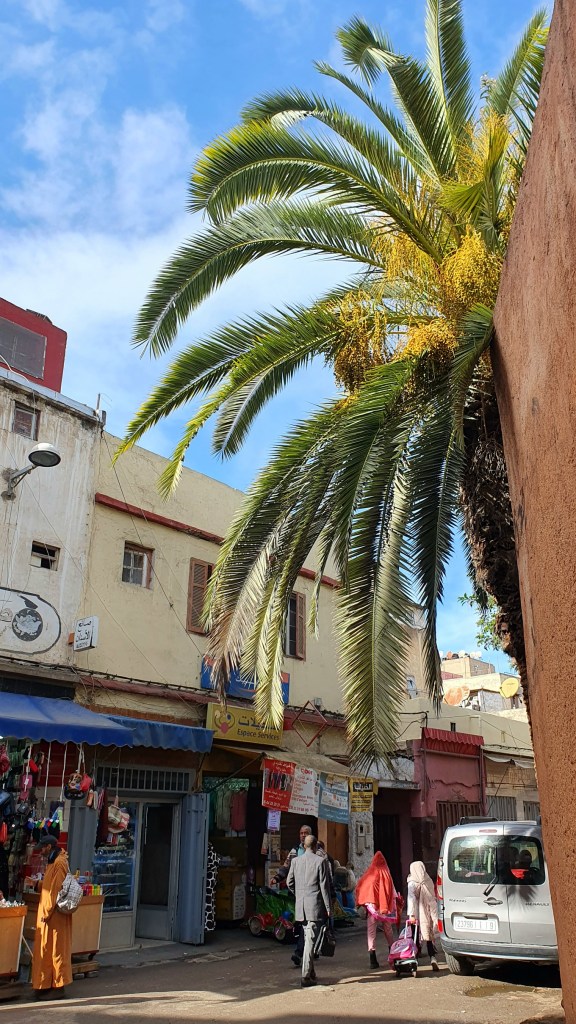
We visit the old Medina and again I would get lost if I was not following my host. He knows the city like the palm of his hand. It is different than the Medina in Tangier which I find strange; for some reason I thought they would all be similar. Here the streets are wider and everything is flat; no stairs or steep hills cut through or elevate the houses. It feels quite orderly, apart from the scooters noisily cutting through the crowds, annoying me. I wish they would ban them.
…
The plan was for me to move on to El-Jadida to volunteer on a farm within a few days, but I talk to my future host and he tells me he prefers for me to show up when I am feeling better. My current host offers me to stay and so the few days I was to spend with him turn into a week.
…
In the weekend he takes me to listen to gnaua music and I am thrilled to find that here I can dance just as I want to. The event is full, the vibe is high, everybody is singing and dancing and I can feel in all of me that we are moving spirits around, we are shifting energies.
The women have a special way of dancing to this music. With their long hair out they throw their head, they basically headbang to the rhythms, hair flying everywhere. It looks beautiful and wild and it is pretty intense; some enter heavy trance states, some even pass out. Other people receive them, sit their dizzy bodies down in a nearby chair, put a cloth over their heads and give them water or fan them. It is accepted here, to be taken over by the trance state, the music and the spirits, and I watch them with a soft heart. I don’t dare to headbang quite like that, but with my hands on the railing I carefully try.
When I hear the metal percussion I see horses galloping through the desert, the voices and the one string instrument, the gimbri, become wind and sand. I go up to the second floor. There is more space and this is where I feel the energy is going. And with the rhythms from below I lift the energy further up, I channel it through all the body, through the ceiling and towards the sky.
And for the first time in I don’t know how long, I enter trance. Everything becomes clear.
In my body I feel all the movements get married as I move to the rhythms of gnaua. Still carrying with me what I have learned before from tremuria and modern afro in Mozambique earlier this year, from dancing salsa some days before, from the traditional dances and contemporary dances that have circled through me.
In my body, cultures marry. Behaviors of right or wrong. As I mold, as I adjust and adapt, as I grow my consciousness around and with the movements. Embodied knowledge, this is what it means. Even if I may not perceive it myself, even if I may perceive myself as far away from present, still, I learn to better and better arrive in myself, in my body, to clean myself of judgment, to clean myself of negativity and poisons that have been fed to me throughout my life. I learn to arrive in the purity, in the presence that is me. I learn to arrive without questioning, I learn to arrive beyond words.
The self, the body has changed lately and I move to re-cognize it and accept it again, change my image of self to match with the new size of my thighs, a new sensation of heaviness. I am still a dancer even if I feel weak and even if I am constantly chewing on big bites of muchness. I need to remember: I can still run up stairs and make playful jumps and there is nothing wrong, it is all a blessing, even if there are days when I feel that my backpack is too heavy and I have no idea how to make it lighter. It is all in process, in growing, in becoming. I am becoming myself. I am becoming the fibers and strings that encompass the new ideas and ways of being, so many ways of being and you know what, I have space for them all. I am still strong and free.
The more situations I learn how to make myself a home in, the bigger I become. I am a net. A net with holes inside, I am the only holes inside, holes and the fibers around, moving, changing the shapes and through the holes pass the past and the present and the future and I am within it and I am without it, all at the same time, nameless and shapeless and now.
And I accept to be sent into trance, I desire it. The energy is deafening, people are singing, some are crying, some have fainted and I have just danced like I have not for almost a year, touching the un-nameable holy space that is beyond me and inside me, and it was these sandy echoes that brought me here, lines and lines of ancestors, galloping horses, dark and starry desert skies. Every breath is sweet and holy.
…
Every other conversation later that evening is both a relief and a disappointment. In a way it is nice enough to enter a grounded space, to chat. And in a way I am frustrated because how can one go back to answering questions about where one is from and travel itineraries after having felt something so big?
I spend my evening with a mixed group of tourists and locals, some other couchsurfers and some people from the band. We go back to the same wonderful restaurant on the main street and eat tajine, a big group gathered around the small plastic tables and I find myself having a good time. Somebody picks up a gimbri and suddenly we’re all singing again. Later we stroll around the city as people drop off one after one and I, too, am longing for sleep.
…
A week passes very quickly in this tempo. I am worn out, frankly barely better and I find myself in a complicated space of being grateful to my host for all of our activities and for being included and at the same time almost desperately longing for alone time and doing nothing at all. After my month in my little Tangier room I notice how extreme the change of pace is. And I am grateful, and I am scared of appearing as if I’m not for needing something else. One of the days I ask to stay back and I spend some glorious hours alone in the quiet kitchen, writing, drinking cups and cups of tea, watching the sunlight move over the Hassan mosque. Smiling, sighing, I conclude once again that I do need my alone time, whether I might like it or not. When I join my host later in the evening I feel recharged.
…
Despite still being sick I decide I’m well enough and I contact my future host, the man for whom I am to volunteer and we agree that we will meet up the same day; he has left everything extremely flexible for me. In the morning I pack my things, head out for an errand of needles – I need to take a vaccine for my future travels as well as having booked a time with a tattoo artist – and by mid-day I return, take my stuff and say good-bye and thank you to my host. I am ready to leave Casablanca, not having known her much at all.
I walk through the Medina with my backpack and dodge offers from taxis and people yelling welcome and where are you from. I make it into the office and I wait for my new host. After an hour or so, during which I talk to the incredibly sweet girl working at the desk and who covers her forehead with her hand in shame when she finds out how little of the Moroccan traditional food I have actually tried during my month here, my new host shows up. He is kind, calm, a little aloof and it turns out that I am not going to El-Jadida and that I am not working on a farm. Instead, I will be staying in Casablanca and I will be working at an English school.
“We’re re-modeling the farm now,” my host tells me. “You could go, I guess. It’s just two guys there.”
I agree to work at the school and I decide to keep the construction job as an option – I have, after all, been longing for working with the body and being out of the city.
“Maybe in a week, then,” I say, and after chatting we pack myself and my stuff into the car and make our way slowly through the honking traffic jams, crammed street after crammed street, all the way to the north part of the city but a part which still is very much the city.
We reach the building, a square crammed right between the other squares by a busy street market, on top of a phramacy and a clothes shop. The name of the school is prited with large letters on the front. Inside we climb up seven floors and I think my legs will break under the weight of the backpack and I try not to cough or look too tired and to overall seem more healthy than I am. I needn’t worry; most of the other volunteers are out on a desert trip and the ones remaining are also sick and even worse off than me; just a few tired bodies feverishly dragging their feet around. It’s quiet. It suits me just fine. I am assigned a bed in a room with four others, just next to the kitchen area. The rest of the rooms on the floor are classrooms, some made into dormitories. I am told that the shower has hot water, there is a gas stove and all sorts of pots and pans and suddenly I find myself living in luxury. I breathe out. It’s going to be good, it’s going to be stable.
After throwing my things in the corner which now is “mine”, I make my way back down to the street and the vendors and buy some basic ingredients. That night I cook myself a pan of tomatoes and eggs and I enjoy a hot shower, the first one since a month (if you don’t count the hammam, and I don’t; washing yourself at the hammam is something else.) I chat briefly with the four other volunteers. Then I snuggle into my bed and I sleep my best sleep, dark and dreamless.
This school, it turns out, will be my home for over a month.
…
(This story told in pictures part one, two, three, four and five.)
 Hulkuv loom