The traffic is loud and the honking is constant even though it’s a so called calm area of town. In Morocco the drivers tend to lean on the horn for every and no particular reason. Some days this extreme expression of emotion bothers me and some days I’m neutral. Whenever I’m indoors I don’t even hear it anymore, I sleep right through it.
The air is heavy with fumes. It’s still chilly.
In Casablanca my life has again shifted quickly. Time flies. Suddenly and straight away I fall into routine; grateful and helpless.
I doze off for the following weeks. Something shuts down.
There has been so much, there is still so much and I just don’t take it in anymore. My diary notes become scarce, my voice retreats. I feel lazy and comfortable where I am, like nothing unforeseen is going to happen and I can stay for as long as I want and need. Between the hectic movement of new impressions my mind is dull and thick. At night I sleep heavily and without dreams in a room that is too cold; curled up in my wool sweater and socks.
I share the space with sixteen other people. It is crammed and we run out of toilet paper constantly and have to queue to use the gas stove but I am happy; there is hot water in the single shower, there are pots and frying pans and a fridge, and the three empty classrooms all have TVs from which we can stream Netflix or Youtube. In one of the classrooms I sweep and wash a bit of the floor and it becomes the space where I go to dance and move.
Compared to the cold bucket-showers and my single pot in Tangier, this place is luxury.
…
The job itself is easy. For a few hours every day we, the volunteers, make our way to the hallway outside of the classrooms one floor below our dorms and take seats in arrangements of two, three or four chairs. At a given hour students pour out and take seats opposing to us. Our job is then to chat in English with them for about fifteen minutes. Often they will have a paper with questions written on it which we follow. Sometimes we freestyle. After fifteen minutes the teacher will say thank you and time is up, the students leave and new ones take their places. Same procedure. Maybe a sip of water if I’ve remembered to bring it. Some days the shifts are one hour, some days two, on Saturdays five but we get breaks and lunch. Five days work, two days rest.
The language levels vary, just as the students’ ages or whether they feel comfortable chatting with strangers at all. Sometimes it is fun and sometimes tense and awkward. I am OK with the awkwardness but what kills me is the level of noise and I learn that the best place for me is to seat myself as far from the hallway as possible, preferably way out by the stairwell.
The months of moving around and using pidgin-English have actually made my English noticeably worse and I struggle, too. But the students are happy when I use the few words of Darija that I know or when I tell them that I like Morocco and Moroccan food. Indeed, most students are happy to talk about food: to list their favorite foods or what they usually have for breakfast. From the setups next to me I can hear the same foods being listed to my colleagues: couscous, tajin, rfissa, tacos, msimmen. I find it amusing.
Pretty soon I come to like the sessions. I like the challenges: how do I engage, challenge, build confidence, focus and connect with all the different students?
The little girl whose glasses slide down her nose and who always smiles as she worms around on the chair, not able to sit still but so excited to talk and try out the new words she’s brought with her from class.
The two boys who try to provoke me but I win by catching their attention without them even noticing when I challenge them to talk about the football teams and players they are passionate about.
The clever teenage girl who speaks fluently about the political changes she wants to see in her country but who violently shakes her hear and waves her arms when I ask her if she wants to become a politician herself.
The mother of three who takes the evening classes and wrestles with the new vowels in her mouth when she shyly struggles to tell me what food she likes to cook for the family.
The little boy who speaks to me only when the teacher has left and who can’t look me in the eyes but expresses himself so well despite displaced grammar and missing words.
The little girl who wants to become an architect and build houses for the poor for free when she grows up; her big, serious eyes meet mine I am struck in the chest by a pain that is new to me: seeing a child making sense of the pains of this world.
The professional surfer who is too shy to try out his English and asks for translations as long as the teacher is in the room, but who struggles through it as soon as she leaves.
The brother and sister who keep picking fights with each other and whose concentration I have to – metaphorically – wrestle out of them.
I can see when the students run into the edges of their knowledge: it looks almost like they are hitting a physical wall. The thought is clear in their minds but they lack the words to express it. They freeze, minds grasping in the air after something that has not yet formed; they know where to cross the river but have not yet built the bridge.
I can relate to the feeling so well.
…
I learn the routes of the bus and common taxis that take me into the city center. What application to use for the private taxis. Embedding the infrastructures of this city into my knowledge, granting me freedom to come and go as I wish.
I spend a lot of time alone.
I make trips to the street market downstairs and to the Medina market in the center. I get lost between the stalls and carts and items on the sidewalks, walk slowly behind and make space for people passing. A body moving in the stream with others, carrying its own silent little thoughts and attentions. Dirr-ham, dirr-ham, the name of the currency, money; rolling over the Moroccans’ tongues like a song everywhere around.
Sure I have adventures too. I go dancing and I meet with friends and we eat or go to bars but this one is my favorite: finding something to snack on while my mind is wandering and taking in the muchness. Maybe chickpeas or beans, steaming hot in the night air and the vendors’ smiles at me as I meet their eyes and greet them thoroughly and ask for the price in Darija. The little love I can give in my smile. Then mindlessly wandering and chewing.
When I am insecure and overwhelmed my method is to slow down. This gives my eyes plenty of time to glide over the stuff, lazy fingers poking the snacks into my mouth. I look, unabashed, and around me the city sings. Dirr-ham, dirr-ham, dirr-ham.
Me, I get to be called “madame” and I honestly dislike that. If the person annoys me I ignore him or thank him without making eye contact or breaking my pace (for it is always a “he” who persists.) If I want the interaction I might retort with a playful “hooja! Le-bess? Al’hamdullah!”, and like this I break assumptions. They smile, me too. I play.
After a week I know most of the vendors on the street below and I have my “guys”, just as I have my “places” in the city where I know to find a good cheap plate of beans or tajin. I am content beyond belief with this, a fat cat purring in the sun. I find people friendly and easy to approach, even if I could do with less of the persistent men insisting on my number in the streets.
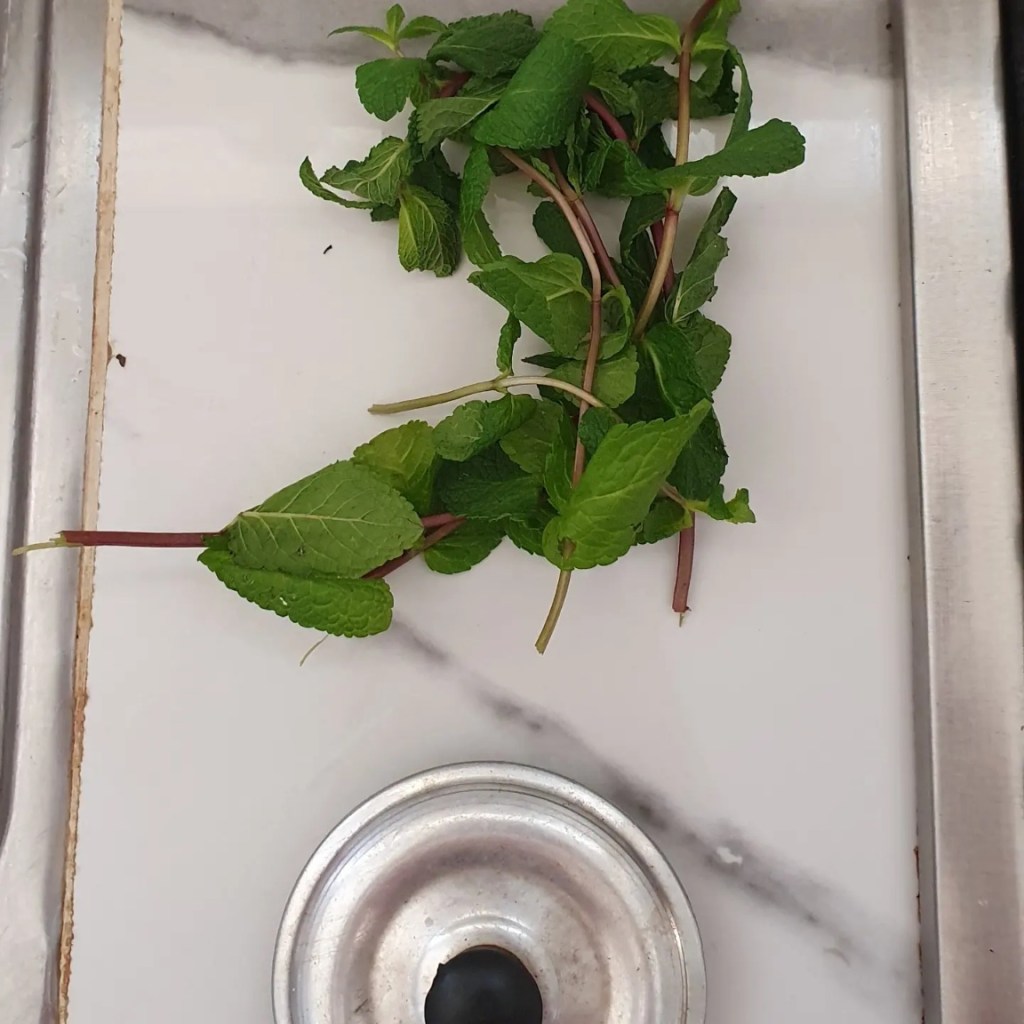
The young guy in the spice shop is sweet and chatty and if I buy my peanuts from him and roast them, he will grind them into a smooth peanut butter for free. The guy who sells bundles of mint – nana – for one dirham each starts giving me an extra bundle or throwing in a different variety. The two hoojas who laugh at my calling then “hoojas” give me a good price on strawberries and bananas, and from the man selling hobbs I can already have the whole interaction in Darija:
“Salaaaam aleikum.” I like to really drag out the aaaa. It offers space for my shyness and gives me a little push. Like I can’t back out now.
“Aleikum salaam.”
“Afek atteini wahed hobbs.”
“Juuj dirham.”
“Shukran bizzhaef.”
Please give me one hobbs, two dirham and thank you so much.
And I smile, and he smiles, and I skip over the street to run up the seven stairs.
…
But the place that becomes truly mine is by the wobbly kitchen table late into the nights after everyone else has gone to sleep. I stay here typing. Slowly I stack and re-stack words in newer and older writing, always removing commas. The gas stove is quiet enough and I make myself tea in the small tin kettle. Then I let the words eat away at me until me eyes can’t see straight and the clock is around two, three, four in the morning. I mime “heey” to the rare pairs of sleepy eyes that squint and meet mine in the sharp light as someone passes me to get to the toilet.
Otherwise quiet and only me awake.
The light switch is at the far end of the kitchen and after I have brushed my teeth and clicked it off I stumble blindly through the dark room in which three sleeping bodies are breathing deeply. The broken door creaks and clonks loudly as it opens and shuts, every time damn it, and every time I am afraid to wake up the sleepers and they move in their sleep but don’t seem to wake.
…
And it all ends up feeling like a familiar place very quickly. I don’t take the time to think about anything. Not about how I feel or where I am. The routine helps settle the turbulence from all the fast pace of travel but it’s still fast. Still a lot of newness entering my orbit.
No matter how much I try to slow down, it never seems to be slow enough.
…
I feel like a stranger here, but in a different way. I feel that my space and my strangeness is left in peace, no poking or tugging. No one is really expressively curious about me compared to the recent travelling where many people just can’t stop asking. The questions I get here are vague and polite and almost none of them start with a “why”. It’s nice.
I take the opportunity to become invisible and inconspicuous which I can’t on the streets or in groups where I am the only white stranger that catches the eye. Here I trot along, I make my little meals and write my little texts and have my little walks and play around when it comes to the work. I guess I recover.
The days pass. I let them.
…
(This story told in pictures part one, two, three and four.)
 Hulkuv loom