I’m a mixture. I am unknown to myself. I do not know which language will be shaped by my lips whenever they part and there are days when the voice is a surprise for me: who is this talking?
I am a trickster, I can not help it. In one hand I hold a bird and the next moment it is in my mouth. The inside of me is as tangled and as chaotic as the outside messes that I make: he visibly tenses when I do not take his hand to shake it but instead smile and place my right hand on my heart. He is offended but I refuse to solve anything.
Not straightening out the question marks, not clarifying anything. Leaving the loose ends as they are; I lean into the role of creating incomprehension.
…
Nothing is constant, everything is in change, that’s the premise. Life is movement and movement is change; nothing is ever frozen in place. What does it even mean, “constant”? Like, what did you expect? That it wouldn’t change and hurt?
All the atoms are dancing.
Some things may seem constant in relation to others; some things will fool you. Play with you.
A mountain might seem constant to me because the time that the mountain-body needs to move and re-shape is much, much longer than the time that the I-body needs to move and re-shape. The mountain may seem constant when I lay my soft self to rest on its steady self, but it’s not. With my cells I can pick up on the small-small movements within it if I lay very still. It’s true.
…
There is an idea that the self is constant. That “I was” in a time that is no longer now, in my childhood for example. Or that I “will be”, the idea that the “I” of a future will bear enough resemblance to the “I” of the now that naming it and referring to is as the same is relevant.
All of these are ideas. Or fantasies; I like to call every intangible movement of light or words or sound in my mind a fantasy. Thinking up the past and the future is the same as thinking up Harry Potter. I fantasize. I make believe.
…
I practice non-attachment. I think that many people are taught to be attached to the idea of the continuity of the self. The idea that the self changes so slowly or not at all, that it is constant and continuous.
I am, sometimes, attached to thinking this too. As in: I want to think this. I want to believe that the self is constant, a stable entity.
It makes sense. It is not un-reasonable; that is to say, there are reasons. I am capable of remembering the past and making believe about the future. I am capable of making believe about a lot of things. And this power is to great and alluring and pleasurable so that it easily becomes a habit and I forget that the self is constantly changing too, just like everything. Not quite as slowly as the mountains, not quite as quickly as the clouds. Somewhere in between.
…
If I un-attach from the idea that the self is a constant I open up to the possibility that the self might be a new self every morning as it enters consciousness. Or even quicker; every moment, the self can be new.
(How long is a moment?)
A mood might lift it up or pull it down, a new idea might enter and disrupt or create a flow, anything might happen. All that is keeping me from believing in this possibility is the opposing belief that the self does not change. This idea might feel strong.
But what is an idea, really?
Is an idea really stronger than a breeze?
It is too, yes. An idea, a fantasy, a belief is also: memories imprinted in the body, living in the body, becoming material through repetition and habit. Creating dents in the skin and shaping the curvature of the spine. It is embodiments that make ideas strong; taken from the bodies, they are nothing.
If I could un-link my ideas from my body and my habits, I could be a person previously unknown to my self in every new context. I could surprise my self by the “I” that I am being.
That is why the mind is moving, jumping in time and space. Had it not been for this capacity of movement and taking positions outside of the body, my embodied ideas would not become visible to my self and I would be incapable of becoming aware of or changing my habits.
Thus changing my mind.
…
And it is what I’m doing or what I dream of doing or what I’m trying to do by changing myself through this travel, becoming my different selves in the different contexts and through the eyes of different people.
My mind jumps out and into the Others’ and I see glimpses through them and the mind re-turns into my self and I re-shape.
I am picking at the pieces of my self and discarding or re-shaping and asking “how attached am I to this idea?” How much can I shed of my self and still remain, what does it mean to remain? Can I become empty?
Can I become no-one?
Can I become every-one?
Can I chose what new pieces and shapes I adopt?
Who, then, is the self that makes those choices?
…
Sometimes I hear people say that they “love to learn new things”. What I later see them mean, though, as they argue against new ideas using their existing world view, is maybe more something like “I love to know new things and I want them to fit into my current frame of reference.” That the learning is simply an addition, not a re-shaping; that they already feel that they have a finished fantasy of the world, they “know how things work around here”, and this fantasy does not want changing.
And then I open my mouth and out struggles a pigeon. But not the same one I put there before, a different one.
…
Sometimes I am awaking this uncertainty in others when they find that their habituated behaviors – their embodied ideas – bounce off me in unpredictable ways. It opens up the possibility for them to become new selves, too.
Not everyone likes that.
Wherever I arrive I am a stranger and so I am expected to be strange.
Sometimes the people I meet find something new when talking to me, or they find confusion or they find emotions of offense or defense. My way of acting may be surprising to them. It may challenge their ideas of their selves. They might be forced to take new paths to become known to me. They might find that their idea of self is just an idea and thus only a thin line between them and the void of possibilities, and that may sometimes be uncomfortable.
Their minds might jump into me and for a moment see through my eyes and then panic at how scattered and immense the world looks from there.
…
I don’t know if I would say that I “love” to learn new things. Maybe more that I can’t avoid to. By living like this I am asking for change. I am asking to get my fantasies about the world wiped out, crumpled, smudged. I am asking to change the frame of reference itself, not just to receive new facts that I can arrange neatly into a system I’ve already made up.
…
I think what I’m trying to say is that this life challenges me, presents me with examples of ways of being which I have never imagined, overwhelmes me and invites me to play. It has all the emotions, it is hard and it is easy and most of all it points out to me how everything is made up and in constant change. I, too, am called out to change.
Change like this is not easy; I am literally and very actively losing my mind.
But then again, why this paradigm about loss, why this connotation to pain and violence? I want to lose my mind the way I lose a sock or the way I lose coins or the way I lose symptoms of a cold; mindlessly, gradually, as if it never was and is not missed until I notice a change.
I am trying to lose my mind with love and care, with softness and thoughtfulness, like a child trying out things without expectations. I try to keep a balance, to remember who I (thought I) was before moving through all the change, to anchor myself to familiarities. To focus on something that changes slower than my mind, like all the little shifts in the body. Like the pace in which my hair grows. I try to occupy my mind with the moment.
I call my parents and I call my friends.
And I see it as a gift: the gift of learning. I get to change my mind. I get to change my self. To time and time again notice the thin lines that are my ideas, shifting in the void of possibilities, the shapes of the lines flexing and bending and breaking. I attach myself to them long enough to see them take shape. As soon as I think I see it, I try to let it go.
Weaving new pathways of neurons; I imagine arranging the thin threads of ideas with my fingers, they move as if under water, shine and divide, jump around and laugh at me and my attempts. They weave me right back. This weave is like nothing I’ve ever seen before and it is beautiful.
A lifelong student, becoming someone that I am not even capable to imagine being. But capable enough to practice to see the becoming.
Only to later change shape, again. And again. And yet again, together with the rest of it.
…
(This story told in pictures.)
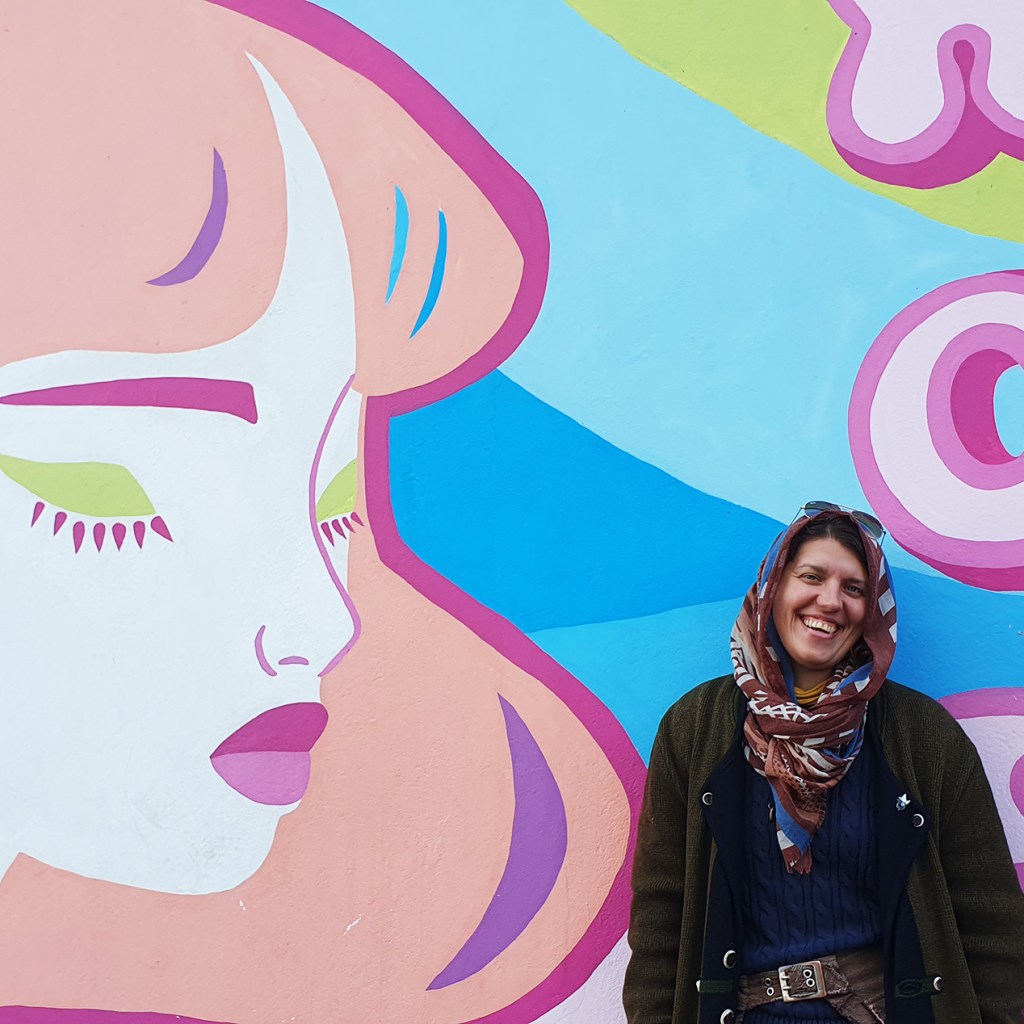
 Hulkuv loom