It was afternoon when the bus finally stopped in this famously blue instagram-city, the sun still high. It had been a winding road from Tangier, climbing steadily up and overlooking valleys of green. The surrounding mountains shifting in blue. Now there still remained a good climb up the streets to reach the old Medina. I declined all the taxi drivers, as always, tied my thick wool jacket around my waist and began to walk.
I only came for the night, maybe just to be able to say that I’d been here more than anything else; you have to go to Chefchaouen, I’d heard I don’t know how many times by tourists and Moroccans alike.
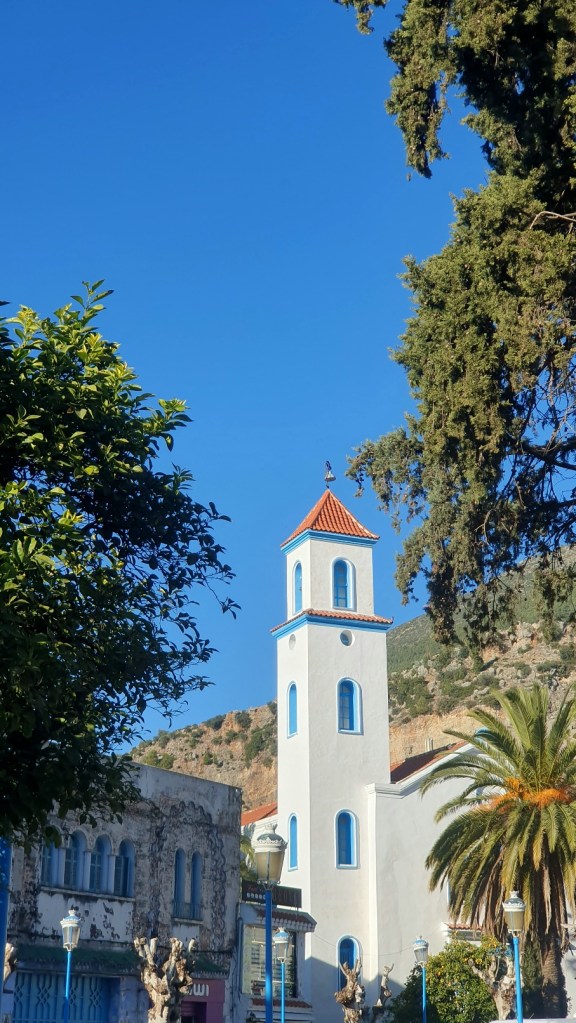
Chefchaouen lays spread out, in patches almost, over several smaller hilltops with the majority of it built against a higher mountain. As if the city has been trying to climb up along its side until it simply became to steep to continue.
Calling Chefchaouen a city isn’t quite fair.
I entered the old Medina through stairs turning off from the main street and was immediately immersed. In towns like these, there is not a clear distinction between what is in-side and what is out-side. The streets are like hallways, here even more labyrinth-like than in Tangier, taking their turns around the houses, at times becoming stairs leading to other stories of the town, other crannies where life resonates, where children play and women hang clothes to dry on the lines. The windows are open and anything elevated is for sitting; conversations are had disregarding the house walls, voices carrying along the streets, echoing into the next ones. Souvenirs all lined up along or hung on the walls, the men selling them barely even calling me into the shops but greeting me on the streets. I almost feel as if I should take my shoes off.
And all of it bathing in generous patches of blue, just like the sky; as above, so below.*
My head was aching vaguely from the heat of the day, or maybe it was the elevation. After having left my few things at the hostel I headed out for a walk. The light had become a warm orange, the sun was soon to set and my feet found the one direction that somehow made sense to them here: up.
There is something about the spatial contrasts in Chefchaouen. The valley on which side Chefchaouen is raised resembles to me almost a lake, cupping the crisp mountain-air within as if it were water. The houses in the old Medina are crammed together, the alleyways tight and the streets always turning just ahead; wherever you stand, should you hold your arm out it is sure to touch a wall. Yet, in the rare cracks between some of the houses or above the rooftops once you’ve ascended a street that is at once a stair, you gain the view way down into and across the valley. Generous space, the crispy lake-like air pouring in, finally ending in the next mountain colored a nuance of hazy-blue, green or grey by the distance and current time and weather. And so, into the small, confined spaces of the city, endlessness spills in.
I was in no hurry. Well above the city I went as far as I felt like; just a little bit further. There was a parking lot and a cemetery next to it, separated by a low stone wall. Sitting on it I could see the city below me and follow the last sunlight as it lingered on the mountain behind me, the sun itself already concealed from me by the mountaintops across. The lights of the town, spread out in small patches on the hills below, grew brighter and brighter as the sky darkened. On the different hilltops I spotted mosques and from them the calls for prayer commenced, one after the other joining and echoing through the valley. I let them echo through me, too.
I stayed on the wall until the last of the sun had settled, thinking my own little thoughts and winding down. Finally I made my way down, through the Medina again and out of it. I had dinner at a cheap restaurant not intended for tourists (and thus well below half the price than inside the Medina) and bought a kilo of mandarines from a market I found on the way. Then I made my way back to the big square in Medina. I sat myself on a bench in the middle of it. People were strolling, street musicians were playing gnaua. On one side of me sat a mother with two young children, on the other two men my age. I offered them all mandarines, traded them for smiles and was offered some pistachios in return. Full belly, mind at peace and joyful I chewed on the salty pistachios and enjoyed the juicy fruit.
…
I slept well and awoke the next morning at some time. The sun was up and I was really in no hurry, but I was keen on trying to hitchhike back to Casablanca and so I swiftly made my way out of the town.
After two months in Morocco I felt safe, relaxed and confident. More familiar with the ways in which I’d be perceived, more secure in my French and with just the right handful of Darija words to make strangers smile at me. Not afraid anymore. After countless interactions where I’d received kindness, I trusted that this would be what I would encounter.
It turned out that the roads were scarce with traffic. Five different hitches brought me to Souk El Arbaa, about halfway, and there my fifth driver promptly treated me to lunch and then took me to the bus station where he bought me a ticket for the next bus to Casablanca, leaving in ten minutes. I knew from many encounters already that most people are not able to relate to the feeling of thrill and pleasure that I feel when I hitchhike. That they will worry or try to help me out of the situation of hitchhiking, even though I have put myself into it deliberately. This day had been hot and long and I was tired from speaking fragmented languages, and so I accepted the ticket bought for me and gratefully got on the bus for the rest of the way.
—
*As above, so below is an alchemist saying.
…
(This story told in pictures.)
 Hulkuv loom