I sneak off a little bit aside of the city and into a park to sleep. High dunes, bushes, patch of forest below. Some camel herders pass me by and jokingly offer me a ride; taxi, good price. Below the bushes it’s full of trash. I see two men on a walk enter ahead of me, make sure to dodge off the track as soon as I can, no need to be alone and run into strangers who will be friendly, sure, but who might linger. Who will not leave on their own accord, forcing me to be blunt.
I do not want to talk to men, I do not want to be seen by anybody. Luckily, most Moroccans don’t really go out like this after dark. I listen into the darkness and I hear no one walking on two feet, no voices.
Instead the loudest of crickets and the above open starry sky, distant prayers from the mosque and I feel free, like I have succeeded, escaped all gazes, evaded all rules. Once the tent is up I sit in the sand and breathe it all into my chest until I tire.
A dog barking right next to my tent wakes me in the morning and I lay still, scared, thinking what could be a weapon. After a while he tires and I hear him leave.
…
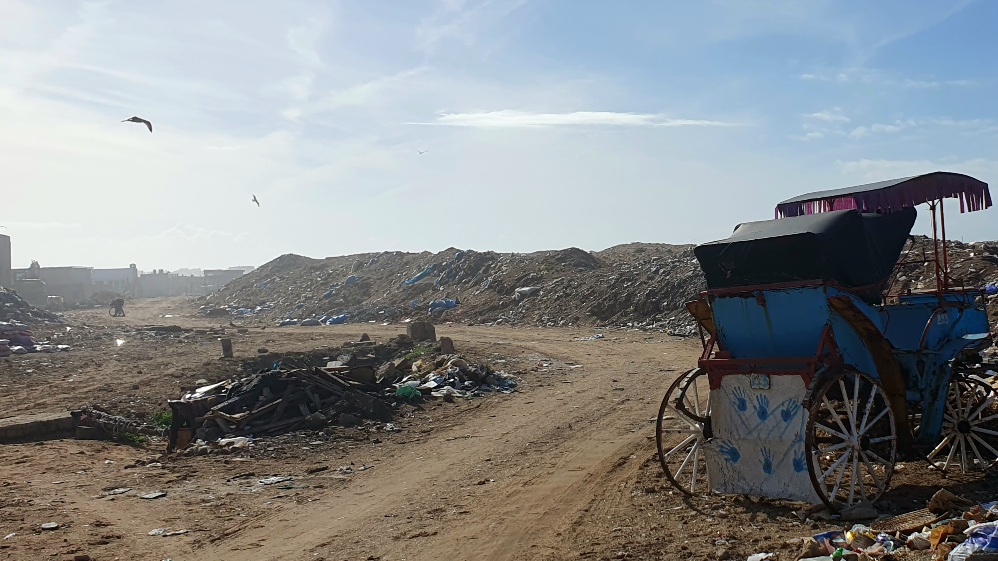
Essaouira is yet again different, yet again displaying the diversity of Morocco; flat like a sheet of paper, full of sea air, colors, trash. Horse drawn carriages. The low, square houses springing up and the straight streets give it an angular feel. Gnaua music is said to originate from here and a lot of people come here to surf; this is what makes Essaouira famous, a symbol.
It is not a big town, long in shape and laid out along the beach. I walk easily through it in two hours or so. It is warm but the wind is strong. On the north side of the Medina the houses reach the water, some almost hanging over the waves beating in. This side seemingly more industrial, with less fancy cafees and more trash and dumps, smelling heavier of sewage and piss. Just south of the Medina people are playing by the sea, crowding the wide beach and boardwalk lined with beautiful hotels and fancy restaurants. Horses are galloping on the sand.
When I pass by the main bus station I see women sitting on the sidewalk dangling keys in their hands.
“Chambre à louer, chambre à louer,” they repeat to me. Room for rent. That is a first.
Two days is not enough. I have become a bad tourist, stressed by knowing that I will move on, struggling to talk to the locals because I believe that I will not re-turn, believe that I will not have my “fruit-guy”, “spice-guy” or “bread-lady” so then what is the point, if we will not get to have even the smallest of relationships? I do my best to shake the mindset.
I go back to the same street restaurant the both days. It is run by a friendly family, baking bread and msimmen out in the street. Inside I ask for bayssara and the second day I ask to leave my backpack with them while I take my walk. Coming back I bring them oranges and I break my sunglasses on their floor. They give me smiles and as much of a sense of continuity as I can get.
On the big square I meet Omar. He sells trinkets to tourists, this time sunglasses. He is dressed in colorful clothing, dreadlocks reaching to his waist (except they are called something else, he tells me, I don’t remember what.) He is Senegalese and Baye Fall. I have met them before, the Baye Fall. I just didn’t know that it was a religion, a mystic branch of Islam. When I ask him about it he tells me to research online and I do. I make a note to find out more once (and if) I reach Senegal.
We meet again for coffee and a walk. He is calm and not too talkative but I feel free to ask him anything. I take the chance of finding out more about Senegal. When he asks me in which hotel I am staying I hesitate. I work around the subject, tell him I’m not staying in a hotel. I don’t want to tell him that I camp. He works it out anyway and is, like most people around here, perplexed and worried, can’t seem to fit it into his world that someone (a woman!) would want to sleep outside, in a tent, alone. He offers for me to sleep at his home, of course with no other intentions than offering me a roof over my head, am I really sure I’m allright?
His concern is real. I just say thank you, thank you, that is very kind. It is. Our worlds collide, I softly insist on mine, declining his offer gratefully. Thank you. Had it rained I would have taken him up on it. It is good to have options.
On my last night, after having spent two or so hours at a beach side café waiting for the night to fall, charging my phone and calling my parents through the sounds of live music and a football game, I make my way south along the beach, away from the town, in search for a place to sleep. In the morning I have decided to try and hitchhike to Agadir. The dunes along the beach, fairly close to the road, look promising on the satellite view. My feet sink, my shoes fill with sand. The moon hangs like a skew smile far away in the night.
It is windy over here. I climb up from the beach and step into the dunes separated by a low structure, like a fence twisted from the weeds. I clear out a small patch of sand to pitch my tent, meanwhile listening for dogs. The lights from the city are strong and they blind me as I stand, erasing all greyscales and soft shadows. Only when I crouch can I see better.
I close in my tent with some of the debris, supposing that I’d hear if someone would move across the branches. Then I slip inside, close the zippers and sink into sleep with the wind and the ocean roaring outside, the sand soft underneath me.
Essaouira seems like a curious place, I think to my self. It has been sweet to me.
The next day I wake up in the heat of my tent, with no water to drink, throat thick of thirst and pain, and running a high fever.
…
(This story told in pictures here and here.)
 Hulkuv loom