“There is nothing at the border,” I was told. I imagined: no shade, no water, no nothing, just trucks lining up to cross and sun glaring down onto the single road surrounded by no man’s land, its notorious land mines, car corpses.
Another guy, a Moroccan working at the hostel in Agadir told me that it would not even be possible to cross the border, that it was closed alltogether, had men with guns patrolling.
They were wrong. I gather my information in bits from different sources, some match the reality and equally often people don’t know what they’re talking about.
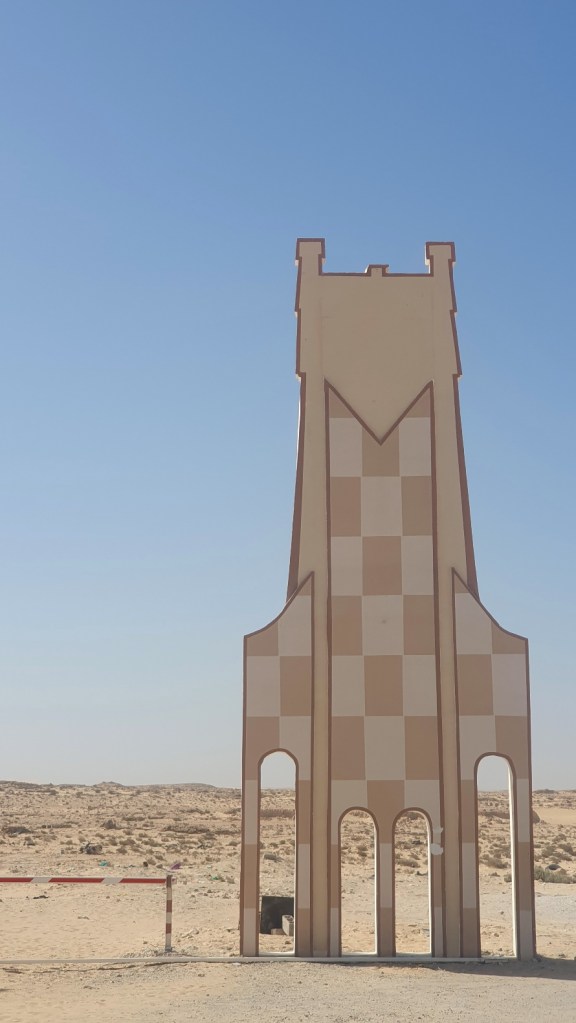
The border crossing in Guerguerat is a little town: a collection of houses for the workers, a mosque, a little restaurant and even a hostel. I find shade to sit in by the gate with a little group of people waiting for the staff to finish their break so they can let us cross. Trucks and cars are in a long line on the road leading up to the gate.
Five hours with the bus from Dakhla felt fast comparing to the 20-hour ride a few days back. Still, the waking up before dawn echoes in how my limbs are tired. Directly under the sun I feel my energy draining even quicker. I rest my heavy head in my hands.
As soon as I stepped off the bus I was crowded by “guides”; men offering to help cross the border in return for payment. Offering taxi rides to Nouadhibou. I expected this and I am used to this; they are just doing their job. I respectfully thank and ignore as they keep circling and persuading.
An hour or so passes. They open the Moroccan side of the check, we can go in. It is small, manual, basic. Sweat is pouring. Everything is scanned and controlled. My passport is checked and I am waved over to the side; mushkil.
Problem.
The guards are calm and they don’t smile but I notice that when I am friendly to them, they are friendly back. I don’t let the unknown problem create tensions in my body or my voice.
I am told that I have overstayed my ninety days and am sent to another house, made to wait for another guy. I argue, claim that I have been told by the border guys when entering that leaving on this date would be fine.
Actually, no one has told me anything. As I wait I count the days one by one from my entry ‘til today and it is true. It is my ninety-first day. A clumsy miscalculation on my part when I made my visa but it is only by one day and the little I know so far about borders in Africa (my only experience being the one in Mozambique I had to frequent) is that it’s a bit of a wild west. If the people working happen to like me, if they are not in a poor mood, bored and hungry for drama or prone to corruption (like, tempted to ask for bribes because I am white), I can get away with it. The truth is made up by stories and reasoning in the moment, not as chained to computer-numbers and regulations as in the countries I am from, not as out of the hands of the individuals working on the spot. If they like me they will let me go, I think, and I can try to make them like me.
While waiting, tense and worried, I decide that my best shot is to try and charm them.
But I needn’t have sweated. When the man arrives from his break I show him my passport, tell him my entry-date, tell him it’s three months and that I don’t understand the problem. He waves his hand and sends me on my way. I haul my bag back down and pass through the security.
One of the taxi drivers is still persisting, still tagging behind me. He has offered me a price for a ride to Nouadhibou which I think is too high. I have told him so, told him no, still he persists, pesters and annoys me. I ignore him as he follows me.
For the last check I am pointed into a tiny office and asked to hand the passport over to a man sitting wide-legged, leaning back in his chair. He is loud, smiling and he hits on me. Tells me I am beautiful and asks me for my number. I moan, loud and tired, roll my eyes and stick out my tongue. I tell him to fuck off, I tell him he is exhausting me, that his way of acting on the job is disgraceful.
Internally. On my face I smile, pretend to be flattered, shy with the dust on my cheeks and military pants. He has my passport and I don’t want trouble. This is not the first time this happens to me; men in power, men at borders, police stations, government offices or military checkpoints asking for my number and flirting with me while holding my passport in their hand. Small paper square. My most valuable possession. I hate it, he is annoying but I wonder if I can use him.
I have met men who act like him a hundred times before. To me he is just a copy, cheap, shallow, barely human. Their weakness is that they don’t know that I’ve had practice. Secret power.
“What is the normal price for the taxi to Nouadhibou from here?” I ask him. I assume he will like it; receiving a question, feeling needed for information. Feeling further in control.
“The guy out here is offering me a ride at this price,” I tell him. “Is that normal?” My voice innocently curious, eyes fixed on him.
It works. He burls up, hands me my passport, leaves his chair and follows me out to where his colleagues as well as the taxi driver are standing. He places a hand on the taxi driver’s shoulder and in a loud voice asserts half of the offered price. He is laughing, being polite but at the same time not asking a question.
I get the sense that he enjoys it, that he wants his colleagues to hear, that he likes being this loud, pushy man, dominant. Leaning on his status for his identity.
The taxi driver agrees, the man shakes his hand, pats his back or whatever else of the hundred available gestures for manly camaraderie.
“For my wife here,” he gestures to me and laughs again. On his demand I have already given him my number, now he only has to make a claim for me in front of the other men. I finish the transaction by thanking him, smiling, grateful. Keep my mask on tight. To not let slip how this charade is tiring, boring, upsetting me but I am comforted by the fact that I will pay the half, that I successfully slipped into the cracks and got what I wanted. That as soon as I have turned my back I am free to brush off this loud, annoying man, shed the last of his energy in my wake, clean me of this dirt. As soon as I arrive I will be free to breathe, act out, close my eyes, rest, whatever I need. Just let me pass through the border with no trouble.
The no man’s land between the border checkpoints is only about 4 km wide but walking it in the sun after all the hassle would have been rough. It’s been about three hours already. My new guide helps put my bag into his beat-up car. His colleagues all around try to call me to their taxis instead but I get in and we drive to the Mauritanian side of the border. The driver is calm and kind and interacting with him is more pleasant once we’ve dropped the roles of nagging and refusing, but he speaks even worse French than me so there is not much we can say. He takes me through the passport control, me still reluctant to rely on him, half-ignoring him.
The guards on the Mauritanian side seem calmer, more quiet. When they look at me I almost feel suspicion in their eyes but when I salute them they reply kindly. My new guide does his best to assure that I am let through smoothly and the rest passes un-dramatically. They don’t ask me where I’m staying, what my purpose for visiting is, where I’m going and so
I get my stamps,
we fill the car and
we are on our way,
straight into the nothing-desert flatness
of Mauritania.
…
(This story told in pictures.)
 Hulkuv loom