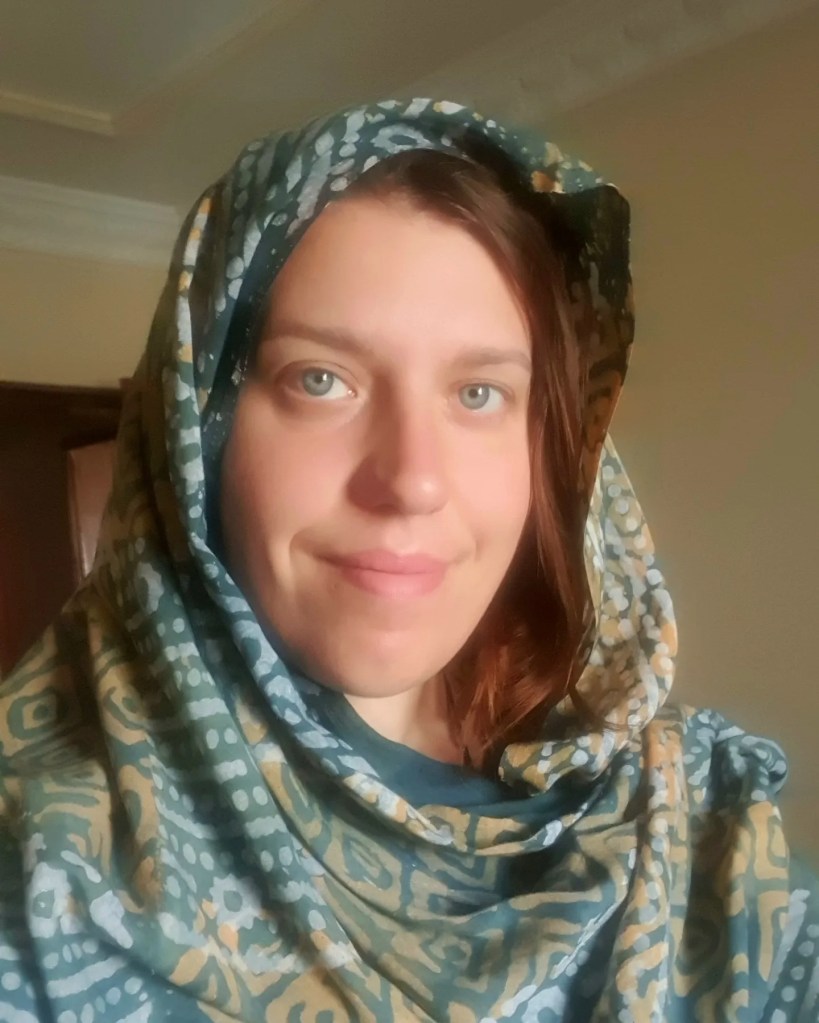
Already on the second day in Mauritania mama Aisethu hands me one of her malefhas and my wish comes true. Her oldest daughter shows me where to tie the knots, two discreet secrets on the shoulders, then the remaining fabric is wrapped around the body and the head. I become a cocoon; a simple shape. Elegant.
I admire the way in which the women and girls effortlessly navigate all the textile draped on them. They flick the end easily over the shoulder when they’re home or go out onto the street, or spend just a few more seconds to properly wrap their heads and secure the fabric if they are venturing further. I struggle with the fabric catching my legs, either stepping on it or somehow getting it rolled up to my knees. And it keeps moving and falling off my head, needing adjustment every other minute. I have to take note of how I move my head, arms and shoulders. The steps need to be shorter. Still, I feel good when my body is covered, less naked in the current culture, and it is a good protection against all the sand and dust. I have yet to learn how to really tie it tightly around my face the way some women wear it to cover the mouth and nose, leaving only a slit for the eyes.
The malefhas stand out in the general monochromes of Nouadhibou and catch the eye with their vibrant colors and moving patterns, always different. I never see a woman wearing anything other than the malefha when outside, with the only exception being the traditional Senegalese dresses worn by some of the Senegalese women: long, close-fitting and colorful, with frills around the waist that accentuate the hips.
The traditional robe for the men is called the darra’a. It is a big fabric reaching from the shoulders to the ankles, worn over regular clothing. It can be white but most are a shade of blue, normally woven in damask, plain or with intricate embroidery to decorate the front. The traditional headwear for men, the hauli, is a long piece of cloth resembling a scarf in shades of blue, black, white and military-green for the military. It is tied to cover the head and can be wrapped to cover the chin and nose too.
Through all the gaps in all the fabrics I linger in the many eyes I meet. They are curious about me, too, silently following me, usually friendly. The wind lifts the malefhas and leaves the women constantly negotiating the wrapping of the fabric; the darra’as fly around the bodies not unlike how the small plastic bags fly around the streets; swirling squares of blue in different sizes. The wind lifts, drags and pokes at everything here. The layers of fabrics wrapped and draped cover bodies along with their secrets, leaving me to discern who is who by their movements mostly. It strikes me how this is a very powerful presence of tradition and culture, and that I get to participate. And so I stumble along in my malefha and lean into it, join the bodies moving along the sandy streets; argue with the wind about the placement of the fabrics.
…
(This story told in pictures.)
 Hulkuv loom