It makes a world of a difference suddenly being five volunteers instead of one.
The others arrive happy, rested and energetic just as I am still on my last days of sleeping off my flu, of sneezing, coughing and aching. In their vanlife-vans they bring surfboards and paints, an old guitar and all kinds of fun, and the children are spilling over themselves for the thrill of it.
They are two couples. The younger couple in the red Hendrix-van and the older ones, about my age, in the big white one which they have converted themselves. Somewhere along the way they have joined and made company, surfing through Morocco, now headed through Mauritania and towards Dakar. They are all blonde and tanned and after spending several weeks on the road together they are a tight group.
…
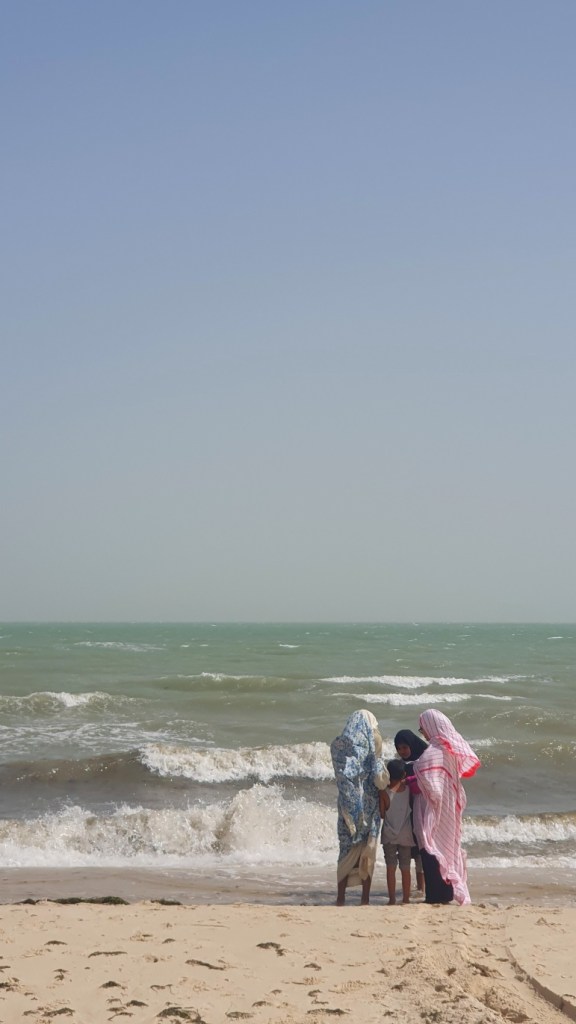
We decide to take the children to the beach. The first time we go we bring only four of the older kids. The two boys are quick into the water, eager to play in the waves and to learn to surf. The two girls haven’t really dressed for swimming and are strolling along the water’s edge. There are other children on the beach too, all boys and lively and I wonder if that makes the girls more shy. I see the younger girl clutching her sister’s hand, edging closer to the water, lifting up her long, black dress just a little and dipping her feet. I know that none of the children can swim, not even the boys who, despite their bravado, don’t go further out than that the water reaches their waist. I see the girl let go of her sister and take steps further out into the water. She is a teenager, far from being a child and equally far from being grown up, now torn between the shore and the waves, insecure between fear or appropriate manners maybe and her longing to play and explore. I don’t know if she has ever swam before, seeing as going to the beach or playing far away from the house isn’t really common for girls here. The other volunteers are further out and occupied with the boys, showing them how to play with the boards. Still not fully well, I don’t want to get too cold so I hang back and I offer her my hand.
We go in at her pace. She leaps back a little when the waves come, just to push on moments later. All of her is indecisive, eyes fixed on the water. She has stopped caring about getting the dress wet despite not having brought anything to change into. When the water reaches her thighs she is knocked over by a wave, falls and screams, eyes wide and water entering her nose and mouth, her black headscarf coming loose and her long braid escaping. She spits and pulls me back by the hand and I follow her, anticipating whether she wants to stay or go back. She stays. I show her how to cup her hands a little and tense her fingers to have more resistance in the water. How to move the arms to stay afloat. Carefully she submerges and tries.
I leave her for a moment when she looks more confident and try one of the surfboards. I have never tried surfing and after a short demonstration and a few pushes I play around with trying to stand up and falling off. It is fun and I bring the board over to the girl. She is looking more comfortable playing in the waves now though her eyes are still cautious. I saw her looking at the surfboards as the others were playing with them and now I offer her to try. Again I see her torn; fearful and curious. Being on her stomach close to the water’s surface is too scary for her and so she straddles the board and holds on. As a wave approaches from behind I give her a push and watch her shriek and slowly drift towards the shore, grasping the board beneath her. When the wave subsides she turns around and with gestures she asks me to do it again and so we go on. I look at her small back as she drifts away and I marvel at how, despite being one of the older kids, keeping her smaller siblings in line and asserting herself, she is still a child. Here she is still so vulnerable and wild, oscillating between force and insecurity. Throwing herself headfirst into the ocean she fears; doesn’t seem to be able to resist. It makes me feel happy to be older, to be trusted with her doubt and determination, recklessness and caution. I realize that these children see me as an adult. How funny.
…
We make a second outing to the beach, this time with all of the children packed into the cars. It is very windy and the waves are wild. We spend the day overseeing bare feet running into cold waves, outbursts of unhinged joy as well as frustration and fights. We make sure to snug the small ones into towels when their lips shiver from the cold, hand out pieces of bread and banana and help aimless arms through coiling sleeves of dry clothes. Heads patted, snot dried. The older children intuitively keep an eye on their younger siblings, catching them by an arm and carrying them out when they go in to deep, over and over again as the small ones ricochet back from the shore like bullets, tears of fright forgotten in seconds.
By noon we spot mama Aisethu’s small white scrap metal pile of a car make its way to us. All the children, even the older ones, run towards it, cheering, laughing, surrounding it. Mama Aisethu steps out, calm as always, and soon a few mats, several dishes and water canisters follow carried by many eager hands and laid out right there, between the vans and under the sun. Mama Aisethu takes place on one of the mats and carefully starts portioning out rice, fried fish, sauce and vegetables onto several plates. One to be shared by the boys, a smaller one for the fewer girls and one for us, the volunteers. Suddenly a concentrated silence blankets us as everyone focuses on the food; the spicy rice, the fatty meat and skin of the fish that so easily tears from the bones.
After lunch the older kids play football, the younger ones nap. Feeling a headache coming on, I crawl into the front seat of one of the vans and let my eyelids drop. The chatter of the children and the roar of the waves merge into a plain noise, flies land on me and I drift into slumber.
…
Another day we paint. The others have brought with them cans of bright wall paint and we decorate the outside wall beside the door with a red and yellow smiling sun. The children add green leaves and dot yellow flowers. Later they don’t tire of showing which of the flowers have been put there by them personally and which have been put there by a sibling. A big, blue head of an elephant appears over the course of two days into the hallway, its taking shape faithfully supervised by the children.
The old guitar becomes another one of the favorite toys, both for the children but also for me; it was ages ago I played, not counting the little jamming I did with my friends in Tangier. I manage to fix the snapped bottom string and to tune it by ear. The back of the guitar is loose and it creaks when moved around and overall it matches my clumsy fingers as they ache across the frets.
The children flock around the guitar every time it is brought out. Small fingers have to be battled off the neck of it so that each sibling can have a fair try. Some evenings I bring it to the porch and the girls from the neighborhood circle me. I can see how they both ache to try and fear it at the same time. I wonder if they have ever seen a woman play the guitar; people have kind of a double sided relationship with music here. I have not heard any music being played anywhere around here and I know that some Muslims consider music to be haram. During a chat about marriage and relationships the older girls stressed that a woman should not marry a man if he is a musician. I forgot to ask what was considered of women themselves being musicians. On the other hand the children readily show me the trending songs by Mauritanian musicians whenever I ask, and I am left thinking that this is one of the blurry areas where clear lines are avoided so as not to create unnecessary conflict.
I offer the guitar towards one of the girls in the circle arounde me. She quickly backs off, hands flying up, insecure smile spreading. I encourage her and she resists until another girl steps forward. We switch places, she sits on the porch and I place the guitar in her lap and myself crouching by the neck of the instrument, clumsy in my malefha. I place her insecure fingers on the frets, force them into the shape of a D-chord, fuss and insist until I think that she will get somewhat of a clean sound, then show her how to strike the strings. Her grip is loose but her focus is solid. When she has grown tired I gesture for the next girl and suddenly they are all braver. I take my time with each, placing their fingers on the frets one by one. Most have the same, weak and uncoordinated grip but a few have stronger fingers and I wonder if that comes from doing chores. Some are so small that they can’t reach the frets. In those cases I sit next to them, press down the chords myself and instruct them to simply strum the strings.
The sun has set and it is dark out when the group of girls have all had their turn. Once they tire and leave, one of the orphanage daughters comes up for her turn. She is one of the teenagers and has been playing at every given opportunity. I hand her the guitar. She is not really right in the head, as mama Aisethu puts it; she doesn’t go to school and the other children sometimes tease her for her speech which is nasal and slightly slurred. But she is not timid. When she plays the guitar she holds nothing back and I enjoy sitting beside her; it is both rock’n’roll and blues in the true sense of the genres. She doesn’t need instructions; she feels the music. She strums the strings, fumbles around producing dark and feverish sounds, a rapid tempo, then joins in with her voice, hoarse and strong. Sometimes she repeats some made up phrase, sometimes she just wails, aiming her voice over the quiet street and toward the moon.
…
The week with the others passes quickly. By the end of it I am almost fully recovered. I have not had a plan for how long I would stay, nor made any agreements with mama Aisethu. A part of me considers leaving as the others do, another part wants to stay, enjoy a few days of peace and quiet. I don’t make up my mind, but practice ambivalence.
I have established a contact with a friend of a friend in Nouakchott. I know he is ready to receive me whenever I should decide to leave and my idea has so far been to catch a bus or a hitch from the main road near the orphanage. It is the only road and Nouakchott is the only destination, so chances to find someone heading in the direction should be good. With the kindness extended to me so far from the people I’ve met in Mauritania the option to hitchhike feels safe, too. Beyond safe.
But as I heal and regain energy I feel a restlessness grow. The train thunders past my window every day; the iron ore train, the world’s longest train. I have read and heard about it, I know it’s a popular tourist attraction and maybe that has been part of the reason why the idea of taking it hasn’t appealed, apart from me just not being interested in getting dirty with iron ore. Something about this kind of adventure- or experience seeking tourism feeling shallow, or tacky even, something about me not being able to relate to the hype. Still. From behind the window I watch the train move and I feel my energy move, too. Whenever would I get the chance to do something like that ever again?
My new friend in Nouakchott encourages me and strongly advises me to wear goggles. I don’t have any, I tell him. That’s settled then, I think. The hassle of getting some item outweighs the coolness of riding the train; I’m not going to buy some stuff just for that, wasn’t too invested in the idea anyway. Glad that’s decided.
Don’t worry, my friend texts me.
I have goggles. I will send them to you so you have them tomorrow.
I stare at the text and my mind changes, again. The moving shape-less unknown approaches me, close now, becoming a near-future I can not imagine. OK.
So we’re taking the train.
…
NAD orphanage is a real place and mama Aisethu is a real person. The struggles and precarity the children are facing are very real, too.
If you in any way can and want to support them, all help is always needed and appreciated. One way to support is by this gofundme campaign here. You can also find more information or contact mama Aisethu directly through this facebook page.
A short documentary was made about this orphanage and can be found here. Thank you for taking part in this story.
…
(This story told in pictures and video part one, two and three.)
 Hulkuv loom