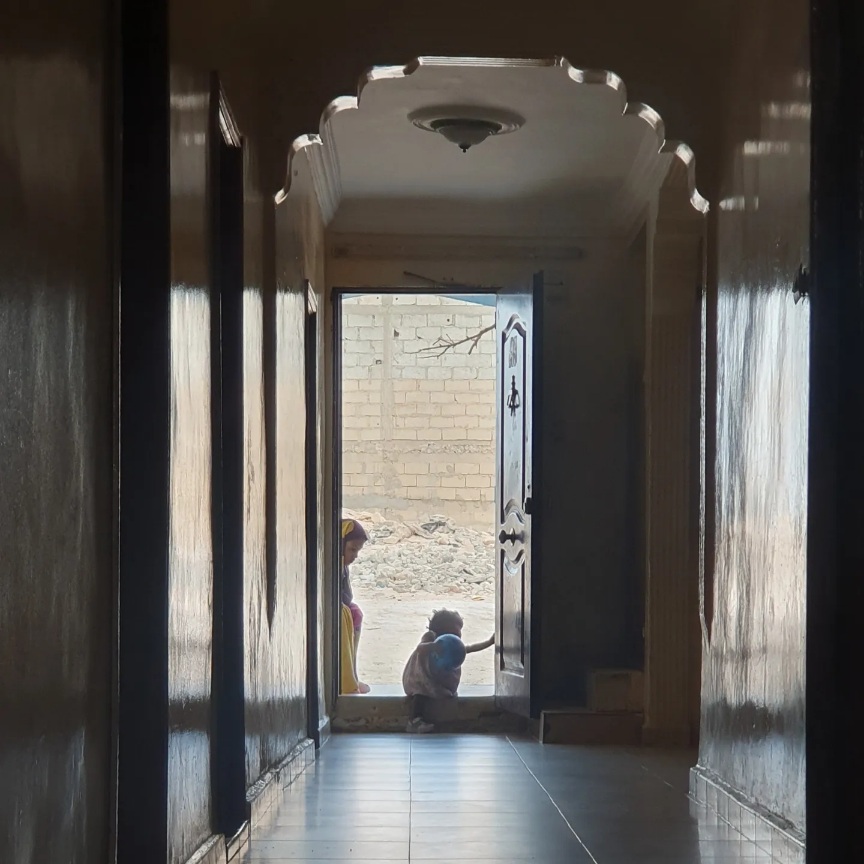
I sit on the porch and weave a basket and the small ones stay nearby. They hover back and forth, between asking for my attention in different ways to then drift into their own attentions and games with each other or themselves. The tree that was blooming with bright purple flowers when I arrived is gone now, torn down by some game getting too reckless and I remember mama Aisethu sighing and going inside when she saw it, her steps heavy. She’d told me before about the countless beds broken by the children, the many things needing to be replaced. What weighed on her now was not the loss of money but the loss of beauty, indistinguishable to the brute forces of play.
Nora sits down on the porch beside me. She is the first daughter, the first baby that mama Aisethu received. She grew up in the orphanage and is now twenty four, married and with three children of her own. She comes by with her youngest some days, prepares tea, helps take care of the small ones and hangs out. Now she’s holding her daughter who seems ambiguous between wanting to stay in her mother’s arms and struggling to get away and explore. We speak a mix of weak French and body language, but it feels clear enough. She asks me when I am planning to leave.
Some time in the next few days, I reply.
Oh. I am surprised by her surprise.
We thought you were going to stay over Ramadan, she says.
I do not know what to say to that. Ramadan doesn’t begin for another week and will last for a month. We haven’t agreed on any dates exactly, but I didn’t think they were expecting me to stay for such a long time. Meanwhile I am already, mentally, packing my things.
She heads inside and I don’t know what to do with my self.
…
From one day to the next the orphanage has fallen quiet; the other volunteers have left.
I have my breakfast alone. The white bread, the black tea. The flies flying big circles around. The scraping from the chair echoes in the hall, long silences between the bites. The gray view from the window the same.
When I head downstairs the older children have left for school already. Binta is preparing in the kitchen and the small ones are playing in the hallway, the blue elephant looking down from the wall. Today its eyes remind me of those of a cockroach I once saw while having lunch at a market in Maputo. It was looking at me from a crack, antennae moving, eyes still. I pass the hallway and elephant without meeting its gaze.
Before leaving the others bought two big bouncy toys for the children, one ball with handles and one in the shape of a pink cow. Now the three youngest are playing with the two toys, fights and tears erupting barely every two minutes about whose turn it is and not wanting to share, small fists passing through the air and bare feet scurrying across the floor to look for comfort from Binta whenever emotions run too high.
I don’t know how they understand the absence of the others now. I doubt that their fragile moods are triggered just because of the bouncy toys. It takes time getting used to change and after one week of high tempo, fun and movement the silence of the house is a contrast, incomprehensible, its density expressed in the tiny fists, yells and tears.
I struggle with my self for feeling this, but even after two weeks of staying here I don’t know if I believe that volunteering at an orphanage is necessarily doing good.
It’s complicated.
I know that I give a lot, still, I don’t like the idea of being yet another person bringing a short presence into the lives of these children only to disappear and never return again. I imagine the children needing stability and attention, every one of the fourteen kids needing to be seen and heard and supported. When I see the emotional effect that the others’ leaving has on the children I am, again, filled with doubts over my own presence here.
…
Being with the children is energizing and amusing, frustrating and tiring, brimming with easy, playful love. Yet the feeling present in me underneath it all, despite everything, is a hollow sort of sadness. Maybe I’m just too melancholic of a person to work at an orphanage.
It can hit when I catch the toddlers doing weird stuff, like eating sand or doing something they know they shouldn’t, as they meet my eye and a mischievous smile grows. How they come running to grip my legs for comfort.
Or when one of the older boys, the one who has dropped out of school so he can pursue his dream to play football full-time, jumps high and turns in the air, pretending that he has scored a goal like Ronaldo. Crying out “ssssuuuuuuuuuu!”
Or when the children return from school and the oldest son catches the youngest as the small boy happily rushes into his brother’s arms; how he lovingly lifts him up and kisses his cheek. How he later carefully prepares tea and comes around to offer it on a small tray and with a proud smile.
Or when I tutor the oldest daughter, her devotion to our English classes and to learning, her confidence in her brilliant memory and optimism as her future spreads out promising before her, should there only be money to cover the school fees.
Or the sister who went straight into the cold waves of the ocean, in spite of the fear shining her eyes.
Or the sister who rocks the guitar toward the moon and wails out her feelings into the night.
It can hit me when I think about it or when I don’t, be it in the middle of a laugh or the silence of the evenings.
They are just wild and lovely, curious and insecure, soft, fierce, polite. They are just like children are, and I can’t understand why or how these lively, brilliant people could at any point, ever in their lives have been unwanted.
It has been explained to me: all the parents to these kids are still alive. It’s just that they were born out of wedlock and in this society it is not accepted. A family will hide a pregnancy like this, then make sure to get rid of the child. No matter what the mother herself might think of it.
“But only the white ones,” says mama Aisethu, meaning people of all colors who are not black-black. She says the culture is different within the black community where children are kept even though they are born outside of a marriage.
Mauritania has many mine fields, I think to myself, picturing the social rules along with the literal, active mines in the sand dunes in no man’s land barely a kilometer away. There are many things intersecting here that upset me: the (probable) lack of sexual education and access to contraceptives, the place of women in society, the potential of sexual violence, no access to safe abortions or the choice to have them and the social stigmas surrounding it all, tying the tongues of the ones most vulnerable. As a visitor for such a short time I am not invited to understand all the secrets and the complex social rules, stigmas and opinions. I am not told all the stories, but I imagine it has to be pretty intense if it forces people to such extreme actions as leaving a baby, otherwise considered the most precious of things, to die just after its birth.
I don’t see it as the mothers making individual choices. I see norms and values coming to life through the mothers’ hands as they are letting go of their children.
I linger there, in those hands, imagine them holding the little body, arranging the malefha, maybe touching the small cheeks with the fingertips and eyes or maybe abstaining, so as to not make the separation more difficult. I imagine the hands relaxed, limp almost, not even shaking but distant, as if the soul has left already to not bear the pain. I imagine the last touch as the baby is placed on the doorstep of the orphanage, then the distancing of the fingers and the baby-body that just a short time ago was part of the self, now breathing its own breaths of cold night air. Or maybe the hands leaving are not even the mother’s. Maybe the steps receding over the empty street don’t feel sorrow but shame, or disgust. Maybe ease, as distance is growing. However the figure feels while leaving, the image of their footsteps, the dark night, cold air, tiny body on the porch but most of all the hands; the hands and their very last touch, placing, withdrawing; breaks my heart every time.
…
…
…
I am learning lessons from these children, these children full of love and destruction. One moment soft and affectionate they are clinging on me for closeness and attention, small arms around my legs, yearning for contact. Next moment provoking, challenging the boundaries set for them, their feelings of rage at times indistinguishable from their curiosity about what punishment awaits them. Like the little sister running after her brother, fist raised with intention to hit him as retaliation for something but her eyes always on me, looking for what I will do for the third time I am to tell her not to hit her brother. Meanwhile the brother’s eyes on me, too, equally curious about how I will reprimand his sister, more so than fearing her potential blow. Were I not frustrated in the middle of asserting boundaries I would laugh at them both, and sometimes I catch my self and I do.
These children are like blind force, like that of the fool in the Tarot, the ultimate tricksters, acting on a multitude of logics inaccessible to me, perceiving so many times and worlds, their feelings un-hidable, always on the outside of their skins. At times I watch them looking to others in order to see how they should react, then trying on different feelings while re-telling the same story and I relate to the process of reaching, of being blind between languages, looking for connection without really knowing how, still straining, reaching (but effortlessly) every part of one’s self to arrive.
I am looking for lessons and I can’t quite phrase what those lessons are before having gone through them. Maybe:
to grip even more
with unabashed curiosity at life;
at its punishments
as well as its gifts.
As if
I had never known pain
and boundaries
were yet un-learned.
Life, I feel, is a strong force.
…
NAD orphanage is a real place and mama Aisethu is a real person. The struggles and precarity the children are facing are very real, too.
If you in any way can and want to support them, all help is always needed and appreciated. One way to support is by this gofundme campaign here. You can also find more information or contact mama Aisethu directly through this facebook page.
A short documentary was made about this orphanage and can be found here. Thank you for taking part in this story.
…
(This story told in pictures and video.)
 Hulkuv loom