I wake up in the morning to voices and when I exit my hut I find new guests having arrived with the iron ore train. I approach them, curious. Three of them have bikes and gear and the kind of energy people have who have been on the road for a while already; practical, extroverted, a little toughened, dirty and happy and in tune with each other. The fourth, a little more quiet and reserved, has accompanied them on the train but is not otherwise part of their group. They are all guys, all from various places, wound up together and coming from a night of rattling in the empty iron ore wagons with their bikes just as I had the night before. Now they are squinting at the sharp morning sun and trying to clean the worst dust off their gear. We have breakfast together. We share stories from the road and they tell me that they want to go to see the monolith of Ben Amera. I tell them I don’t have any money but that I would love to join. They invite me along and so we head for the village to try and find someone with a four-by-four who might be able to take us for a reasonable price.
We are lucky. We ask around, phone calls are made on our behalf, negotiations translated but in the end the man helping us with all the translations and calls offers to take all five of us along, for free, as he is anyway already taking two people out into the desert to visit the monoliths. We would fit in the car. If we are OK with staying the night, he adds, and I can not hide my excitement as a smile washes over my face at the thought of sleeping there, under the starry sky, far, even further away from everything than I already am. Is it really sure he wants nothing for this, we ask over and over again. His smile is wide and white between the fabrics of his hauli, his eyes friendly. No no, he assures, you are welcome. Be my guests.
We buy canned fish, pasta and water. We pack our sleeping bags. We wait for the car.
I am squeezed in the back of the truck, on top of mattresses and bags and objects coming along, between two of the guys our backs leaning against the car, facing back. To my left is the quiet guy, to my right one of the cyclists. My legs and feet are knotted underneath me on the uneven surface, shoulders interwoven with the others’ – we will all have to painstakingly shift and wiggle during the ride in order to regain blood flow in various feet, buttocks, calves – and after the doors have slammed we watch the auberge, the village, the last houses distance themselves and become first smaller, then far, then only hints and then quickly disappear from sight. We hold on.
The sun comes down straight from above onto all of it, mostly flat. I had thought before that the desert was one, that there exists a type of landscape which is called “the desert”, but I realize during the hour we’re driving through the Sahara that in reality, there are a many desert landscapes. The colors keep changing. We pass flat areas where the sand is hard, clay-like, brown; then there are hills in the distance, growing smooth shapes or sharper black rocks with golden sand filling the gaps and I don’t know us sick-sacking between them until they pass us and enter our rear-view and I watch them disappear. Then there are the yellow sand dunes, just like in the pictures. They are treacherous, I learn, as the car slows down from its straight trajectory and the ride comes to feel more like being in a boat, rocking in all directions as the wheels sink in and we sway back and forth, left and right while the driver avoids getting stuck. The back of my head hits the hard metal and I am happy to be wedged in the middle, not worrying about the edges of the trunk.
A flash of green passes by and joins the other things placing themselves in the distance. Another flash, then more as I try to see what it is: a bush of some sort, softly light green lines reaching upward, bending slightly, and suddenly we are passing a whole field of them, growing spaciously. So this is what the camels eat, I think to myself. The thought continues: if there are plants, there must be water. Where does it come from? How deep do the roots go?
The monoliths are only 60 km away from Choum. 60 km is less than an hour’s drive if there is a decent road. But in the desert there are no roads and the four-by-four is bound to a speed of 60 km per hour, sometimes slower, avoiding sand dunes and rounding hills. Sitting in the back of the car though, exposed to the wind, 60 km per hour feels like break-neck speed.
I admire the driver finding his way in this sign-less vastland. Sometimes he follows the train tracks but mostly we’re off-road. I wonder how it looks like to him, how the landscape makes sense in his mind; which of the hills, so random to my eye, are landmarks he pays extra attention to; if the shapes have names to him; who taught him the way.
There is no way of knowing if we are approaching. The way we are crammed in the back makes it so we can not turn to look ahead. I don’t know – I never know – how much time has passed. But at some moment it feels like we are getting there. The car slows down, one of the guys struggles out his phone from his pocket and lifts it with its camera turned over the car roof, like a periscope. We can see Ben Amera in the distance.
The car turns slightly and approaches the rock in a circle. This way, craning our necks, we can see it too.
I remember the facts, strings of words I’ve read: Ben Amera is the second biggest monolith in the world. Monolith means one single entity of rock; one rock-body. The largest one is that famous one in Australia, the red one I’ve seen in some films. It is cool to think about it like this, too: how we have mapped and measured the world, compared the numbers and placed pins in the stuff we find extra impressive. We relate this big rock to another on a different continent, millions of miles away, separated by oceans and having seemingly nothing to do with each other, no other way to relate, yet by knowing these numbers they can reside together in my mind, attach, induce the feeling in me that what I am seeing is something truly exceptional, something that, in the way we measure and categorize, is rare. The second biggest monolith in the world lives right here, in Mauritania, in the quiet desert, smack in the middle of winds, sands, and space.
The world falls quiet when the engine turns off. We hear the sounds of us, stiffly shifting, car doors opening and shutting, our voices; sound waves sandwiched between the land and the sky reaching all the way towards the horizon and the big rock body facing us. My footsteps feel so loud after I’ve jumped out of the trunk and started forward, eyes fixed on the rock. A few bushes and smaller rocks precede it. Other than that it just rises up, straight up from the ground, curving slightly. I wonder how big it is under the surface, if it is like an iceberg. I wonder how it got there.
Whenever one would find a big rock lying about alone in the forest or the countryside, the folklore in Sweden says that it was thrown there by forest trolls some time long ago. Some myths say that the rocks are trolls, turned to stone during the day or by someone looking. Forests are convenient for trolls; they can easily hide there from the human eye, live their mythical lives without being too questioned by people. Here in the desert I can not imagine trolls. It seems to me that the spirits and guardians of a place like this have to either be much, much smaller; to fit into cracks or hide behind grains of sand, or unimaginably big and vast like the landscape itself, like the winds; like the hand of Allah.
The group breaks apart, scatters, each approaching the monolith at their own pace. Some chat, some take photos. Someone walks straight ahead, looking for a way up. I see the quiet guy withdraw, place a small prayer mat near a tree and sink into prayer. I break apart from the rest. With my eyes fixed high I come closer, then let my focus fall to the root of it, the rocks scattered at its foot, the crevices. Aware of it towering over me. Alone, I am by its side. I lift my hand to touch and round the corner of rocks, finding a small passage, fold and move my self along the hard, set stone; another nook, a cave-ish shape big enough for someone to sleep in; good shelter. Then to my left a crack, made for me to slip into and climb up through and so I do. Something catches my eye up and to the left, I don’t know what; it wasn’t movement because he is perfectly still and pressed into another crack, his one eye fixed on me, the scales shades of gray and brown but in places glistening in blue, or maybe I imagine it. A lizard. With the tail he is longer than my forearm. I stay as still as him and just look. I think he probably thinks I might eat him, there is no way for him to escape the crack into which he has pressed himself if I’d try that; he is so still, tense. Despite that he is probably scared I stay and look at him. He is beautiful. An understanding flashes somewhere in my mind: a guardian.
I break eye contact, cautiously place my palms on the rock and continue moving upwards through the crack, leave the lizard in his. It feels nice to touch the rock with my palms and bare feet. I am careful as I balance, reach out of the crack and come onto a height from which I can see the car and the group down below. Their voices are quiet but audible from here. A small black bird lands briefly on a nearby rock. When I make my way back down a while later, the crack that had held the lizard is empty and I send another thought to the guardians of this place, this rock and desert; life is everywhere, even in, on, and around a rock springing from the nowhere of desert. Even if it’s quiet and hiding, there is no making it go away. I thank the lizard, the hidden spirits dancing and retreating into the cracks, for making themselves known to me.
…
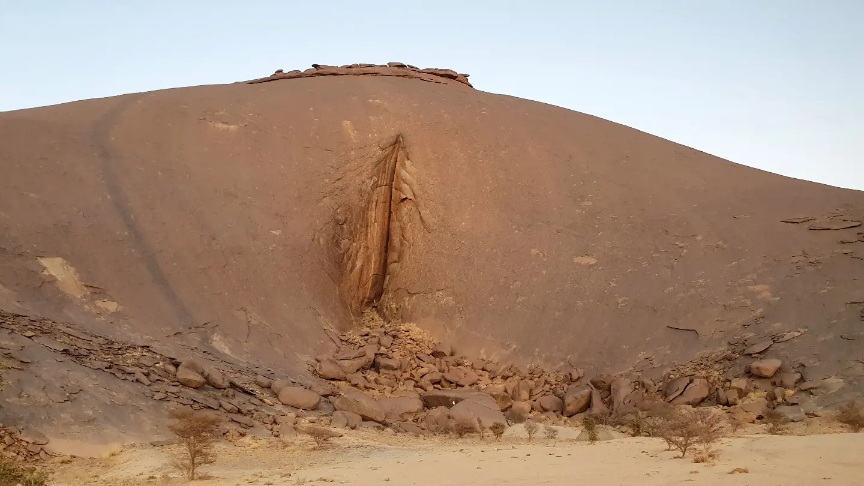
We meet again by the car to move on to a smaller monolith nearby. She is called Aisha, Ben Amera’s wife, we’re told, and we’ll be spending the night by her side. We cram into the trunk again and I watch Ben Amera turn and begin to shrink. A few minutes later we reach her. The sun is starting to set, the light turning the gray-and-red streaked rock bright yellow against the clear-blue sky. The way the light falls on the gray rock makes it look to my eye as the forehead and eye of an elephant coming out of the ground, its body buried in the unshifting flatness. As we approach the rock grows, the illusion breaking apart as the angle changes. She doesn’t look like much, to be honest.
Until we turn around her, and she opens. I can not believe, at first, her shape; I stare, dumb, at the bright yellow folds lit by the sun, curling out of the smooth rock, right in the middle and under the soft curve of the top. On both sides the rock is opening and holding, protecting like doors ajar, and underneath, rocks, spilling out, falling out of her.
It is a vulva.
We are passing in a wide circle, turning around her and I watch her turn until soft rock obstructs the labia from view and we reach her shadow and I am left with my mouth open and heart pounding. Ben Amera, the second largest, all the numbers and facts; all that has become uninteresting. This, this is something else: a miracle. I have seen the shape in flowers, but never in stone. I just want to go back to the giant vulva; awe at her; pray to her; spend the night in her shadow, protected from wind and everything evil.
…
The setting sun colors the desert in rich pastels. I walk around and busy myself with watching; every minute, it seems, the palette shifts, changes again. The sky offers dim blue and rich purple, the sands have turned warm and range from yellow, to orange, to red. The small shrubs break off with light, fresh green and I feel stupid; I had thought there was no green in the desert! Turns out, all colors exist. Maybe the vast distance between the horizons gives them time to mature, take shape in the light traveling unobstructed before meeting my eye; maybe becoming a color is a craft like any other, becoming deeper, more refined the more time the waves of light get to slowly reach their length before caught by my retinas. And in return I honor their travel by marveling; I have time to look.
Another group has set up at the spot between the hills and the monolith, I find as I return. They are a group of French cyclists and local guides making a track through the desert for a cycling event they are arranging the following year and they welcome us to join them.
Night falls. The wind picks up but between the rising rocks we are safe from its tugging and noise. The guides make a fire and we are served small, hot and sweet glasses of tea poured from high, then invited to share the pasta with camel meat. I watch as one of the men skillfully kneads a dough in a big bowl, then he moves the fire aside and digs a hole in the sand under the hot embers. In the dent he places his dough, now flattened and round. Just like that: he puts it straight down in the sand, ushers hot sand back on top of it, then the embers and the burning wood. I have never seen bread being baked like this. He turns it once after a long while, removing the fire again and feeling his way to the buried shape with a stick. When it is finally finished I watch his silhouette, moving the fire with the sticks, feeling under the sand, digging out the big, round shape. I see him take it in his hands, fast, the steam backlit by the fire, his smile. He smacks the bread with his palms, to shake off the sand I’m guessing, then throws it onto a plate with fluid movement. Later I get to taste it, a piece broken off for me in the dark and the sand, somehow, didn’t stick to the dough at all. The bread is hot, soft and delicious. I chew on it slowly, ponder the miracles of wheat, water and fire and watch as the guides’ hands, lit up by flashlights, dig into their one bowl of meat and pasta, fingers scooping the sauce with the hot pieces of bread.
I decide to skip my tent and sleep only in my sleeping bag under the stars. I remove myself from the group, find a bush and make my home by its side. It gets cold at night and the wind is picking up, too. The stars are many and bright, the shape of Aisha a comfort. I change and brush my teeth in the dark, feeling wild and free, then crawl into the sleeping bag, vainly attempting not to get sand everywhere.
During the night it turns out I have made my home at the wrong side of the bush; I am woken by strong wind and the familiar feeling of sand in my eyes and mouth. It is not beautiful anymore. My strategy, too lazy to crawl out and look for another place in the dark, becomes to bury myself deeper in the sleeping bag, close the opening and plug it with my scarf. The wind enters through the seams by the zipper. It’s not comfortable and I can not see any of the stars, but sleep comes and holds me well enough until voices calling my name wake me before dawn.
I am the last to stagger out to the mat laid out with mostly what remains of others already having had their breakfast. I pour myself the last hot water from one of thermoses and enter a tea bag, find a piece of that light, white bread to chew on, not really willing to put food into my self so early, but grateful for having been offered. Also unsure of when I will eat the next time. The sun is not up yet but light pours out from over the horizon from which it will rise. In the shadow of the monolith the colors are blueish gray, fresh, steely. I try to hurry up; the others seem eager to go.
On the way back I get to ride inside of the car and watch the dawn through the tinted windows. I can not see the shapes of Aisha or Ben Amera disappear behind us. Instead I look to the side, over the enormous vastland and distance and everything, too sleepy to properly see but with nothing to rest my head against in the bumpy back seat. I watch our guide shift gears, his eye on the sands ahead. I am too tired to ask him about landmarks. The sound of the engine fills the car. Conversations are brief as we fly between the dunes and the sun rises, rises over the great lands, over our little car with its little roar of the engine, us crammed inside and the thousands of secret guardians beginning their day in the quiet of the desert, in the stillness that is only a mask, a facade of shifting colors and infinite change which the winds move like currents of water. Over Aisha, the rock giving birth to the world.
…
(This story told in pictures part one, two and three, and video.)
 Hulkuv loom