THE BREAD
Fire crackles and I am in its small circle of light and heat again. Crickets are singing all around me in the dark, stars bright and many above. The smoke smells unfamiliar; I have never burned palm leaves before. My tent is pitched behind me. Around me, though I can not see them, are neat rows of carrots, onions, leeks, beets. All sleeping, growing, peacefully in their soft sand beds still warm from a day of sun.
I take out the little plastic bag with dough. Negotiate its sticky shape flat between my fingers. The air has turned chilly. I lean back and take in the crickets, the sky, the smell of the smoke while I wait for the fire to burn down into hot embers under which I can bake my bread.
Finally.
…
THE ROCKS
Stiff and aching and rough in every sense – that is how I woke on the gravel ground in front of the military base. Roosters sounding from the village around. I woke wary, on my guard. Unsure whether I was free to go but nobody was approaching me so I made my way out of the sleeping bag, came to standing. Lone, unconcealed in the open yard. Was someone watching from the windows? Would someone come and order me not to do …something?
Slowly I started rolling up my things, stuffing everything into place. Somebody came out with a cup and placed it on the wall beside me; breakfast, he said, then left. I glanced into the cup: gray porridge. I was curious, but I was going to leave it. I hoisted my bag up and looked around; still nobody. Should I say something? I made my way past the building without a side glance, as if my gaze itself would attract eyes, and passed onto the street, turned left, then turned again as soon as the street allowed, getting out of view. Gathered; fleeing.
Few people were moving about, slowly crossing over the square to and from the small shop, coming out with breakfast bread. I went in and pointed at some small, dotted bananas. A few older men were sitting in the shadow next to the shop. We said our hello:s as I joined them to sit, to look over the square, to peel and chew absently on my soft bananas. One of them offered me a small mango from the ones he was selling. Yellow and sticky on my fingers.
People’s eyes lingered intently on me; bodies passing but eyes staying behind. A few greeted me. Children playing nearby started gathering around me, wanting to interact but not sure how. Some only stared, others tried talking to me, confused when I replied in a foreign language. We played games on our hands for a short while, clapped patterns, made fingers disappear and reappear on the other hand, compared the different ways to make hearts with fingers and palms. But the crowd of children grew and soon they were more than fifteen and it got too intense. I retreated, let my focus shift from them, smiled that we were finished playing. Some dropped off and the older men sitting next to me told off the ones too insistent. Most obeyed and ran to play with something else. A few still stayed nearby, keeping track of me from the corner of their eyes. Like the adults.
I was different here: trousers, backpack, white. Female, but not in a way anyone seemed to recognize. I didn’t make sense to them.
The rising sun gradually shrank the shadow back into the wall. I had already spoken to some men with four-by-fours about taking me to Richat, but the drive was longer than I’d anticipated and the price higher, too. I could pay it, but it would leave me with no money to go back to Atar and I didn’t want to end up in that situation again; relying on five different people, chasing cash for a full day. Instead I strolled aimlessly through the village.
A group of children spotted me and started following me. I said hello to them and kept strolling. More kids joined as we walked and the group grew; ten, twenty, maybe over thirty children all in all, boys. Some were shy and curious, looking warily at me from a distance. Others tried talking to me in Hassaniya, yet others stretched their hands towards me, demanding:
“Cadeau, cadeau!”
I waited for them to lose interest. Some were starting to become bored and the boredom showed in aggression. I didn’t need to speak the language to understand the lewd gestures or the increasing snickering. Some hands were starting to get annoyingly close to tugging at my backpack, some voices too loud. A few rocks flew through the air from behind me. I turned, calm, but was met by more snickering. This wouldn’t do.
I noticed three men sitting in a small shop. After greeting them I pointed to the crowd of children outside, my face and hands enough to compensate for the fact that I didn’t know the words to ask for help.
“Mushkil,” was all I thought to say. Problem.
One of the men addressed the group of children, the others quiet, looking. His voice was authoritative and most of the children obeyed, scattering into side streets, folding slowly and unwillingly around house corners. A handful hung around, just far enough, peering at me. I thanked the man, sat down with my back to the shop wall, hoping to wait out the more stubborn kids. Sometimes they would call for my attention, yell something or make more lewd gestures. I sighed. With not much else to do in a small village like this, harassing a traveler was probably the best available entertainment.
The lack of sleep, the pain in my body, the recent fear and anger in my encounter with the military. The harassing children, the silent, staring adults. The sun, the damn desert sun so aggressively coming down from above. Should I go back to Atar today? What was the point of staying?
I wasn’t welcome here.
…
THE DATES
Ahmed found me just outside the village, underneath a thorny tree. The sun had crossed its peak and I was slumbering with my back leaning against the trunk. He stopped his four-by-four and backed up again when he caught sight of me, leaned out his window to greet. The usual: where are you from, what is your name. I answered more from a sense of duty than anything else, but then he asked me if I wanted to see his garden and it prodded me from my glum mood. Always, I thought. I always wanted to see a garden. A desert garden? That would be a first. I got into the car and we rocked along the uneven tracks.
The garden stood out as a thick patch of bright greens in the sandy-yellows and browns. The vegetable beds were soft, neat squares in the sand with ducts for water between them. Carrots, leeks, onions, beets, aubergine, pumpkins, mint; he had everything! He pulled out a carrot for me from one of the beds, the root sneaking soundlessly, without resistance from the grains. I broke off the leaves, washed away sand under the running stream, then bit into the softest carrot I had ever tasted in my life. Sweet, mellow, bright. Juicy!
I gathered that Ahmed had a job administrating the commune of Ouadane besides running his garden at a small profit. I told him about spending my night at the military base (though leaving out how offended I’d felt) and the children following me, not knowing if I should stay in Ouadane or try to find a way back.
“You can sleep here in the garden,” he offered, not missing a beat.
It was all I wanted.
He invited me to meet his family and as the sun began to sink we drove back up to the village. His wife greeted me timidly as we stepped into their yard, his two teenage daughters and younger son with more curiosity and enthusiasm. This I can do, I thought to my self. To a handful of people at a time, I can be the strange foreigner. If they give me food, if they are kind to me, I can offer to be stared at.
We ate, we chatted, we laughed tentatively. His daughters bright and energetic, holding most of the conversation and despite our mutual struggles with the French I found out about their everyday lives; their favorite subjects at school, their dreams for the future.
“Are you sure you don’t want to sleep at the house? We can arrange a room for you,” Ahmed said well after the sky was dark and yawns overcame me. I only shook my head, smiled and thanked him again, thinking about the soft sand and quiet of the garden, the fences that would keep dogs and people out. To finally be in peace. Without insisting further he drove me back down to the garden. His family had given me gifts: a bright-pink malefha to wear and a rosary of small black plastic pearls.
I stayed for another day. Ramadan had begun.
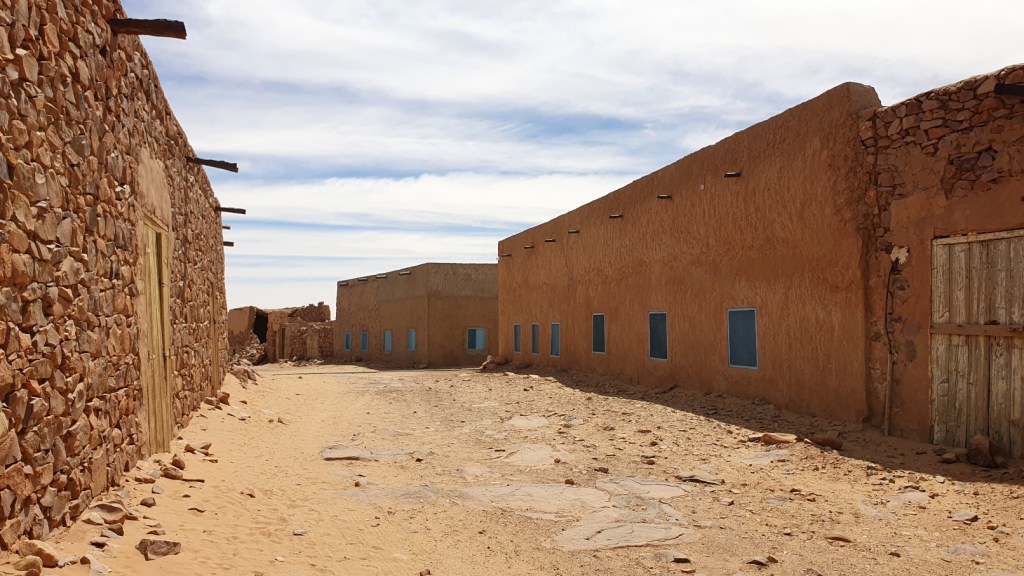
I walked through the village again, now draped in the pink malefha and without the backpack. It was even more quiet now. No more fruit sold at the square, no more people carrying breakfast bread from the store. I wandered through the old town ruins and the valley beyond them. The heat, the date palm plantation, the open sky with its eagles and swallows. In the evening Ahmed invited me to break the fast with his family and I sat together with his wife and children on a carpet, all waiting for the prayer call. Between us was a generous plate of dates and grapes, cups of water, milk, porridge and lentil soup beautifully arranged for each of us, waiting, still, dusk falling around us, a peculiar tension in the air that seemed to stretch beyond this one yard to reach the next one, the whole village; all families sitting together, waiting for the same thing. I had fasted too, now struggling not to look too greedily at the cup of water in front of me.
The call sounded, echoed between the houses. Small nods, smiles, eyes that met mine, guiding;
“Bismillah.”
They all reached for the dates first, offered me the plate, then placed the sweet small knots between their lips, whispering out thanks before taking the bite. Chewing, hands slowly moving, dreamlike for the cups. I watched the eldest daughter bring a bowl of goat milk to her mouth and drink big, grateful gulps, eyes closed. I placed the cool, metal cup of water to my mouth and slowly, too, whispered a word of gratefulness before taking the first cold, divine gulp.
I am here to learn, I thought; remembered. I am here to learn.
…
THE BREAD (AGAIN)
It only takes one person’s kindness to balance the rest.
Somebody on my side, helping me despite not necessarily understanding me.
Alone now, in the orange circle of the fire I feel ecstatic again, expansive; I have won. I have found a way to do exactly what I want: to make a fire and bake my bread and look at the stars and sleep in peace beneath them. No one will bother me, no one will question or stare at me here. I can breathe in peace.
Everything is OK; everything will be OK; everything will straighten itself out and become clear when it’s time.
The vivid sunset I saw from the top of all the luggage; the mighty plateau rising around me before that; the rocks piled into silent square walls in the ancient town; images rise and shift in me and I think about how it is me, only me who will store all of this within; me, the keeper of the red and blue clouds and sound of wind, the sand billowing behind; the keeper of the pleasant and the painful, even now, the stars, the sleeping carrots nearby which I think of and feel through my body, the fire’s crackling, the crickets’ songs. This life is for me.
The embers only a faint red glow now from the center of the pit. It is time to turn the bread.
…
(This story told in pictures.)
 Hulkuv loom