I saw the minaret first.
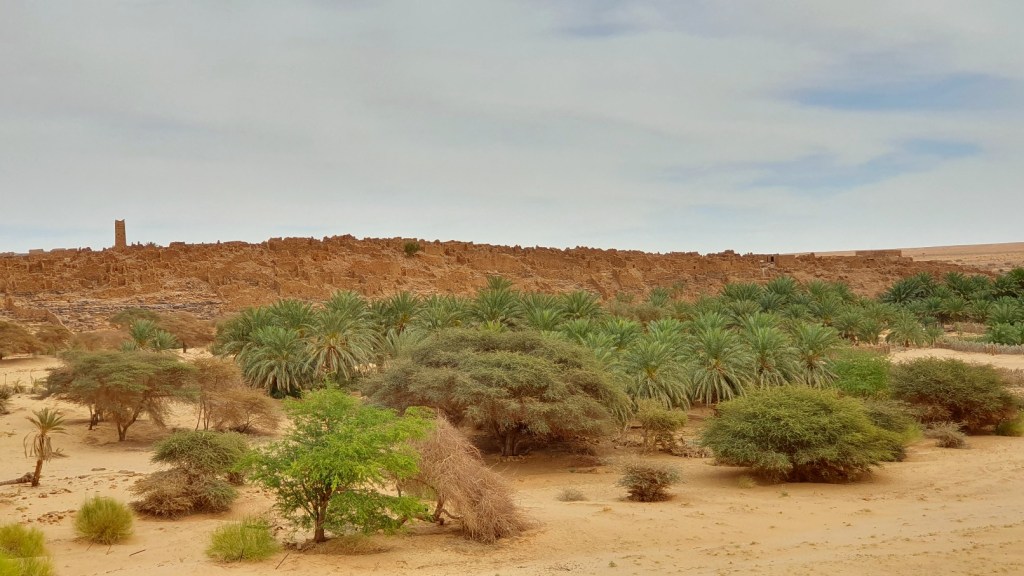
The houses open up to the mosque. The minaret, alone, points straight at the sky from the top of the hill. Its body made of rocks: all flat, soft, rounded edges yet together, laid on top of each other, they give the lone spire four sharp corners. Small triangle-windows of slanting rocks built into the sides here and there.
The only sounds: my feet setting down on hard sand and pebbles. Nobody else around; no one has lived here for centuries.
Only the swallows swooping down above, their movements also muted.
Behind the ancient mosque lay the old town. Narrow streets, piles of rocks here and there; some of the house walls fallen into the streets, all fallen. A surprising amount of walls still intact; how can they stand after these hundreds of years? Is it because it does not rain, no force of water to erode, to drag the particles down down down until all swims away? All stacked rock, held together with clay. Still here, standing. Would it budge if I slammed my body against it? Can I move it with my breath?
At this edge of the village the houses more collapsed and through the walls that were no more the valley came inside, the distance letting itself in through the wall-holes, spilling into the rooms like the sky did from above. The palm trees, the hill on the other side of the valley; everything entering.
I turned back and walked the other way through the quiet ghost-town. A sign told me to pay a tourist fee, but to whom? Nobody breathing here but wind.
And Ouadane was big. Draped itself over the cliff, the street running up and down like a snake, the rock made smooth by feet with time. Had the rocks been cut already when they were carried up the hill? How many rocks would a pair of hands hold, sweat dripping, eyes careful? Every rock hand cut, carried, chosen and laid into place; this one goes here.
This one.
Goes here.
Every rock a relationship; a family; network; with the others by its side. Hundreds of years later the labor still standing. Or is that fair to say?
What is a house when it is not a home?
Missing doors inviting peeks into what once had been homes. Peoples’ homes. Small rooms, sometimes with traces of a second floor: old remnants of wooden beams sticking out. There had been families sitting on carpets on the floor, gathered around food just like people gathered now. Same hands with fingers picking pieces of meat, same eyes following the speaker; same conflicts and hunger and love.
Architecture might change, but humans really don’t.
The street led down, wound and split itself into side streets like rivers. Walls tight and tall, then ebbing to just waist-high. Just inside the old city walls opening into something that might have been a mosque, or maybe a market: pillars springing up, now supporting nothing but the sky. A small staircase leading up into a remaining tower.
I followed the stone slabs, the uneven steps: bumped my head then, and when I turned to look up I saw an oval dent in the ancient wood beam – mine joined the countless heads already bumped here over the centuries. From the tower I had a view over the ruins and the valley, the new part of the town just above the old one, occupying the other side of the same hill. Houses built on what, to the first inhabitants, might have been a naked hill, now dressed with new straight house corners, arched windows.
Ouadane was once an important town for the caravans passing through the desert. I imagine: small, short human steps taken days on end through endless sand, fabric billowing and camel in tow; small slits between the headscarves to protect the men’s eyes from the sand; heading for horizon after horizon, only the strength of your legs and sense of direction to take you there. Then one day – after how many days? – the valley of green far away: palm leaves stretching up, behind them the hill and the square patterns of overlaying rocks; carried rocks, placed rocks; same color as the sand around them, the silhouette of the minaret clear and determined from above them all. Or maybe it was night and dark already; maybe the caravan was pushing its last steps, somehow knowing that not too far away were the small, flickering lights on the horizon; fires, lamps; people; food being cooked and stories being told. What were the travelers’ feeling at a sight like that? After all their steps? What would a life like that be like, crossing the desert over and over again? Was a life like that chosen, or born into? Homes and goals on the horizon just temporary pitstops;
I know, from the moment I see it, that I have to leave, yet my heart is regardlessly overtaken by the joy of being welcomed.
…
(This story told in pictures and video part one, two and three.)
 Hulkuv loom