I arrive late at night after a long journey through the vastlands, my lips chafed, mouth dry, legs shaky and head aching from the heat and lack of water. Hadmine meets me, finally: my mysterious friend who has helped me so much during the passing month and whose face I am to see only now. He welcomes me into his house and installs me in a room with its own bathroom. The first thing I take is a shower and it is glorious. Then I join him and his brother in the salon. The TV is on showing wrestling or something like that and his brother smiles and makes us tea. They are not tired even though it’s well after midnight;
“Many people stay up until the morning prayer during Ramadan,” Hadmine tells me, “then they sleep during the day.” I think back on all the people I’ve seen sleeping in the market stalls and tie the image to the new insight.
Hadmine brings me along with him to run errands in the city and this way I get to see Nouakchott. The city is flat with low buildings, stretching on and filled with slow-moving traffic. Most of the time is spent on navigating the traffic, the cool, air-conditioned four-by-four a blessing in the heat. And he plays music; I have barely heard music since coming to Mauritania! He brings me to the market and we stroll along the crammed stalls protected from the sun with masses of fabrics draped over and tied to poles and sticks. From a balcony we watch how the city officials make some vendors clear and move back their rickety stalls where they spill too far into the street. “Imagine the fire hazard,” Hadmine says, and we’re silent.
It is hot. It is unbelievably hot.
We fast. We spend the days inside the cool, cave-like house, the lights in the salon where Hadmine’s brother sleeps turned off until well after midday. To go outside I have to feel my way along the wall. I am hit by the heat and light as I open the front door. After barely half an hour outside it is almost unbearable and I have to retreat.
Hadmine brings me with him to meet his friends, to break the fast and have dinner together. We mix shy English and French and I stay gratefully quiet and rest while the conversaton takes a turn in Hassaniya. Another evening we spend sitting on a carpet by a lively square, watching the people passing, biking and dancing. Taking selfies with the synchronized fountain with the colorful lights.
And Hadmine asks me questions. He asks me my opinions and he waits for my answers and I realize as he asks and as he waits that people haven’t done that to me in …a month? Two? Besides wanting to know my country of origin people have not asked me about any of my thoughts, opinions or experiences. They have asked me how I like their country and expected me to smile and approve. They have invited me into their homes but they have not wanted to know anything about me. In a way it is humbling. Like I don’t have to be any certain somebody in order to deserve a welcome. In a way it is a little sad.
And I ask him questions too. I ask him to betray all the secrets of his culture and people and sometimes he does and sometimes he does not; chuckles or answers vaguely that he doesn’t know, but I see in his eyes which he doesn’t move from the road that that’s not all. Or maybe it is, and I just want intrigue. Either way it’s OK.
“People lie,” he says when I ask him what he dislikes here and that takes me aback. They do? They lie despite the religion? The next moment I find footing; of course they do. People lie everywhere; about different things, at different times, for different reasons. People here are no different. Why would they be? People are people.
I sit back in the passenger’s seat next to him, lean back. Enjoy the music, the cool air, the mutual silence as I watch the endless traffic struggle by.
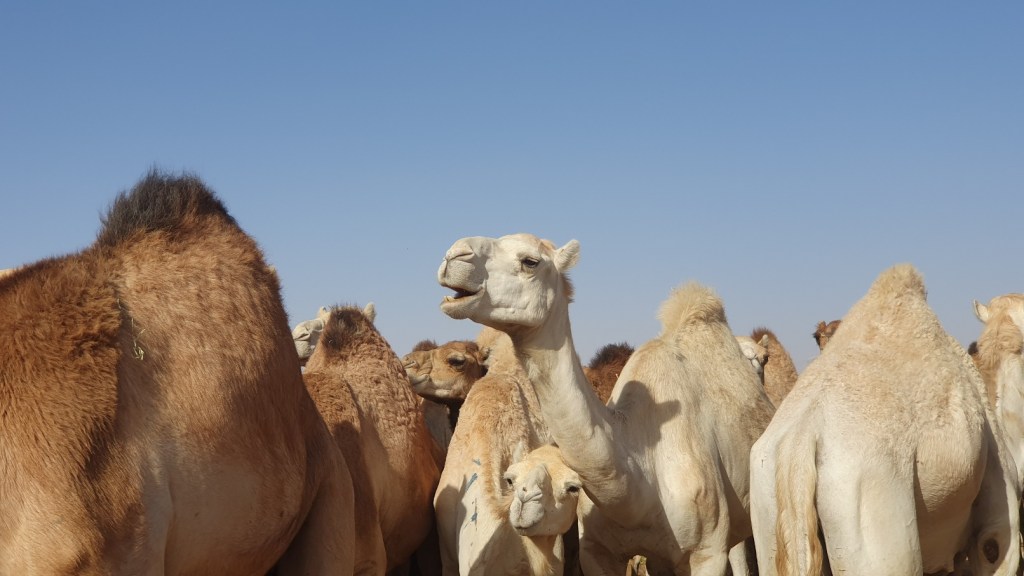
Hadmine brings me to the camel market and I see the gentle, weird creatures for the first time up close. The herders don’t need force to prod the camels along. Their feet are tied, sometimes the front feet together and sometimes one front foot to a back foot, making their steps short and undignified. Still they look gentle and remain calm as the groups move where the herders desire. They bump into each other, their curiously bent necks swaying, weaving over and under each other, into sides and humps but with no ill demeanor, no frustration. They seem equally at peace as when they stand ruminating, chewing cud or simply gazing through their half-closed, dreamy eyes. Sometimes, without any apparent reason and with intentions unknown to me, they sing. I enjoy them. I enjoy their calm and their heavy smell. I enjoy knowing that creatures like this exist.
Hadmine brings me to the beach after nightfall. The wind is strong and salty and blissfully chilly after the day being so unbearably hot. The waves crash hard and loud and I sing into them with the full force of my lungs opposing their motion. Then we sit in the wet sand and talk for hours. I hadn’t realized how much I had missed speaking English. All of a sudden I barely need to think as my voice conveys the abstractions inside my body and mind, my tongue moves in familiar patterns and I get to be my self, a more familiar version of my self. And I remember what a gift that is: the space to be.
On my last evening Hadmine helps me change my remaining Ouguiya into the West Afrian Francs I will need in Senegal. He helps me find information about my bus to Rosso and on the day he drives me all the way to the station, over an hour and a half through endless traffic jams in endless Nouakchott. He makes sure the staff at the station will help me get on the right bus, then sweeps out in his clean light blue darra’a, flashing a last smile at me before shutting the car door and leaving me to wait. And I go inside to sit and sweat and wait for the bus that will take me away and out of this country.
—
Hadmine is a real (and wonderful!) person whom I happened to meet through sheer luck. He is a professional tour co-ordinator, guide and auberge owner who arranges trips of all kinds all over Mauritania and makes a lot of beautiful and well-informerd content to represent his country. He runs Time for Mauritania and can be reached through their website or instagram.
…
(This story told in pictures.)
 Hulkuv loom