I was nervous to cross the border into Mauritania. I didn’t know what to expect. Everyone I talked to on the way told me something along the lines that the people are kind, but conservative. On many occasions they also told me: “There is nothing there!” when I asked about what I could find.
Which upset me. There is always something everywhere.
What triggered my fear to begin with was reading about Mauritania on the web page of the Swedish Ministry of Foreign Affairs. One sentence stated that they recommend not going to this country unless absolutely necessary, motivated vaguely by “the general safety situation”.
Not going to this country.
The whole country.
Within these lines on the map, this exact land area, the government of the country that issues my passport recommends me not to set a single foot.
Some tourists have known to meet tragic ends here a few years back. I’ve heard about tourists getting beat up, about rumored kidnappings. I don’t want to take any of it lightly; the warnings are there for a reason. Yet there are countries where children get shot in schools and the police kill on the basis of skin color and I am yet to see a recommendation to stay away from the USA. So I think there is wiggle room here; space to question. Not if one should visit this country, but how.
…
Mauritania is the most conservative Muslim country I have been to. It is culturally rich and diverse with the Arab cultures from the north mixing into the “real” African customs from the south, mingling also with many nomad people’s traditions and migrants from Senegal, Mali, or Guinea; many cultures living side by side. Morocco, in comparison, is very much like Europe.
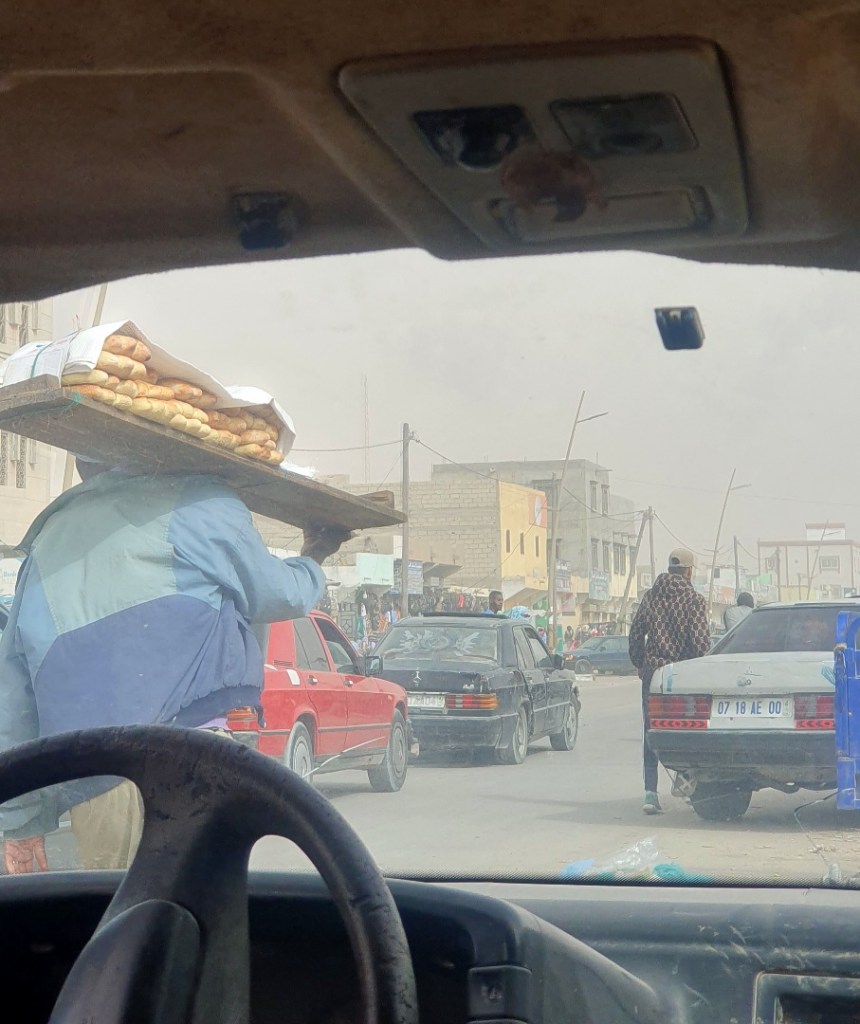
Here, most streets are sand and goats are strolling freely. Water pours in small streams into the streets as men do their abolitions sitting on the steps, washing their faces, noses, arms and feet. The traffic consists of cars returning from the grave and scarred donkeys pulling carts, the men driving easily resting their chin on a knee, the other foot dangling out from the side. Children come up to me to ask for money, a silent hand cupped toward me. The lack of infrastructure for waste management is clear by the heaps of trash everywhere and the non-existence of waste bins. On Fridays, the day of prayer, the men wear their finest and loiter on their way to and from the mosques. Even the little boys shine in their clean dresses, whoever can afford it.
Here, people will look you in the eye, acknowledge you and say hello when you enter a room or an office or a shop or just pass by on the street. Me being white is an excuse in itself to strike up a conversation and people chat to express their curiosity and to make sure that I am properly welcomed. People take their time. When they meet they exchange phrases of greetings for a full minute or two before anything else, a group of men exploding into mumbled or shouted how are you:s on the square while everybody touches everybody and smiles at everybody. Until it’s done. The towns may be busy yet they are quiet; no loud music is played outside, no rowdy parties. Very few raised voices. The colors are sandy-dull and the moving people, wrapped in their fabrics, are really the only dots of color in the landscape; figures offering the basic human shape around which the wind plays with the textiles.
For the meals everyone gathers, sits on the ground around a big plate and eats with their hands (the right one.) Some families divide themselves by gender around the plates, others not. Mauritanians of all ages sit easily on the ground; they do not grunt of pain or exhaustion when getting up and down. Here, it is on the ground that one eats, talks and rests. The rice, couscous or pasta mixed with veggies or meat is shaped into little balls by being thrown around in the palm of the hand as the conversation flows, then flicked into the mouth. In the circle, everybody’s eyes meet everybody’s and especially good pieces of meat would often be separated and placed on my side of the plate. The clothes and the floor in front of the Mauritanians would be clean after the meal. My lap, as well as the floor between myself and the plate usually not so much, and often I would resort to the spoon I was offered.
…
I didn’t plan to move without money to the extent that I did here. The first two weeks that I spent at the orphanage I barely used money; I was offered food and a bed, they even dressed me in malefhas before I bought my own.
After having a portion of my cash stolen, I was hosted and fed for free at the auberge in Choum. (I will not blame the stealing on Mauritania – this is to be expected everywhere when traveling.) Just by chance I slipped into a desert tour with four other travelers to the monoliths of Ben Amera and Aisha where, again, we were driven around and fed without charge. Returning back to Choum auberge the manager arranged my bus ticket to Atar and pressed a 500 bill into my hand as we parted, just in case. In Atar, while trying and failing to receive money from the ATMs I ran into Sidahmed, the owner of Auberge Inimi. He and his brother helped me on my continued chase for cash and in the end he offered to host me for free until I had it figured out.
“You will eat with the family,” was all he said.
By the next day, after hours of effort to try and solve the problem and many people involved to help, I had the money in my hand.
Yet even after that more taxi drivers refused to take my money as they offered me rides, only wishing me well on my road. At the market a man I didn’t know paid for my kilo of mandarins and on the bus to Nouakchott another man gave me half of all his food which I gratefully munched while my own snacks lay unhappily in the bag that was strapped to the roof. Everywhere I went people smiled and complimented the malefha I was wearing, happy to hear my few phrases of greetings in Arabic and patiently waiting while I wrestled my way through the French. Unyieldingly kind, polite and proud of their country.
No, most of them were not happy with their government or the politics, expressing their dislike without going into too much detail. I didn’t ask too much; by standing beside them I saw the lacking infrastructure as well as they did: the trash, the roads, buildings and cars falling apart, the families in poverty and lacking education. Yet despite their awareness of their money falling into the wrong pockets, they remained with their backs straight, working hard and hoping for a better future for themselves and their country.
…
Here, I cover my body and my hair while I move about. Seeing me wear pants challenges some; once a woman even told me how it is not good for a woman to wear pants. Another time children in a small village harassed me. Unpleasant, but liveable. Sometimes people would want to take photos of me, some asking, some not. This I didn’t like, but my “no” was always respected.
On a few occasions men would hint their romantic or sexual interest at me, usually by saying something along the lines of wanting to take a second wife or a European wife, maintaining eye contact just a fraction longer than necessary.
“Well good luck with that, I am sure you will find somebody,” I would say, and that would be that. After the months in Morocco where men would follow me around on the streets nagging for my number and more or less aggressively insisting on maintaining a conversation, brushing off these vague approaches was child’s game. My subtle steering to keeping these interactions platonic were always understood and respected so I was never forced to be assertive, and thus never taken to be rude, allowing for the conversation to continue on as before.
The single worst thing to happen to me was being arrested by the military that one time I tried to camp alone outside a desert village. They insisted it was for my own safety and were mostly polite to me, offered me dinner and breakfast. I was very upset about it, but in the end nothing bad happened.
Still I can not see the dangers of Mauritania. Even as someone who travels in a way that challenges many beliefs and thus may cause provocation (not only in a conservative country like this, but everywhere!), for the life of me, I can not. Some unpleasant and stressful things have happened here and I do not want to make excuses for those, but these have not been worse than anywhere else where I’ve had unpleasant and stressful experiences.
I am not traveling to argue or change anything. Only to observe, learn and softly participate. Entering a conservative country and traveling the way I do has been my choice; there are ways to move around in this country as a tourist without compromising on one’s own customs (such as not covering as a woman) or risking discomfort (by, for example, sticking to guided tours and auberges.) It is me who has been stretching the boundaries for what the culture and customs allow.
And on the other hand, never yet have I been so pampered and cared for. I step in to claim the highest position within this culture: that of a guest. It gives me privilege and freedoms not available to many in this country, especially not many women: the freedom to move as I want, the freedom to make social mistakes, to ask and say the wrong things, to be curious about people’s personal lives. To wear pants, to ride in the back of a four-by-four. People offer and share with me the best, bring me to places and tell me stories they normally wouldn’t, because they want me to enjoy their country.
I have moved around here for a month, traveling solo but never alone. I have always been received and people have gone above and beyond to host me, connect me and care for me, send me off, keep in touch and make sure that I arrive safely, make sure I have somewhere to sleep. They are inviting me straight into their homes, both literally and metaphorically: into the layered and complex culture of Mauritania. And besides most people being kind and generous there are also many people intentionally working very hard to change things. To keep and cherish the local traditions and make Mauritania a safe place to visit for everybody, grounded enough in its roots to be able to meet others with different customs.
So tell me: what are the dangers of Mauritania? It is tricky, sometimes, yes. But dangerous? I can not see it. In the face of all the kindness that comes so easily to the people here, it is simply not fair to advice against visiting the country as a whole. Only underlying racist structures motivate an official statement like that, something that is put in print without being checked twice, accepted because “we know how those people are over there”; assuming a privileged worldview thinking that moving requires no compromise on the mover’s part and that the whole world should cater to the Western cultural viewpoint. That any other way of living is strange and should be treated with suspicion. But me, I’ve checked it twice. For a month I’ve had my both feet firmly planted within these lines on the map, my hand repeately dipping in the same bowl and my eyes met with smiles. And I would go back in a heartbeat.
The fact is that there are dangers everywhere. Everywhere. And everywhere, the majority of all people are kind.
…
(This story told in pictures.)
 Hulkuv loom