From behind the bus windows the landscape turns gradually more and more green and I have to look twice to make sure my eye isn’t fooled. Yes, it’s grass! Thin, sparse, scattered, few straws with sand in between but still; it’s there, it’s grass!
I breathe through my still-clogged nose, so as to not let water evaporate through my mouth. The bus is hot, crammed. Sweat is pushing out of the pores around my nose, my face and feet are swollen.
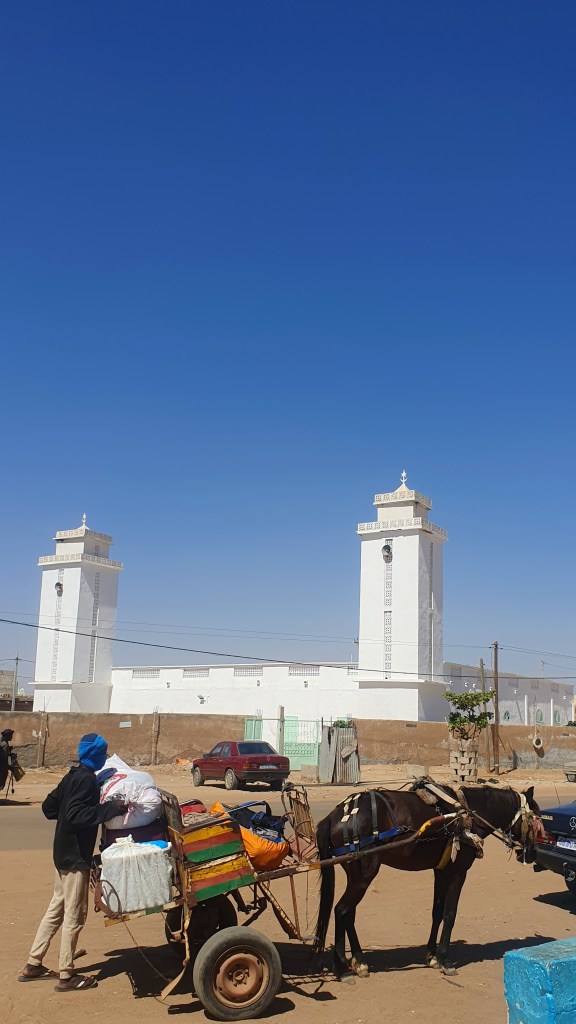
In Rosso I ask for the way to the border and am told that a taxi will take me. The taxi is a horse and carriage. During the long wait I reflect on the change of landscape, the fact that I am getting out of the desert; if there are horses there has to be grass enough to support them. Until now I’ve only seen small donkeys and goats, eating cardboard.
I wait while two men load the horse carriage, then unload it again. In the end I am the only one taken to the border, me and my backpack. In the end the border crossing turns out to be barely a ten minute walk away and I turn out to have been effectively fooled.
Throughout the whole ride the man beside the driver tries to persuade me to let him be my “guide” and help me cross the border. I refuse him but can not stop him when he lifts my bag from the carriage and refuses to give it to me, insisting on carrying it, or when he goes ahead and talks to the guards and the staff at the border. I will not pay you, I repeat to him many times over. If he wants to do it all for me he can, but I will not pay him. I know that he understands. In the end he still asks for money. In the end I feel no guilt in refusing; I had been clear all along.
Finally all my documents get stamped out and in order and I go off to the side to sit in the shade. Men keep approaching me, more “guides”. How much will you pay? My white skin is exactly what they are looking for, attracting them like a magnet. They are kind, sure, but it is so, so tiresome. How do I neither let them drain all my energy, nor become the rude white tourist? I barely make eye contact, remain soft and say my dismissive thank you:s to the air next to them. I remember why it takes a day to cross a border and why it is so very exhausting; all this bother, nonsense, rigmarole. In Russian we call it канитель ([kanitel’]); this requires a lot of канитель.
The river Senegal divides the two neighbors Mauritania and Senegal. On both sides the towns are called Rosso. The river itself is wide. Tall reeds sway in thick lines along the riverbanks. I don’t remember the last time I saw so much water that wasn’t the sea. People, mostly women, are getting into small, long and brightly painted fishing boats to cross, carrying packages and produce on their heads. Some young boys and men are bathing and I am overwhelmed with the urge to go into the blue glistening water and cool myself as the heat calls forth a pounding headache, but I stay, seated and sweating on my backpack in my military pants and wool sweater. Deeming this place too unreliable, too full of people watching me too closely.
The ferry comes and takes us on, me and the locals; more women with basins full of produce to sell, trucks. The air is cooler on the water and I breathe in pure strength and watch the shore distance itself. Gradually, a sharp line is drawn. Something new is beginning. It doesn’t get more clear than this; borders between nations are made up, but the rituals we practice to maintain the sense of their presence and power and the feelings these rituals provoke are very real. I am not only crossing a river in a boat; I am leaving and I am arriving.
In the Senegalese Rosso it begins again and I am immediately called at by several men as soon as I step out from the ferry and they spot me. Many hands gesticulating me to this side and that, many uniforms and it is hectic and confusing, everyone is marching off the ferry, watching their steps on the narrow bridge-thing so to not step into the water. I push myself through with the backpack wide and clumsy between the railings, swaying, avoiding the water. I follow two men, both shouting and gesturing at me; a uniformed policeman brings me to a window and I get asked my purpose for visiting and my passport is stamped after being cross-referenced to a list of countries printed on a paper and taped to the wall. The woman is curt and I struggle to keep up with the French. No one is smiling. After the window I follow another man, he is authoritative and gesticulating wildly and he is still holding my documents. The next thing, something with a health-check? Too much is going on.
I remember I need to buy a SIM card and I hang back to buy one from a man selling them on the street. The process to register takes a while and during the ten minutes waiting I have time to think. The stamping process is over. I have crossed, I am in Senegal now. Why is this other man still holding my documents? My vaccination cards. He is not wearing a uniform, I notice, and a chill grips my spine. I’ve been too caught up in the chaos to question his authority before.
I hold out my hand and demand my papers back. How could I miss this?
The man makes some excuse but I am firm.
“Give me that,” I say, and he finally does. He tries to intersect himself into my deal with the man selling SIM cards, tries to pay in my stead but I pay and get on my way without looking at him. I am upset at him, his audacity! He offers to carry my bag, then asks me where I am going. I ignore him and his loud gesturing around me, his fast speech, his forcefulness. I have to ask for the way to Saint-Louis and hearing this he stops a horse carriage-taxi for me. I lift my bag up myself, greet the young boy driving and climb inside.
The “guide”, of course, demands money. I tell him no. Then he demands a “cadeau”, a gift. I tell him no, again. Once, three times, he keeps insisting until finally, I raise my voice at him in a mix of frustrated Swedish and French.
“I never asked for your help! You were the one who took my documents and ran your way with them! I will not give you money for that and I will not give you a gift!”
I see heads turn our direction on the roadside. The man falls silent. I ask the boy to leave, and we do.
In the carriage I breathe and try to calm my self. I have crossed. My mouth is so dry it hurts. The stress running off me with the sweat. The sun is setting, still hot and painting everything in a warm, golden light. The carriage sways over the sand streets and the boy is calm in his place next to me. Tentatively I try to have a conversation with him, try to calm my self further. He is very, very kind and sweet. At nineteen he is the oldest of seven siblings. He tells me that his mother bought him the horse and that his name is Billy Joe. A soft smile flashes over his face when he says that. You should be in school, I think to myself. He greets everyone we pass and I ask him to teach me how to do that in Wolof. Soon, I am greeting everyone too.
In the shared taxi to Saint-Louis I am charged a ridiculous price for my luggage and we wait an excruciating amount of time for the taxi to fill. The people waiting are talking loudly and it reminds me of people talking and joking in Mozambique, a reminder of home in a way, but I am too tired and they mostly annoy me. I call a friend to complain and ask for sympathy, my head throbbing and mouth dry like concrete.
When finally the taxi is ready to leave I am crammed into the back-back seat and endure the hour-long ride slumped forward, too tall to sit upright. At this point I am ready to cry, but outside my window the big baobab trees tower curiously over the green fields and the orange setting sun is reflected in the water reserves looking so new and different to my eye after the month I’ve spent in the desert that I am simply left awing, forgetting. I speak to the man sharing the backseat with me. He is an English teacher and tells me about the book he is writing. I overcome my mood and my shyness and ask him about how to get to the camping I’ve set out for, whether he knows it. We chat and he spends many good minutes thoughtfully googling options for me and I don’t even feel bad about it.
It is dark when the cab drops me off at a busy market. Lights are flashing, meat is being grilled, loud taxi drivers gathered and cracking jokes at the end of the day. People drink bissap, red sweet hibiscus juice from small plastic bottles. I buy a bottle of cold water and down the liter almost instantly. Better.
The English teacher told me and also the taxi driver the name of the village to ask for but I can not pronounce it and I forget it almost immediately. The taxi driver helps me ask. I manage to gather a small circle of taxi drivers around me and by sheer survival instinct I find the energy to haggle playfully with them, laugh and drive down the price of the currency I don’t even know yet;
“Why would I pay 3000 to go 20km, when I just paid 2500 to come all the way from Rosso?” My dad would be proud, I think to my self with a smile. The price stays at 3000, which is better than the 8000 we started at. In a passing taxi my best offer is matched and without further ado we are off along the dark countryside, the radio playing fast, compact rhythms and the two men in the front of the car quiet in the dark.
I am let off into silence and the car drives off. Only a few houses stand along the road. The blue dot on my GPS indicates that here is right. I step into the first little shop and ask if there is anyone selling cooked food nearby. The older man tells me there isn’t. I ask for bread and a soda, hoping to find something more substantial at the camping despite arriving late. He, too, is kind and calm to me.
“I would invite you for dinner,” he says, but I tell him I need to be on my way. It is not true, I don’t need to; I just want to arrive already. With the comforting carbs clutched in my hand I set out into the dark towards the sea. The moon lights the passage between two bodies of water to my sides. If I don’t find the camping I can alwaýs sleep in the bushes, I muse. It seems calm enough.
But I do find the camping. It is a big, nicely lit and beautifully designed place, with a bar and fairy lights and cricket song and low voices from the few people hanging around. Made for Europeans, I think. The woman receiving me is European herself and visibly upset with me for arriving late and unannounced, but the man working in the kitchen is kind and heats some cooked potatoes and fish sticks for me; if he minds having been put to work at this hour, he doesn’t show it. I eat gratefully and later we chat in a murmur. Afterwards I pitch my tent and drown myself in mosquito repellent.
I am exhausted way down into my gut, my breath itself is tired as it gathers like lead in my lungs, but I am feeling way better after having downed the liter of water and after having eaten a dinner kindly heated for me. After having received just the little kindness from the boy in the horse carriage, the man in the shop, the man in the kitchen. With my belly full and feeling safe, I am happier. Tomorrow I will give a malefha to the kitchen-man to give to his wife, I decide; a gift weighing down my bag which I could not refuse because there is no word for “no” when it comes to gifts in Mauritania.
I step out from the behind the trees and onto the beach. The sea is so loud here and I don’t know where the roar comes from. By the beach itself there are no waves; the water simply laps, licks gently against the sand, quiet, but there is a lot of noise of waves crashing somewhere and it carries all the way here. And the crickets are singing so loud, and the moon is shining so bright
and I am in Senegal and I arrived today.
I hope I will get to sleep for a long time.
And I hope I will make it to Dakar.
Everything else will be clear tomorrow.
…
(This story told in pictures and video.)
 Hulkuv loom