I am a liar.
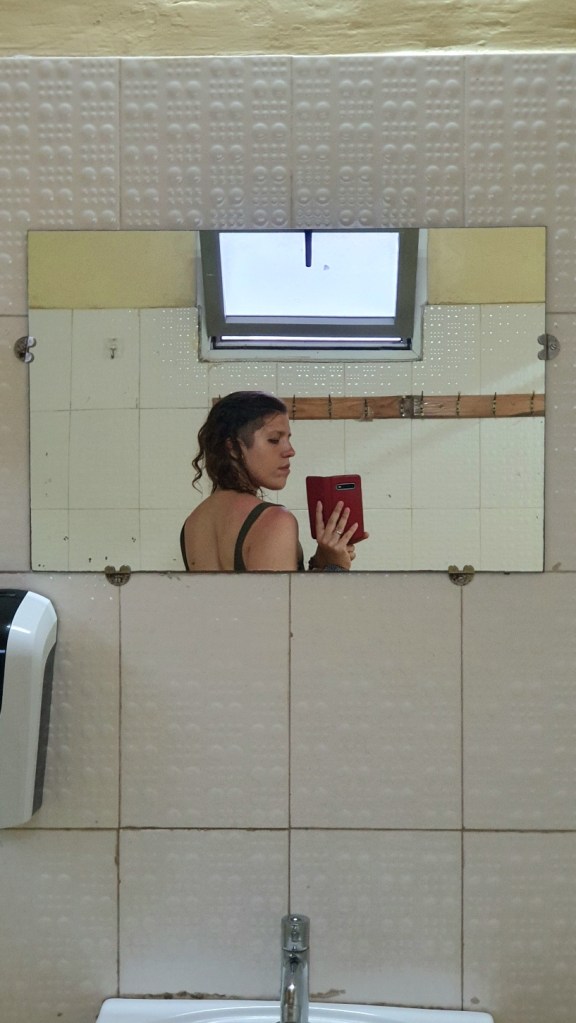
“Are you in Mauritania?” my Senegalese friends text me after seeing my Instagram posts.
“No, this is from before we met,” I reply.
I have been in Senegal for five months already. I have gotten used to being white here by now. Everyone seems to have some sort of reaction to my lack of melanin, almost every time. I wish I was less affected by it than I am.
“Where did you learn Wolof?” one of the passing women asks me. The two have stopped and turned around. My friend translates her words. We have just greeted them on our walk, me taking extra care to keep my face relaxed and friendly as they were staring, this woman in particular almost glaring into me, head tilted down.
From your husband, I want to say.
I want to say it so badly. Fuck her glaring.
Then I would laugh, cackle. Maybe run.
How would she react, even?
“Oh, just from here,” I say lightly, smiling, shrugging my shoulders.
I am a layered liar.
After five months I feel like I sort of-kind of-guess-I-know how things work around here. The frames of reference have settled in place, circles have been drawn around what words and actions are acceptable to the people. What they like to hear, what will make them laugh. What will confuse them, what will make them drop a topic. The stars from my eyes are mostly washed away.
Countless times I have been offered:
food, water, a place to sleep, company, help to find things and to find things out, to arrange or have anything my heart desires.
You will never be hungry they say, and they pull me in by the arm and put a spoon in my hand and sit me down around the big round plate on the ground and we all dig in, saying “bismillah”, the pace of the whole group the same, small talk exchanged across the one plate. I notice that I am always the only one complimenting the food; maybe the others are used to it always being delicious. There is mafé, yassa, thiepp, thiebu djenn. The sauce is on top and spoons press it into the rice, mix, then scoop towards the edge of the plate, shape it against it so as not to lose any grains, then journey the spoonful to the mouth. No hurry. Small half circles appear in the rice in front of each person, slowly growing toward the middle of the plate.
I have been taken care of; thoroughly, unquestioningly. It’s called “Teranga”. That means “hospitality”. And people do all sorts of things in the name of Teranga.
And countless times they (to be fair it is the men, mostly) start up with their lectures:
“…so “jërëjëff”. Do you know jërëjëff? It means “thank you”. Do you know mafé? Teranga Senegal, do you know Teranga? “Alhamdullillah”, it is Wolof. Do you know café Touba? Nanga deff,” here they pause and look at me expectantly to repeat it,
“nanga deff, it means “how are you.””
And there is usually an edge there, something forceful in the way they place me, put me in place, deny the conversation from taking any other turn (or maybe I am just so tired of the repetition of it,) than from establishing how Wolof is the best language and “il faut que t’apprends Wolof,” and how Senegal is the best country and how they just assume I am from France, despite my heavy accent and struggle for words because they haven’t let me say a word this whole time, and sometimes it takes all my might to not fill my lungs and empty them into
“I HAVE BEEN HERE FOR FIVE MONTHS
OF COURSE I’VE HAD MAFÉ
OF COURSE I KNOW JËRËJËFF,
ALHAMDULLILLAH IS ARABIC, NOT WOLOF,
YES,
YES I KNOW
IT MEANS “THANK GOD”, THEY SAY THE SAME THING IN MOROCCO AND MAURITANIA AND EVERY OTHER MUSLIM COUNTRY,
YES,
CAFÉ TOUBA,
YES,
I KNOW IT,
PLEASE,
ASK ME SOMETHING ELSE, TELL ME ANOTHER THING, I BEG YOU,
PLEASE,
SIR, WHY
CAN WE NOT HAVE A CONVERSATION?
PLEASE.”
“They should learn to mind their own business,” a Gambian taxi driver tells me after I have asked him how he finds the Senegalese. I laugh and agree and we rant about them, it’s true! I say. Sometimes the well-meaning spills over into some compulsion of sticking their nose everywhere, and
I could just about vomit the next time I hear the phrase “Il faut que tu…”
But I am a liar.
I find a way to hold on to the moment and remember that even though it is not the first time I meet someone Senegalese, it might be the first time for them to meet a foreigner.
Sometimes I play along;
“Oh, really?” I ask with my distracting eyes big at them, as if I didn’t know. I’ve noticed that when I tell something about myself, most of them space out and forget immediately. Most of them don’t want to meet me; they want to fulfill an expectation placed on their country, on Senegal: the country of Teranga.
It is not a bad thing.
It is not personal.
“They have a certain pride, a patriotism about them,” a Cameroonian friend tells me when I ask him the same question about how he finds the Senegalese. It can be annoying at times, yes, he admits. But
“I think it’s good. I find this patriotism lacking in African countries in general,” he concludes.
And so I have to forgive them, for how forecefully opinionated I can find them sometimes.
And I truly, fully do.
When I do need help, they just about save my life; once a bus stops for me when I am leading my bike, the tire flat, along a national road after dark. The young boys jump out and ask me where I am going. Soon three pairs of hands, aided by phone flashlights, make sure my luggage, my bike and my self are secured inside and on top of the bus, me sitting with calm quiet women in the dim light who speak barely a word of French and never reach out to touch me, yet with their gazes alone as if caressing my cheek and saying “you will reach your destination safely. We will make sure of that.” There is no question about it. Later when I ask how much I should pay, the boys wave their hands and shake their heads, look at me matter-of-factly while knocking on the side of the bus in a signal to the driver that they are ready to leave, and the bus speeds away into the darkness.
And with the same heartfelt smiles, in broad daylight, they are trying to scam the socks off of me.
The deal is: “the toubab* can pay.” One moment someone takes offence when I try to negotiate down a fixed price and the exact next second the next person offers me not the double, not the triple but five times the price of whatever and I am none the wiser.
I negotiate down the price of a small, tired head of cabbage to its normal 400 CFA at the market from the mami offering it for 1000.
I call the man driving the shared taxi a racist and refuse to get in after him having offered me the ride for 1500 CFA, when I know that the fixed price is 350. I know, because I have traveled the same route several times already.
I know the price of cabbage because I have bought cabbage almost every week.
They just smile.
They treat me so strange sometimes for being white; aggressively they try to grab my attention, men stepping into my way, not letting me pass as I walk on the street; they shout after me, stare or take pleasure in blatantly ignoring me when I approach to ask for something; they try to scam me or make it their business to spend a good chunk of time to interrogate me and then tell me what to do. It is never neutral; I am never neutral. In smaller towns and villages almost everyone who sees me will yell at me. In Dakar, though I may remain more anonymous in the stream of people, the more aggressive approaches of grabbing and following me are more frequent. It tires me to the point that I avoid going out some days. I push my errands into the late afternoons, moping around at home and distracting myself under the pretense of preparing mentally.
But then I do it; I get dressed and kick my feet into my flip-flops and breathe my back straight and use the out-breath to hurl myself down the stairs and the door shuts behind me and the street wakes me and in a second I feel like I am newly in love: the turbulent energy slowly wrapping around and squeezing my heart.
I watch them play with each other; friends greeting and joking as they pass by, wide white smiles flashing, palms meeting, hands touching shoulders, backs with easy camaraderie, easy love. The man passing looking me in the eye, his fingers counting the beads on his rosary. The motos folding attentively and carefully around the cars in the thick traffic, everybody keeping a watchful eye, stretching their awareness. How the boys working the buses cling on to the open back doors, bickering, playing, sometimes lowering themselves just for the kick of it, almost touching the sole of one plastic flip-flop to the fast-passing asphalt. How the mamis manage their small stands with their many covered dishes, turning over small fataya or benje frying in the oil or filling white long baguettes with beans or eggs for the queuing, hungry crowd, fingers slipping on the small coins from their pockets. People dropping off while taking big, satisfied bites from the newspaper-wrapped sandwiches.
And I see all this and usually it does not even take two minutes for the pain to reach my heart and weaken my knees and my lungs to become absolutely saturated with love; how I love this, how I am in love with this! This life-stream is absolutely catching me and dragging me under as the horns and shouts sound all around and I watch my step for potholes and piles of sand and dodge for a horse-drawn carriage, my attention stretching into everyone else, too; my body folding, too.
…
There are countless secrets under the relaxed, smiling surface in this conservative, Muslim country: hundreds of things people don’t say out loud, don’t even think out loud for themselves.
Because in fact, they are all liars, too.
Gender roles, age hierarchies and the family’s expectations form rigid frames and strict boundaries. Still most people find excuses to slip between the lines; the women lifting off their scarves, showing their bold cleavages, smiling wide when entering the clubs; the married men flirting openly with me, asking about my marital status before even knowing my name. It’s not so serious. They all smile, they laugh, they play and they invite me to play with them.
And so I do. I jump into the stream and play and lie and dance, pick up attention and drop it the second it suits me without looking back. I become jolly and capricious. Nyckfull.
People place me into their frames of reference and their expectations just to watch me twist and slip out of them like a wet fish. I play using the same tools: smiling, agreement, vagueness, avoidance. Distancing my self emotionally, swearing loyalty only to the moment and the moment alone.
“Are you married?” is the hundreth random man’s question to me after barely saying hello.
“Yes,” I reply.
“Oh? With a Senegalese?”
“No, he is from Mali,” I correct, smiling. “We’re both here for work. And you? Does your family live here in Dakar?”
And this is how I may finally get that conversation.
The only person I owe honesty is my self. All the other questions may be answered by any lies I desire because sometimes, my truths sound like even wilder lies when I tell them here:
I don’t want to get married, nor have children.
I am traveling alone. I hitchhiked and took the bus to get here all the way from northern Europe and I am hoping to continue like this all the way to Mozambique.
I don’t know when my journey will end or what road I will take. I don’t have a plan for it; I leave it to fate, to god.
I am happy living my life like this.
They rarely believe any of that. But it’s all right. As long as they are kind. As long as I manage to keep my head enough to remain gentle, too.
I am, after all, a friendly liar.
—
*”Toubab” is what they call a white person in Senegal and the Gambia. The North Africans (like Moroccans, Algerians, Tunisians, etc.) are called “Naar”.
…
(This story told in pictures.)
 Hulkuv loom