The first time I arrive in The Village I have just crossed the border to Senegal. I have taken off the malefha and hauled my bag between a modern and air-conditioned train, then several buses and shared taxis. The heat is incredible. The difference to Mauritania is immediate and I feel right at home finding the right bus by yelling and waving and mispronouncing the name of my destination while climbing up the ladder, trusting my bag to be attached on the roof and finding a seat among the more or less broken ones and the people already seated. It reminds of Mozambique. My shoulders relax.
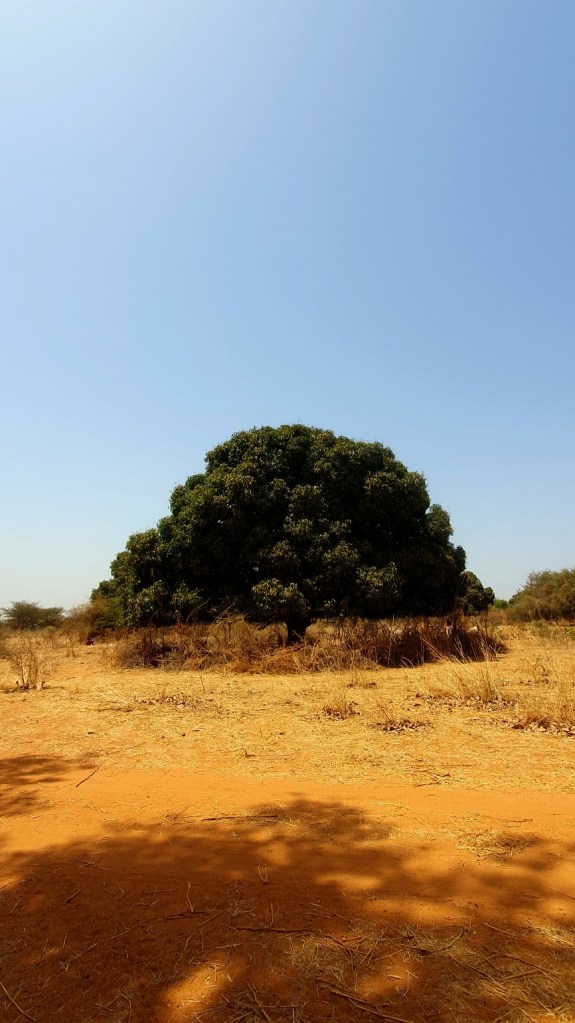
The Village at this time is sweltering, yellow and dry. The mango trees, bravely towering above, give the only green. The rest is crackling under my feet. Skinny horses graze in the bushes. All the dogs are panting.
The Village is a bit off from the main road where the bus drops me. A few minutes walk down a sand road, then the houses begin: simple concrete block buildings with fenced in gardens – usually with fences of sheet metal or concrete – and open gates, laundry hanging to dry, chickens and donkeys wandering as they please. The people look as I am white and we greet each other. A few minutes of walking and the houses give way to the fields and woods behind it; The Village is not wide but long, stretching for some kilometers along the main road.
There are a few small shops, a barber’s and a welder’s, a school and several small mosques, the smallest barely bigger than a bedroom: a small, concrete cube with a speaker attached. The roads are all sand and they weave well behind The Village and through the fields. Following them, a bit off, the richer folks have bought land and built their houses. There are many black-white couples living here, in these big houses with varying architecture and big gardens. The villagers pass by there to work; as gardeners, constructors, cleaners and house keepers. All of these families are well known to the villagers. Everyone is related to someone who was there to make the bricks, lay the groundwork, do the plumbing, make the gates or in any other way build the rich people’s houses.
I live in a guest house of one of these houses. It is a round building, white on the outside and on the inside. One single, spacious room and an adjacent bathroom with no door, a double bed and a desk build into the wall. White tile floors on which I constantly leave reddish-brown footprints. The main house next to me is also round but bigger, with a high, thatched roof, outdoors kitchen and sheltered patio. The garden is big. It has a well, plenty of mango trees, a few cashew trees, a baobab tree, a young tamarin and grape tree. A bunch of small plants I don’t know and a big rack to dry mangoes. Small squirrel-like animals frequent to look for food, lizards scramble up and down the walls and pillars, stopping still to look at me. Birds chatter from the trees, the small ones with the bright yellow plumage coming to pick off the bright yellow flowers growing by the kitchen. Sometimes monkeys come, but they are shy and run away as soon as they hear someone moving.
The Village is bordering a big lagoon and mangroves. It begins quite near to the house and to get to the small tourist town we have to drive through it. The sand is white and reddish brown and blows in through the open car windows. The wet mud in the distance is a dark gray streak under the green line of the mangroves. The tracks and roads on the lagoon criss-cross. I never learn to find my way on my own. Big white herons are pacing patiently in the low water and small black crabs explode in every direction when the car gets near. I am told that sometimes during the rainy season this road becomes impassable. In the evenings the lagoon is pitch black and only a small round lit up area is visible in the car’s headlights. I never understand how my hostess manages to get us home, despite also getting confused and following a new track every time.
My hostess is a skinny French woman with the determined energy of a train heading forward at full speed. I have come here through WWOOF to work on her small farm. I struggle. I carry cans of water in the heat, pour them over the young papaya trees, the one avocado, the passion fruit. I re-fill the bird baths, bend down and climb through the protective net to cut salads, laying small leaves in the same direction in the plastic container. Weighing, dividing 200 grams. With every small movement, sweat is pouring. My own weight on my feet feels like too much. With a cigarette hanging from her mouth my hostess divides the produce into paper bags, then marches to load the big baskets into the car. She reaches just about to my shoulder, yet I almost have to run to keep up with her. But her fingers are tender and careful when she pokes small seeds into the ground, the grains of sand sticking to her fingertips. We drive to town where she sells her salads to the finer restaurants targeting European tourists. We drive to the side of a magic well where cows ruminate under the mango trees and load up two big sacks of dry manure. In the evenings we listen to the crickets and she smokes and tells me about her life; her travels, making documentaries in Algeria, learning to farm in France. Now she is in her fifties, settling here in Senegal. Her sister was the first foreigner to buy land in this village and her house is just on the other side of the sand road. They are both married to Senegalese men who follow the sufism of Baye Fall. My hostess is one of the few on this side of The Village not involved the movement. I express my curiosity about the Baye Fall, having met a few already in Morocco.
“You will meet them,” she says. She doesn’t say anything else, and I gather it her way of leaving me to form my own opinion.
We sit silent for a while, each one thinking their thoughts, smoke rising from the cigarette and crickets singing.
…
The Baye Fall are sufis, following a branch of Islam founded by Cheikh Ahmadou Bamba and Ibrahima Fall. They often let their hair grow into long dreads, wear colorful clothing and big rosaries. So even the Baye Fall of this village; they pass often by the house and in the course of a few days, I have met most of them.
Most Baye Fall don’t follow the five daily prayers of Islam, instead seeing work and charity as a means of prayer, as well as reciting their name for Allah to enter a meditative state and seek deeper understanding. During the month of Ramadan they don’t fast, but prepare bean sandwiches and Café Touba to be handed out to the people breaking their fast. They deliver the food to the mosques and distribute to anyone who arrives. I go with them once. The children stare at me with big eyes and come forward to receive a sandwich and a small cup of coffee. I am corrected and told to use my right hand as I hand out the sandwiches.
One night we are invited to Dayra, the Baye Fall evening of prayer held once a week. The men join together in a small circle with a hand on the person in front, the other held to the ear. They chant, voice rising from their chests, open and repeating; raw and rhythmic. I watch them rise into trance. The women, their partners (the Yaye Fall), are sitting on the sides looking, some swaying along in the rhythm but staying quiet. I wonder why they are not singing; the Baye Fall have told me that their teachings see women and men as equal, in fact see everyone as equal. Yet here the women sit by the side as audience or tend to the food cooking on the fire. Shouldn’t the prayer be for everyone? I watch the men and feel my self growing restless. I wonder how long they will go on singing.
No one takes notice of me as I slip from the garden and into the moonlight outside. I want to sing, too. A bit off at the crossroads, I find my own chant. I aim the words toward the moon and fall back into my own voice in my own chest, free from quietly watching, free from politely paying attention to someone else’s worship, free from my own weariness of seeing the pattern of women waiting on the side… In that moment I am free and undisturbed, just one of the other trees reaching as a black shadow straight up. Free and reminded of by own voice of my strength to follow my wishes.
I hear barking and the patter of feet in the sand. They are fast. My voice cuts off and I fumble to find my phone and light the torch. Maybe if they are blinded they won’t bite. They are two, their silhouettes growing quickly. I shout “hey!”, bracing, but they are already slowing down and stop before they reach me, smelling me through the air. I’ve met them before, the pair; they belong to the neighbor. They come closer as I shine the torch at them. They have stopped barking and seem calm now, smell the ground around me, making smaller and bigger circles. Briefly, they smell me too. Then they lay to rest, one just beneath my feet, the other a bit off to the side. Carefully I resume my chant and their ears peak, but they don’t budge. I relax too and turn off the torch. They have come to look after me. I am reminded of the Tarot card “The Moon”, the two dogs and their towers, drinking droplets under the full moon. When I hear the chanting subside from the house I head back, the pair trotting by my side.
…
From this night the dogs become my best friends, coming out and following me to the garden whenever they hear me pass. They are called Pulo and Pastek. Our friendship is simple: we run together on the sand roads, them taking detours into the bushes to chase something that peaks their interest but always returning or reuniting with me at the garden, napping in the shadow while I haul water. Pulo is the leader with the cut tail and Pastek follows him, but she is softer with me, checking in on whether I am following. They are easier than the humans with their chain smoking, overbearing piety or exaggerated curiosity at my whiteness. They don’t say anything to please or impress me; if they want to come, they come.
Both my stay and peace of mind are cut shorter than I’d hoped for one morning when my hostess shows up with a swollen ear and black eye, upset but not unabashed to tell me about her relationship with her husband not being in a great place at the moment. I had known there were fights, just not that they were physical.
“But I hit him, too,” she tells me. It doesn’t comfort me.
Her steps are even faster and more tense and in the storehouse of the garden her tears finally flow and drop over her suddenly clumsy fingers, rendering her soft and small and human.
I hold her.
I think: where is the boundary of how much I can live with?
I consider the other friends I’ve made in The Village, the relationships and understandings just beginning and unfolding. I consider how much I like the garden work, despite how hard it is. How much peace the bird song and breeze bring me. The dogs. It is not an easy boundary to set.
In the end I pack my stuff anyway and head for Dakar, blaming something else for my sudden move. We promise to stay in touch and with my full heart I wish things to get better for her.
…
(This story told in pictures and video part one, two and three.)
 Hulkuv loom