I feel right at home in Dakar. It is a big city and I am used to big cities. The houses are tall with stories reaching up, unlike the ones in the cities of Mauritania and southern Morocco. I wake up to the noise from the streets and it invites me to mingle and play, unnoticed and anonymous, white in a black country but perhaps, hopefully, not worth paying too much attention to, protected by the crowd.
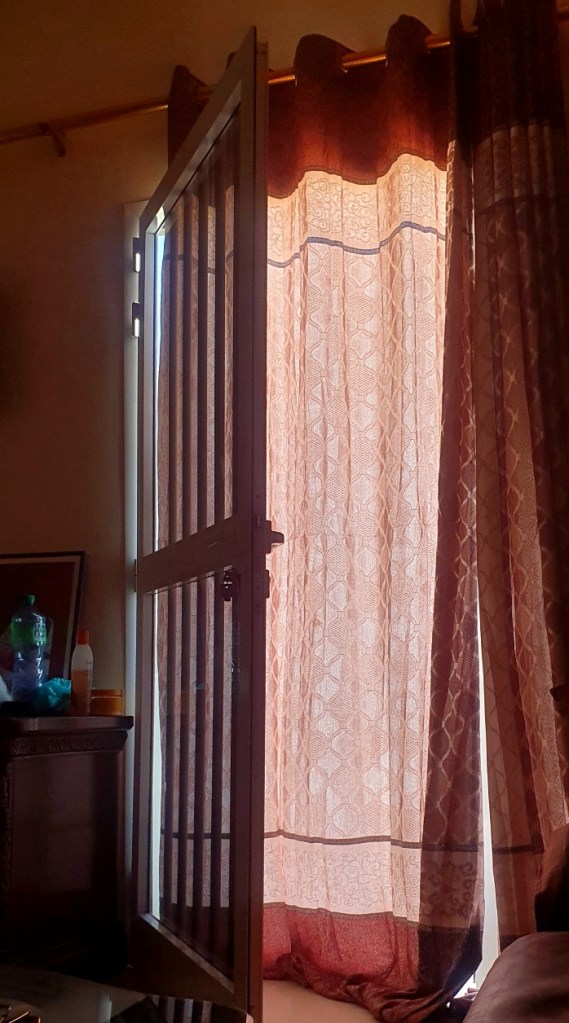
I rent a room in a three-room apartment, sharing it with two others. My room has a mattress on the floor, a big brown couch which makes my arms itchy and a glass table with loose legs that is always swaying and tilting and in the way. A shelf with stray items in the corner and a chest of drawers on which I pile my belongings. My backpack sags empty in the corner next to some other big suitcases. Heavy brown curtains darken the room. A half-broken door leads to the balcony. When I open it the sound from the street below brings the day in. From the balcony I can see straight down onto the rooftop of a Koranic school. Children in green uniforms and different ages play around there during recess periods and when they spot me they wave and sometimes we play together. During the day the sound of saws and nail guns echo from the furniture workshop below the school. Some evenings a group gathers on the rooftop of a neighboring building, singing songs and drumming. Below them a street restaurant kicks into action for the night, smoke and the smell of grilled meat rising, people joking and laughing and picking up meals. Taxis and cars are lined up and edge along slowly. The local mosque on the other side has just finished the call to prayer and people are pouring out. I watch them mingle and greet, sharing hands and smiles and shouted greetings. I feel like part of all this.
My roommate is an Algerian girl doing her internship. She welcomes me with open arms. She likes nice perfumes, going to restaurants in the finer parts of town and having a good salary. She tends to her skin and hair with a million products I don’t understand the function of. I stroll alone or take the run down buses and eat on the streets while chatting to strangers; I patch the patches on my clothes and wash my hair with soap. Still she asks my opinion on her outfits and invites me to video chat with her family and tells me her worries and dreams. I cook beans and lentils for us and am beyond happy when she takes seconds and compliments my cooking. Some evenings we binge watch something, anything, laying lazy in bed. We laugh about the Senegalese boys trying to flirt with us and compare the price on vegetables in different markets. She tells me she’s been waxing her body hair since the age of twelve and she waxes my legs while laughing at my cries. I teach her to torrent movies and curse off her bosses and whoever mistreats her when she returns home weary after long days of work. We become sisters.
The apartment has cool tiled floors, cold water in the shower (which, in the heat, is really nice) and plenty of visitors. We have a kitchen with a gas stove where one of the burners works and one leaks as soon as the valve is opened. We solve the waste by always heating a pot of tea. Trails of small worker ants make various ways every day and we let them be (“It shows that the host is a generous person!” my sister says.) We have a fridge and a microwave and after we have bought a frying pan I waste no time establishing a pancake-routine. Feeling free in a kitchen is a dearly missed luxury when I am on the road. Our landlord never uses the kitchen but brings plenty of food for us to share: fast food from local restaurants and big, beautiful dishes from his mother’s house which we share all together sitting on the floor of the salon. “Viens manger!” is a phrase I learn fast.
The landlord is a Senegalese man always speaking loudly on his cellphone about some business or another. He almost never smiles and I am scared of him at first, until I learn that his kindness may show up as blunt and frowning but it is kindness none the less. He brings us plenty of vegetables and meat to cook, but prefers to eat his mother’s dishes. Problems get fixed swiftly and undramatically. Once I accidentally puncture the freezer while trying to defrost it with a knife, causing an unknown gas to leak out with a loud hiss and my sister to escape the kitchen and peek at me and my panic from the hallway. Our landlord barely throws a glance from his phone screen. I sweat in anxiety and regret, his silence wrecking my nerves more than anything else. The next day he calls from work to inform us that a repairman is coming and the freezer is fixed in less than an hour, without our landlord even returning from the office.
When our landlord announces that he is receiving a visitor “for one, maybe two weeks”, me and my sister move into the same room, hers, the one without windows. I pile my clothes in a corner and our messes mix on the nightstands. We share the bed and are somehow saved by the fan. The visitor is an older uncle who speaks no French and does not understand the microwave or the kettle or the stove. But he speaks Arab and so my sister can communicate with him. We serve him tea, coffee and food and he floats through the apartment in his long blue boubou, making jokes with his eyes and his hands which we can not understand. He ends up staying for the whole month of May and a bit into June.
…
I take French lessons and dance classes. In Dakar the cost of living is high but I can allow myself that for one, two, three months. The city is my playground and I roam its streets: the big streets, the highways and the pocket-streets enclosed in market stands or apartment buildings. Everywhere people are selling snacks and it is so easy to let a small handful of salty peanuts or a little bag of fresh mango with salt and chili or a piece of coconut or a few fried fataya (savory dumplings) or benje (sweet fried round donuts) slip from my hand into my mouth as I flip-flop along and listen to an audiobook, dodging cars, motos, horses and potholes, dodging those of the men trying to grab my attention, sweeping over the hanging power lines and facades and faces with my gaze, the air pollution sticking to my sweat.
Through a note on the street I find the number to my French teacher and for two months he makes house visits three times a week to struggle me through past and future and conditional conjugations, plurals and definite and infinite forms and hidden letters of French. He brings papers for me and I read like a child reads while he corrects my pronunciation every other word. I grit my teeth. It doesn’t feel like progress. In fact I feel the worst after every class as I close the door, thanking for his patience with a crushed spirit, my brain melting away in conviction that I will never remember anything ever. But it is progress. I get many opportunities to practice with the chatty Senegalese, the best moments being whenever I need to take a taxi; there, alone with the driver and with nothing else to do, I ask about people’s origins, relationships, whether they have children or siblings, how they feel about Dakar, what they think about Senegal. They leave space for me and my mistakes, turning gentler as I fumble with the words. Maybe because they see I am not French. It doesn’t matter why, really. I wonder if they know how they are letting me grow, what a gift they’re giving.
…
I arrive in the middle of Ramadan and the dancing resumes as Ramadan is finished. I find classes to take during the days and save my evenings for the soirees of kizomba, salsa and batchata. I learn which bus I need to take to Mermoz. Later I learn the ways to walk, slowly stitching together the parts of the city. From a class of modern Afro I might walk a few blocks, buy an apple or banana as the sun sets and sit on the stairs, listening to any voice notes and waiting for my next class, kizomba or batchata. Every day something like this. Late at night I hail one of the small buses, every time asking if they go to Liberté 6, every time surprising the boys working with the color of my skin and my choice of transport. Only one or two times do they try to scam me; the rest of the times I pay the same as anyone. Every time getting home safe, squeezed in with others returning from work or night school, scrolling on phones or looking out the window.
The social dancing is abundant: every Wednesday is Surfer’s Paradise, Fridays is New Africa and after that Hibiscus, and on Sundays there’s Mer à Table and Maison B until 03 or 04 in the morning. After months of covering and sitting around in conservative countries, I find my cardio and coordination again. I learn that I have not forgotten how to fall into connection. I relax into my partner’s breathing, connecting my hand to my back, finding the frame. The dance community is small but the level is high and mostly focused on kizomba, which I prefer. As with every small dance community, so is this one full of intrigue and histories. I manage to dodge most of it, though of course there are some leaders who hesitate to talk to me or invite me to dance if they get the impression that I’ve been “claimed” by someone. It is a bit childish, but I focus on the dancing instead of the social parts. I find people generally friendly and considerate with my beginner-level, not tensing up by my mistakes. At the same time most leaders are soft, relaxed, casually sensual and attentive. I find the ones speaking my language in movement, some nights spending up to hours with the same partner, exploring nuances of breathing and tension. Playing. Every night is like a life on its own. I stay until the lights come on and the DJ announces the end by repeating a recorded phrase over and over while people reluctantly un-glue themselves from their partners.
“C’est tout, pour le moment. C’est tout, pour le moment.”
And I am left to say good-bye and find a way home with the sun due to rise in barely an hour, chatting with the guys working the night taxis, un-locking the gate quiet-quiet in my sleeping neighborhood where only cats and dogs stoll around and guards lean over their smartphones in the plastic shairs, taking the steps up the echoing stairwell, legs aching, sneaking into the dark apartment and in between the sheets, still smelling of other people’s perfume just as the prayer call hits the sky outside and I smile, revelling in the last moments of the spell before sleep comes to wash it all away.
…
(This story told in pictures and video part one, two, three, four and five.)
 Hulkuv loom