It is the middle of May. Dakar is sweltering, dusty and dry. It has been my home for about two months now; I know the streets, the neighborhoods and the buses that take me where I want to go. I know the taxi fares; nobody can rip me off anymore. I walk an hour and a half to my dance classes every day, listening to audio books, and I take the bus back as the sun sets. Some evenings I jog around my neighbourhood. At night when the buses don’t run I take a taxi to go to dance socials in the fancy parts of town.
A month from now is Tabaski: a big Muslim holiday. The people are gearing up for it; everybody is making plans to travel to their families, the streets are full of sheep and the tailors are working late into the night to finish the fine new dresses and boubous for the occasion. My roommate is making plans to spend the holidays with her family in Algeria and our landlord has invited me to join him and his family in Touba. I say yes, but I have a dilemma: my permission to stay in the country is due to expire right around the same time as the festivities.
Senegal doesn’t ask me for a visa, but they only allow me to stay for ninety days at a time. The thing to do is to go to a border, get a stamp exiting the country and stamp into the bordering country, then make a U-turn and get a new stamp entering Senegal, thus re-starting the ninety days.
I try to negotiate with different immigration instances in Dakar if they could not, please, extend my permit without me having to bring my ass all the way to a border and go through the stamping-hassle. A friend of mine even writes me a fake contract for an internship and my roommate helps me write an application letter to extend my stay. But none of the sirs and madams in any of the offices know anything. They shout to colleagues down the hall and point me into other offices where yet other sirs and madams shrug their shoulders; nobody knows how to extend a stay permit that is not a visa, they don’t know if and what else I could apply for and they can not stamp my passport because they are not the border. Shrug, shrug, shrug. I keep walking to my dance classes and my time keeps running out.
…
I had thought of buying a bicycle for quite some time, both to move myself around Dakar and as a means to continue my travel through Africa. Already when leaving Europe I had weighed between backpacking or bikepacking. At the time I had chosen backpacking. But why not re-choose?
I spent around three years working as a bike mechanic in Stockholm. I started out as an ambulating mechanic working on the streets and was later employed at a proper workshop, working for a 73-year-old boss who has been fixing bikes longer than I have been alive. Our shop was not a high-end workshop (though we would get the occasional Bianchi and Specialized), but we served and repaired everything. We had recurring customers who’d had their bikes served by my boss for twenty-plus years, sometimes with bicycles from the 60s, 50s and 40s. He would buy the inventories from workshops going out of business and in his many storage rooms he had stashes of parts no longer in production. He could open up and re-assemble most models of hubs with his eyes closed, making him one of the few to actually maintain and keep old bicycles functioning. Thanks to him I’ve seen how a properly taut spring, a correctly tightened bearing and a well-greased hub can keep a bike rolling for years and years. From him I learned to repair and maintain most models of bikes, but I always loved the old ones a little more. Though the parts may be out of production they are often better, made to be maintained and not replaced. If I had any speciality, the old bikes was it. (Sure, you could call them “retro” or “vintage” bikes. But in the cases the rust was eating up the frame and all the shifts and handles were of various models, they weren’t necessarily pretty.)
And this was the kind of bikes I kept seeing in Africa: old models from various eras, inherited from Europe, America or Asia. Second hand, third hand. Mixed parts dissected, welded together and modified, repaired and jerry-rigged to the best of one’s abilities to keep them rolling just a little longer. And roll they would!
I believe in second hand as the only reasonable way to buy hardware. Thoughts about consumerism, capitalism and climate crisis weigh on my mind; I don’t want to use materials freshly mined from the Earth, leaving big holes that will not be healed for generations. Especially when there’s good stuff already lying around.
I wanted a bike that would grant me more liberty in Dakar: to avoid waiting for the bus and get quickly through the traffic jams. Something that would be a good city bike and maybe, eventually, could become a reliable touring bike. (I was tired of carrying the backpack, OK?)
Something that could take being kicked around in Africa.
I knew what I wanted;
Steel frame. I always prefer that; it is classic and basic, heavier but also stronger, as steel is springy in a way that aluminum isn’t. It withstands more stress and in the case the frame cracks it can be welded on the spot by local welders.
Rim brakes. While not as good as disc brakes, rim brakes are good enough, way cheaper and easier to repair. They are more common, which means the brake pads are easier to find and different pads can be modified to work on different brake models unlike disc brakes, which sometimes require very specific models of brake pads (to hell with that, by the way!) and are costly to repair even in a well-stocked workshop; I don’t want to imagine the hassle of searching and ordering the correct disc if one would need to be replaced in an African country without its own high-end bike shop. A hydraulic brake is out of question; what if the cable would break while I am out in the middle of nowhere? This would leave me with zero brake capacity on the particular brake and a costly repair! As long as I carry a spare wire and a size 10 key, the same problem can be fixed in less than ten minutes with a wire-brake.
(I like roller brakes and internal hub brakes too, for their function and durability, but they seem to be more rare here and so spare parts would probably be lacking.)
(As for the model of rim brake I prefer U-brakes, V-brakes are fine but I find Cantilever brakes the most annoying to adjust. Though if the rest of the bike is fine, the brake model is not a deal-braker for me.)
Few gears. No more than seven, I imagined. (I even considered single-speed; after all I would not bike for speed, but for the freedom. But I’d probably regret that, so no.) A good hub gear would be nice, like the Nexus 7. It is heavy but reliable and gives enough exchange to offer some versatility. Spare parts would probably be hard to find if it would break down, but on the other hand it’s not too prone to break down if it is well kept.
But if I couldn’t find a Nexus 7, external gears would be fine, too. Still no more than seven; more gears means thinner cassette and thinner chain, which means quicker wear and more advanced, hard-to-find and expensive replacement parts. In other words: more hassle!
Oh and I didn’t want a mountain bike, though they are probably a good choice for Africa. I just find them clumsy. Like they don’t have the right roll. I wanted something basic, easy and elegant.
…
Searching for stuff in Africa is always an adventure. It takes some time. Or sometimes it doesn’t; it’s luck more than anything. Stuff is rarely Google:able. It demands walking, asking, pushing and digging.
What could a bike cost in Dakar?
Once I stopped by a highway, next to a row of bicycles leaning sadly on one another: all dusty, cables hanging, wheels flat. I listened as the man tried to convince me that 110 000 CFA was a good price. One of those sad things even had a Nexus 7 hub. Sure, I could fix the flats and cut-off brake cables, oil it and make it run. But 110 000 CFA was more than my rent, and I was hoping for less than half of that.
I walked through markets and asked around, took photos of phone numbers and followed hands pointing in general directions, into side-streets where somebody might be selling bikes or had sold them at some point or maybe had a cousin he could call to ask. I wiggled wheels with horribly loose bearings, found good looking bikes way too small for me, good frames that lacked wheels, and so on.
On one of my detours I turned into a hardware shop and asked for the price of the bike leaning against the tree outside: 85 000 CFA. The seller barely looked up from his phone. The bike looked proper: the kind of high frame I prefer, steel, straight and basic with a back carrier.
But too expensive.
But looking good.
And intriguing: stickers were decorating the frame, some that said “COME ON ENGLAND”; this thing had a history. I wanted something like this. Yet in the end I left it leaning against the tree, too discouraged by the price.
June came. My roommate had traveled home to Algeria to spend the holidays with her family. I had found no bicycle I liked and my time was running out. I considered putting more effort into my search. Or giving up. I couldn’t trust the prices the people were giving me. Did they all tweak it up a notch for the white person asking? How much was I expected to haggle?
Eventually I went back to that hardware store.
“I told you the price already,” the man said when I stepped into the shop. He had recognized me immediately.
“Yes, but can I have a closer look?” I thought it polite to ask before I went over and started wiggling the wheels and testing the brakes.
“Sure,” he said.
The head bearings were fine. Wheels straight, spokes strong. Brakes OK, the pads would have to be changed front and back. The frame was whole, bottom bracket bearings fine (a sigh of relief here; these can be the most difficult to replace.) Front wheel bearings… wobbly. A little. Back wheel bearings… very wobbly. My courage sank; this could mean that either they only needed tightening or that the bearings and axis themselves were worn down, a problem that could be costly and involve me chasing around for parts. I wouldn’t know until I opened to take a look. If the bike had rolled for many kilometers (as it probably had, judging by the stickers), chances were that the bearings were worn. And if I didn’t find the right bearings and cones, it might bring the axis, cassette, derailleur and gear shift all along in the fall, maybe forcing me to change the wheel entirely. (Sure, the chances were small, but I had seen and solved this problem enough times in the workshop to not be wanting to take the chances.)
I called over the seller and pointed out the wiggle, tried to explain the extent of the problem and would he not give me a better price? Say 60 000? No, the price was non-negotiable. I sighed. The frame was so handsome. But I wasn’t going to pay that for a faulty machine.
A small gray bike had been leaning against the tree this whole time. I had looked at it from the corner of my eye as I was going over the black one. I asked if I could give it a check.
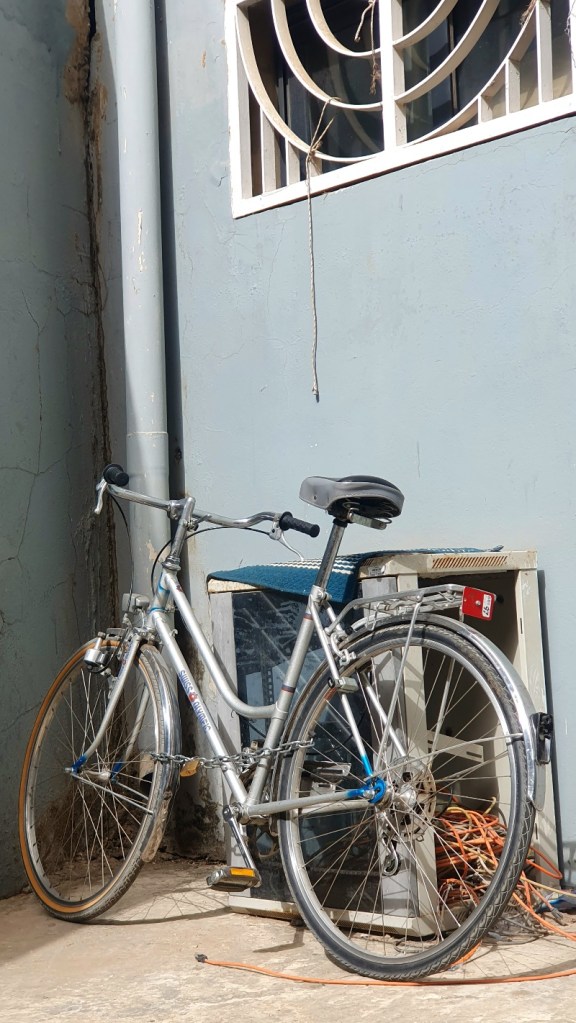
It was not exactly what I’d had in mind. The frame was low, whereas I had imagined a high one. But it was steel. And the thing was older than I was, another perk; if it has survived for 40 years already, it could probably take a few more laps around in Africa. Five external gears, a freewheel and a frame-mounted gear lever with no fixed positions: also good. Actually very good: the old freewheel would be more resilient to wear than a cassette and a gear lever without fixed positions meant I would set the gear manually, which would allow me to adjust to the chain getting worn over time. The more I went over and checked the bike, the more I liked it; the wheels were straight, all spokes tight and springy. No wiggle in the bearings. The bottom bracket was old, non-typical; that might be a problem if or when I eventually needed to change it. But so far there was no wiggle there, either. Even the dynamo worked. The head post was loose, but that was easy to fix. The tires were bad, dry and cracked with the tube sticking out through a hole in the front one and just waiting to explode, but that was an easy fix too.
“How much do you want for this one?” I asked.
“65 mille,” he replied.
I pointed out the problems, the tire and the head bar. He shrugged and didn’t budge the price.
“I want this all fixed before I buy it,” I said. I couldn’t test it properly like this. The saddle came up to my hip all right, but I would not know if the size was right, if the derailleur worked or if I actually liked cycling on it until I tried. The seller shrugged his shoulders again, brought me a wrench to tighten the head bar, then waved over another one of the guys to accompany me to look for a new tire.
The guy had thin dreadlocks coming down to his shoulders from underneath a red-yellow-green beanie and a sweet smile. He jumped onto a blue mountain bike, me on the gray one and we took off. It was late afternoon now, the light had turned deep-yellow and the traffic had picked up. People were returning from work. We passed queues of cars and dodged taxis, went to one place, asked around, then another; they didn’t have my tire size anywhere. I watched the different mechanics wave and point my guide in different directions and I was glad to have someone navigating the city and the language for me. (This is exactly what it is like to look for things in Africa.)
Finally we turned into a small, slanting side street. Full minibuses bumped heavily over potholes, the sides were lined with stacks of tires, mechanic workshops and stranded vehicles with various parts missing. Pairs of legs in dirty trousers were sticking out from underneath the cars and backs were bent to operate deep under the open hoods. Grey-brown water flowed from somewhere. There, squeezed in right among the workshops was a small bike shop, completely crammed with bike-stuff. And they did have my tire size (and would later turn out to be the only ones to have my tire size out of all places I looked in Dakar and the Gambia. OK, so one big minus for the small gray bike was having wheels in what was no longer a standard size.)
The mechanic would not let me use his tools to change the tire and I did not want to pay for a job I could well do myself, so we just bought the one tire and cycled on. By this time I was already chatting pleasantly with my guide and had found out that he was from Guinea, here working as a musician. He invited me to sing and goof around in his studio some day. He brought me to his friend who let me use his tools to change the tire. Fifteen minutes later the small bike was flying. When we returned to the shop I had already decided: I paid the 65 000 CFA and brought her home.
…
Tabaski was only a week away. So was the end of my stay-permit. I wasn’t too excited for the festivities themselves, which require mass-slaughter of sheep, but I had been excited to pass the holidays with a Senegalese family and to visit what was considered the holy city in Senegal. But everybody in the offices kept shrugging their shoulders to my request of getting my passport stamped or my permit extended in any other way than personally going to the border.
“You have no visa, so there is nothing to extend,” they told me.
In the end I accepted that I would have to travel to the border if I wanted to stay in Senegal.
I was so afraid of having my new bike stolen during the first few weeks. She brought me to my dance classes and my lungs out of breath. I brought her up three flights of stairs and through the apartment to store her on the balcony, sweating and stumbling while yanking at the broken door with one hand, trying not to get dirt on the white tiles or the curtains. My knees came up to the handlebars when I cycled and I had to mind that when turning. I was waiting for all sorts of problems and breakdowns, but things seemed fine. Despite being small the wheels were rolling fast and she folded neatly between the tight crawling cars in the traffic jams.
She needed a name.
…
I decided that I would go the the Gambia for my border-errand. The Gambia doesn’t ask me for a visa either and its border is only about 250 km away from Dakar.
The Gambia is a small strip of a country inside the mass of Senegal; on the silhouette of Senegal where the peninsula of Dakar forms the nose of the lion, the negative shape of the Gambia forms the gaping mouth. It is following its namesake river from inland while a small side of it borders the ocean.
I might as well make it a proper adventure; I had my small gray bike now. I had a tent and Google maps and stuttering beginner’s French. I had five days to reach the border before I would become illegal in the country. Once there I could stroll for two weeks or so and look around. Why not? I would find out if my bike would manage a tour. All I needed was a smaller backpack and some rope to tie it down.
…
(This story told in pictures.)
 Hulkuv loom