Slowly on my tiny bike I roll out of the densely populated Dakar region.
I pause when the sun is at its hottest. I am in Rufisque. The light is blinding me, reflecting on the pale ocean, white-gray concrete and the white pages of my diary. I lie down on a dusty tile bench and make small talk, sweat and wait. Some boys drag a sheep out into the sea and start washing the confused animal in the waves. Women are washing heaps of clothing next to me. Their toddlers wobble over to look at me with big eyes and to poke at my bike before the mothers shoo them away. I don’t mind the poking, but I’m afraid something might shift and clamp their tiny fingers. From the women’s mouths I sometimes hear the word “toubab”. It is what they call white people. I wonder what they would be talking about if I wasn’t here.
I am invited to lunch with the Chef de Quartier and his family. We gather around the big dish and the cover is lifted to reveal the lush red rice topped with fish and veggies.
“This is Teranga Senegal,” the Chief tells me. “This is rice; this is thiebudjenn.” He looks at me expectantly. “This is African food.”
I say thank you. I am given a spoon. I’ve had thiebudjenn and I’ve heard exactly this so often during the months I’ve been here, but food is food and hospitality is hospitality so I’m not about to say anything. Some eat with a spoon, others with their hand. Small pieces of vegetables and fish are picked apart by nimble fingers and placed on my side of the bowl to make sure I get the good parts. They rarely look at me directly but always keep an eye on what I eat, urging me to have more as soon as I stop unless I ask for water to drink and wash my hand straight away. These kind, insistent souls.
…
Sun climbs up behind thick baobab trunks. I drag my bike through a field and when I reach the road my back tire is flat; a thorn almost as long as my thumb has found its way in and through the tire and tube. Oh Senegal.
I have patches but no glue. I wave to a passing truck, hoping I can ride on top of the load of sand in the back. But the driver lifts the bike into the cabin, not minding the sand from the wheels, ushers me into the passenger seat and takes me to the next junction where I lead my wounded warrior into town. I gesture for a place to buy a tube. I find one and give away my old tube to one of the many boys who has gathered in the flock around me to watch as I dismantle my bike.
“You know it’s broken, right?” I ask him. He has already draped the tube around his shoulder.
“Yes, but I will repair it,” he replies.
This is before I’ve learned about the boys working with mending tubes by the road and before I’ve learned to mend my own tubes the African way, with rubber glue and patches cut from old tubes.
…
I fly past Mbour, its big Decathlon and the fairy tale castle-like mosque and the busy main street. I turn toward Fatick and find my self on a national road dense with heavy trucks that squeeze me out to the edge as they pass without slowing. I have to brake and get off the road whenever I hear them approaching behind me, adrenaline spiking. But small villages and markets line the way and I enjoy looking at them; the rickety stands, the big stacks of mangoes for sale. The passages of dry and bushy landscapes are getting longer and longer in between. I am getting more attention now: people yelling “toubab” at me, looking and waving.
At noon I turn into an enclosed field riddled with trash. A small building offers some shade. I figure nobody will see me or bother me here while eat my snack and take a nap.
Suddenly a boy passes. A teenager. He stops, almost freezes when he sees me and greets me while his hands fumble. I say hello and hope he will go away. He asks me careful, curious questions and shows me his finger with a bruise that is healing all wrong. After a while he leaves, but returns soon with three friends. They hang out around me, all curious but unsure what to do or say to me. I hope they will not rob me. They seem peaceful, but I don’t dare to sleep anymore. Our combined French is not really enough to make small talk. I make an effort and find out they all play on the same football team. I ask for their positions. I can tell they are getting bored, but being bored around me is probably more interesting than being bored elsewhere. They ask to take photos and pose with their lanky arms. They spot a monkey and teach me the Wolof word for monkey. I offer them water.
After a while they drop off, all except the first boy. He sits with his back leaning against the building. Soon I notice him twitch and breathe deeply; he has fallen asleep, upright in the sun.
The hottest part of the day is about to pass and I can move on. I put on my shoes, pack and secure my stuff on the bike. Can I just leave? Should I wake him up and, I don’t know, say something? I touch the boy’s hand. He stirs and his eyes open wide. He blinks and looks up at me without recognizing me. I wave goodbye, then, as his spirit returns to him, I turn away and lead my bike back to the road.
…
The sky, the sand, the mud and the bushes all turn shades of deep dark pinks and purples this sunset. I get off the road and pitch my tent underneath a bush, hoping nobody will find me and be curious, friendly or hospitable to me. The heavy trucks boom along through the night, but nobody bothers me.
The morning is minty-green and drops of dew hang fresh from the spiderwebs and the vegetation. I don’t have any breakfast. I just want to get through this damn part of the road.
I speed into Fatick and in Fatick the road splits past the city center and market and I have enough momentum to carry me through the town. The next objective is Foundiougne (I know, it takes me weeks to learn to pronounce it: [Fu:ndiu:n]). I imagine getting something to eat along the road but the joke is on me because the road turning south is flat and empty and clear; no villages, markets or anything at all for the next 30 kilometers. There is open space and wind, salt depots and dry thorny bushes which barely provide any shelter from the sun still rising. Damn it, the heat. I’d forgotten about the heat.
Up until now, nowhere has been empty. I didn’t imagine the road could be empty. At least I have some water left. I wrap my scarf around my head and thank luck there is no headwind and I leg it.
…
In the distance I make out a structure. A white, horizontal line, white legs reaching down. Any structure should mean settlement (unless it is another abandoned salt processing plant like the one I saw a bit back.) Bushes obscure the view and next time it’s closer; it’s huge. It’s a bridge.
The man at the toll booths smiles and waves me through before I even stop. A moment later I have to laugh too; I have already cycled maybe 45 kilometers, stomach empty and sweat dripping, and now this: the climb up the bridge. It’s steep.
On this side are a few tin sheds and flooded pirogues next to a ferry station no longer in use. Two motos are parked by the bridge and a few heads turn my way as I pass. The river is wide. On the other side the town spreads out along the edge, small blurry squares with movement I can not see yet.
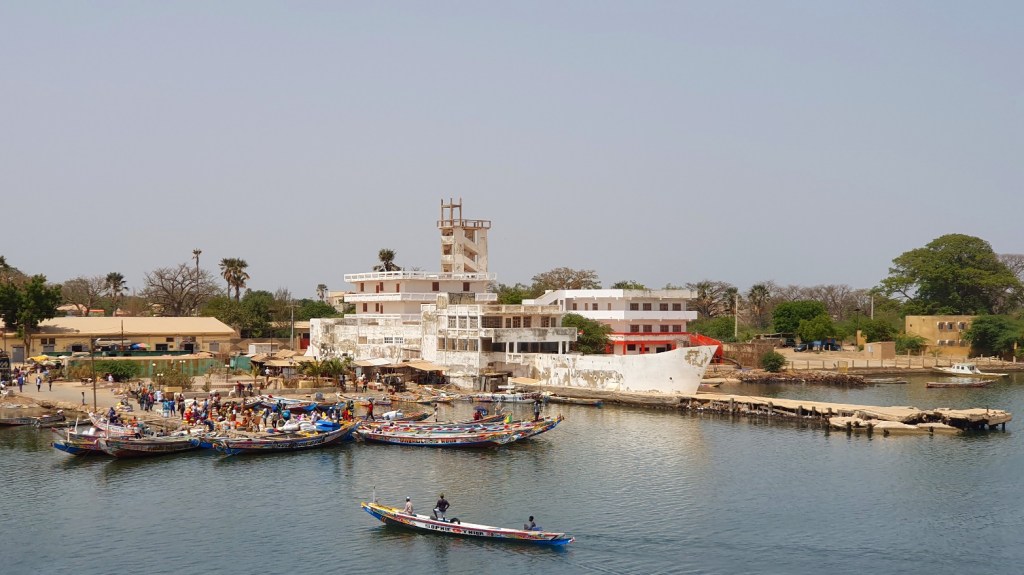
I pause at the top. The water is bright turquoise and big and far, far below me. Little ripples on its skin. Colorful pirogues are coming into the small port. People are moving in clusters, loading and unloading from the boats and their heads, back and forth between hands and carriages and cars. The port building is shaped like a white ship, but the people only seem to use the pier. They haven’t seen me yet.
Soon. Soon I will find rest and food.
I watch them just a little longer. Their day passing without them maybe even noticing. Just like any other. Then I fold my legs up, let go of the brakes and let the bike roll down.
…
Eyes follow me and shouts rise and ring after me.
“Toubab! Oi! Toubab!”
“Toubab bonjour!”
“Oi où tu vas?”
“Viens ici!”
“Toubab!!”
I scan for food stalls or Mamas cooking on the street. I make out a few signs saying “restaurant” but that is not what I am looking for; I don’t want to pay the prices aimed at tourists and eat a small portion of something “fancy”. Finally I find it: a red metal box by the road with an opening cut out for the counter. The outside has pictures of sandwiches and steaming bowls and people are approaching the window.
Mama Hadji ignores my first “salam aleikum” and leaves me waiting while she structures some stuff inside the small resto and deals with other customers. But I know she has heard me and so I wait. The space is crammed. Just inside the opening through which she hands the food is a big freezer. The other wall has a long shelf with different pots and containers. A table takes up most floor space, also crammed with bowls, cups and thermoses. A naked metal chair is pressed between the table and the wall with the pots, next to it a stack of bread sacks. On the other side of the table stands a rickety bench. A small TV is pushed into a corner blaring French-dubbed Arabic action and another corner is stacked up to the ceiling with big water cans.
Mama Hadji moves between all the stuff with evident habit. In a while she turns her attention to me.
“Aleikum salam.”
I gesture that I want to eat and ask what she has. Just come and look, she gestures back. Maybe expecting that I would not understand if she told me the names of the dishes, which is very true. I step inside and one by one she lifts the lids from the pots. I peek down. Most are empty, already finished now by midday, but one still has plenty and I point enthusiastically to that one. Niebe, beans; my favorite.We figure out together how much bread, what condiments, if I want tea or coffee. I take place on the bench next to the only other guest, a young girl all properly dressed and just finishing off her sandwich.
Slowly Mama Hadji warms up to me as I munch the sandwich. Maybe it is my strained, hesitant French. Maybe because I am dirty and tired. At midday she closes up shop and invites me to sit with her under a nearby tree. My phone is left charging in the restaurant, the TV is left on blaring and my belly is warm and full. A few of her neighbours gather under the tree. We chat, I rest and nap. Someone brings a bowl of mafé and I am given a spoon and we all tuck in. (“This is mafé. It’s peanuts. This is African food.”) Later I am offered sweet bitter ataya, boiled in a small pot and poured from high.
I don’t head for the road straight away after I’ve thanked and said good-bye. Instead I turn back toward the bridge and into the smaller streets, following the water. Everyone seems to have retreated inside in the heat. The water laps softly against the rocks. There is not too much trash in it. A handful of pirogues are bopping further in. The white of the bridge curves silent, further away.
I wade into the water and it’s like going into a bathtub; it doesn’t cool me at all. I lower down. It tastes slightly salty. I scrub the sweat and dust and car exhaust and layers of sunscreen off my skin. Then I lean back. My ears submerge and everything turns quiet. All but the sound of my breath. My hair floats out around my head. Above is blue and around is blue. I close my eyes and just like the pirogues, the water bops me too.
…
The road winds pleasantly around small hills and through small villages. The afternoon light is golden over the big baobab trees and the dry fields running past me. I pass carriages drawn by trotting horses and donkeys with perked-up ears, the people looking up from their conversations or smartphones and smiling and waving to me. Birds screetch or drill in dialects I haven’t heard. The shadows grow longer and I step down on the pedals, my speed creating the only breeze. Golden-lighted kilometers fly past.
…
I wake up on a gray field. The morning light is darkened by the shade of a mango tree opening up above me. I pack and roll my tent, lead the bike to the small sand road I turned off from the night before, hoping not to roll over any more thorns. It is dawn and the road is supposed to be a shortcut, but it is bumpy and shaky and it hits me right where I am already sore after the days of cycling.
But I am not in a rush. The villages here are even smaller, with fences made from wood and leaves instead of concrete. Smoke is coming from few of the houses but it is quiet and people are barely moving around. Mist still hangs over the empty fields.
Slowly things start picking up. More and more people are out and about on the road. Horse carriages pass me, one after another, loaded with people sitting tightly side by side. Carriages with schoolchildren and carriages with women in colorful dresses. They smile and wave at me as they sway along, and I smile and wave back. More and more carriages pass me, motos, even some cars. The roadside grows more littered with trash until finally I pass a landfill. I have reached the town; Sokone. I am not far from the border now.
I want to find breakfast and so I turn into the first local place I spot and I meet Mama Awa. She, too, prepares sandwiches with a million fillings and I plop down on the bench while she deep-fries bean-balls, akara, while wielding an enormous pestle. When I find out that she is originally from the Gambia I gratefully switch to English. I ask her about her life here compared to there. She asks me where I am staying and if I know anybody, and when I say no she gives me the number to her son living there and tells me to let him know when I arrive so he can receive me. Her husband comes by and chats with me too, and I need to wrestle my self out of their kindness and generosity to not make promises to stay for lunch and then dinner, so that I can be on my way.
…
I swish by Toubacouta. Am I hungry, should I rest, take a break? I turn into the town and buy strange, square candy made from baobao fruit. Then peanuts and banana by the roadside in the next village where everybody shouts “toubab” at me. I keep pushing down the pedals. Will I make it to the border tonight or tomorrow? Is it time to look for a place to pitch my tent?
No, nah, keep pedalling.
There, finally, as the sun is setting and the road turns: Karang Poste. Border town; I am here. My permit runs out tomorrow, I am here with a day to spare; that’s good. It’s around six in the evening, an hour until nightfall.
The military and the police just wave at me and urge me to go on as I enter the town. The town keeps getting more and more busy, chaotic even. Damn it is big; I didn’t imagine. Markets and restos and people and motos and horses, welders and wood workshops and stands for Orange Money. A lively market, oh yes, that’s right, we’re just before Tabaski. Sheep everywhere, people shouting, popcorn machines and gadgets and snacks, plenty of heads turning toward me. Is it time for the border yet?
Not yet. The road turns even more chaotic and now cars and buses are lined up, crawling along and honking. Oh yes, there we have it. People selling fruit from piles in the middle of the road, people sick-sacking between the veichles, men with stacks of cash shouting and making a beeline toward me as soon as they spot me and so the children; boys in tattered clothing asking for money for bread and footballs with eyes turned sad and voices whiny. With my eyes I search above them all to pass them. I spot the building and the people in uniforms and I make for it, smile good evening to the guard and leave my bike leaning against the wall as I go inside.
Oh the stamping turns out to be easy, who would have thought. On the Senegalese side they stamp me out with no hassle and on the Gambian side they write my name, passport number and occupation into a big book, then send me into another office where a strict officer asks me my purpose of visit and how long I’ll stay. But I am wearing my best relaxed-excited tourist-smile and I tell him two weeks and he writes “14 days” inside the stamp. I was hoping for more, but I didn’t know I could actually ask.
“Is that all, do you need anything else?” I ask him. I still half-expect him to ask me for a bribe or for some document I can not produce. I will, of course, fight him over it, but I want to make him feel like I respect his authority and I give him time to think. He looks at me and smiles for the first time.
“No, that’s all. Enjoy,” he says and I turn and skip out of the office as others pour in.
I change my CFA into Dalasis with a friendly lady in a booth just there. She asks me to teach her to ride a bike. The road continues straight on from there but the movement calms; the Gambian border town Amdallai is considerably smaller. The sun has almost set. I am thrown off balance by people suddenly shouting English at me. But I have crossed and that was the whole point of this; now I am free to move around for two weeks before stamping back into Senegal. Now there is nothing else I have to do. Besides the time limit I have no restraints; if I am hungry I eat. If I am tired, I sleep. If I want to leave, I leave and if I want to stay, I stay. Nothing else but following my needs and whims from moment to moment.
And now my need is to find a place to sleep before dark. Just like the nights before I check along the road and I check the satellite view in the app. The villages are clustered but here is a space with some trees. I turn off from the road and follow a sand trail until I reach them: they are evenly spaced out with thick canopies coming down all the way to the ground, with a few openings forming doors. Behind the foliage I only see shadow. Good. If I can not see through them from here, nobody will see me living under one, either. Only later do I learn that these are cashew trees. In that moment they are my home for the night.
…
(This story told in pictures part one, two, three, four, five, six, and video.)
 Hulkuv loom