I wake up inside a cashew tree and under an overcast sky. This is my first day in a new country and I am about to learn that here, I will never walk alone.
I stay still for a long time, listen to the birds and let small thoughts bubble by before I open the tent zipper and poke my nose out. The low canopy is like a second tent around my tent. The bike is still there, chained to the trunk. The light falls in gray and calm and turns the sand and fallen leaves cold shades of brown.
I crawl out on all fours. Nothing is going on.
Yesterday they stamped my passport at the border and wrote “14 days” inside the little ink square. That’s how long they will let me stay here in the Gambia. Today is day one.
I stretch out my arms, twist my back a little, point my toes. Everything is a little stiff after four days of cycling. I lean in to squeeze the tires and notice that the back one is flat. That’s all right; I’m not in a hurry anywhere. I look up and peak through the leaves to the sound of footsteps. A couple of cows stroll by and stay chewing near another cashew tree. My phone is dead and I have no idea what time it might be. I am not hungry, I don’t need anything.
I get dressed, brush my teeth, pack my tent. I put on a clean shirt. I drag the bike out into the light, flip it over and take off the back wheel. I have some patches but no glue; maybe I could try to patch it with regular superglue? I can try it, why not; I have time to mess around. I don’t feel like biking today anyway, being all sore like this. Yes; I’ll take a walk today.
…
I lead the bike along the sand tracks edging by dry fields and cashew groves. The termite stacks are taller than me. I look at them standing by the roadsides and can not imagine how they got made. It doesn’t look like anyone is living there now.
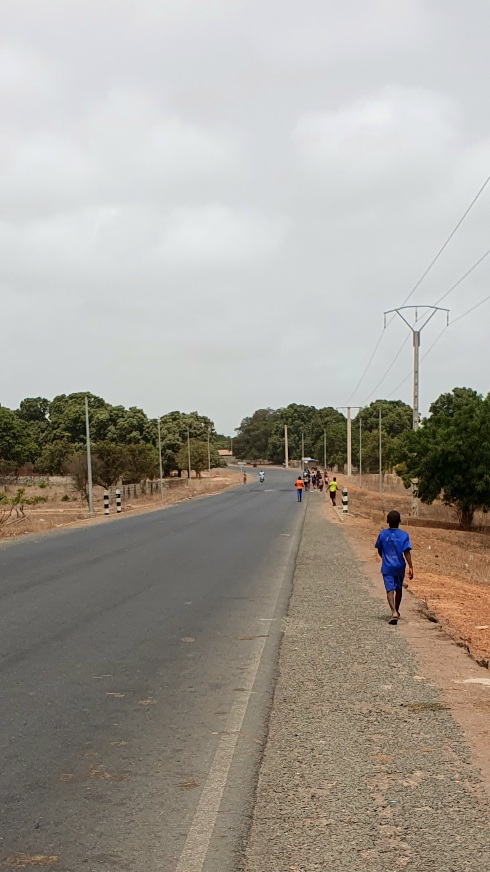
As I get up on the main road, the people are starting to wake up. Motos and carriages pass me, a few cars. People turn their heads and gradually, the yelling begins; “toubab, toubab!”
“Ey toubab! Give me money!”
I walk on with my flat tire and my dirty shorts.
I have heard the Gambia being called “the smiling coast of Africa” and sure, people do smile at me a lot. They seem friendly. But I don’t understand what they want with the yelling. Yes, I do smile and reply when somebody greets me good morning. But what am I to do with “white, white, give me money!”?
A teenage boy catches up with me as I leave the first big village. He lives in the next village and is on his way home from school. He seems shy yet eager to talk. He tells me he wants to be a police officer when he grows up. When we pass the police checkpoint he stops to chat with the officers sitting under a tree. They all smile and greet him. They give him water and ask about his studies and his family while they ask me for my number and whether I am married. I watch them talk and I think I see where he has gotten the idea to become an officer.
The sun might be at mid-day, I don’t know. The sky stays low and it is not too hot. I walk on from the one village to the next. The road turns in gentle bends and hills, surrounded by bush and open fields before periodically closing in on small villages. People passing me on the motos turn their heads and the yells of “toubab” echo and spread like an alarm over the fences and through the compounds as I approach. The people crane their necks, the children stop mid-play to look. Some of them run ahead of me and then let me catch up. I find some behind me, keeping up with a few steps distance. They startle when I say hello but I smile and keep on walking. They are a mix of girls and boys and different ages. Some have hatchets with long shafts over their shoulders, some carry buckets and some their younger siblings. The girls seem more shy and their eyes stare wide at me when I try to talk with them whereas the boys run along and around and babble more freely. I don’t know when, just that I suddenly am in their midst and they form an entourage, sometimes with more children joining as we pass a village, sometimes a few dropping away. They barely talk to me, yet whenever I slow my steps they hang back to wait for me. It is kind of sweet and kind of annoying and would be more fun if it wasn’t for the fact that I need to pee really badly. When finally I stop by some bushes they stop too, waiting and looking at me with those wide eyes. I wave bye-bye, urging them to go on. The hesitate. Finally they go, throwing constant glances behind them as they walk on ahead and I feel free to dive into the bush.
…
For a moment I am alone. Ten minutes later Omar finds me.
“Helloo-oo! Hey! How are you? Ey!”
Suddenly he is there, his steps eager and his smile big. I only have some seconds to decide if I feel like having an interaction as he catches up.
He speaks fast and laughs loud. He tells me he is living in St. Louis in Senegal, but that he is home to visit for the holidays. He asks me if he should get a car for me and my bike. He asks me if I know Couchsurfing. He asks me if I am planning to go to Kunta Kinteh Island and how long my holiday is. He tells me he is a tour guide and at that point I understand why he is so oblivious to my lack of response – he is probably used to approaching and persuading withholding white people all the time. He invites me to celebrate Tabaski with him and his family and what do I think about the Gambia? Am I sure I don’t need a taxi?
“I’ll walk with you,” he replies when I assure him that I want to walk. “I love to walk! Once I walked for a whole day…”
I let his voice fill up the space and contemplate if I should ask to be left in peace. But I figure that the next person would find and join me within minutes again, and also that if I’m walking with somebody fewer people yell “toubab!” at me. His attention span is that of a puppy, his voice carries with a smile and I am pretty sure that he wants to flirt with me, yet with him fussing over me and wanting to make sure I have a safe place to stay and fun things to do, I have to admit that he is a sweet guy.
“Oh look!” he suddenly interrupts himself, crosses the road and goes down to where some mechanics are sitting underneath a sheet metal shade. He greets them with the same smile and asks for an inner tube for me, but this was not what caught his attention; crawling along the legs of the bench and chasing each others’ tails between the men’s feet are two tiny, white kittens. Omar lifts them up, turns them over to examine them, laughs and jokes and within seconds decides that the kittens are coming home with him.
“They are so cute! I love animals!” he exclaims. “I need a bag, do you have something?” The kittens are crawling over his arms and torso. One of the boys has gone to look for a bag. I take my dirty oversized t-shirt from where it’s tied to my backpack and make a knot at the bottom. Then we try to put the kittens inside as they protest and struggle, claw themselves to the fabric with their million feet, heads pointing out of the neckline and sleeves mewing, refusing to be packed down.
Omar halts the next passing car and then crosses the road while holding the struggling t-shirt-bag, says a few words to the driver, looks over and smiles and asks again if I am sure I don’t want a ride. Then he tells me he has to go home now that he has the kittens to look after and that I should call him if I want to come for Tabaski. The door shuts and the car speeds away, leaving me in the sudden silence wondering what the heck just happened.
…
The next one slows down on his moto maybe 20 minutes later and we go through the usual where are you from and all that. Then he stops and starts walking next to me while pushing the motorbike.
He works with digging wells and points out the different wells that he has been part of making as we pass them. He is from the villages around here and clearly knows everybody we meet. He tells me that sometimes a goat can fall down into a well and then it has to be completely emptied before anyone can drink from it again.
The sun starts to set. We pass village after village, him sweating and pushing the heavy motorcycle. His is the village right before the port. He invites me into his compound to show me his chickens and geese and to introduce me to his family. A big mango tree stands in the center and the houses are small and arranged around it. His father greets me warmly and his sister serves us rice and mafé while his nephews stay nearby to stare at me.
We sit on the porch. Someone brings me a cold Coke. I have just leaned back with my belly full, thanking for the meal. His gaze has been turning more intent and so I have avoided eye contact for a while, bracing for what he might want to hint at and determined to send all the “no, thanks”-signals. But then of course he asks me what I feel about marriage and the next moment he leans in to pinch my cheek and I say thank you and good-bye and thank you so much, wrestle myself out of the “are you sure you don’t need to stay for the night?”, say no thanks and thank you for everything. I get my bike, lead it out of the compound and away.
I find a campsite nearby on my mapping app and head for it. The owner is an older in a small house. The garden is thriving but he seems a little lonely and lights up when I ask him for a place to sleep. He starts fussing, invites me to share rice that his neighbour has brought for him and we sit underneath a canopy of vines as the darkness falls. He tells me about a few other tourists, a German girl who stayed for a month and helped build the campsite. It is still not finished.
A few other neighbours pass on their way from work and drop by to check in on my host. One after the other they enter the garden and duck under the vines, greet good evening and sit on the bench. They are painters, musicians, construction workers. They all eat from the same dish and they stay rolling joints and talking as the night falls, small orange glow the only light. I loiter in the hammock while they talk, answering the questions about my name and origin but zoning out from the rest. It makes me happy to see the the neighbours come and chat with my host, bringing him rice and news. He is not alone, despite living alone. Like me; I have barely taken a single step today without company.
I ask to camp just outside the garden, by the riverside where the ground is soft. I pitch the tent in the dark and chain my bike, then crawl inside and go to sleep to the sound of low voices circling the words “toubab” and “bike”.
…
(This story told in pictures.)
 Hulkuv loom