The road is flat with green walls of forest on both sides. It winds and winds and behind every turn there is nobody, just the sound of the chain turning and birds singing in the trees.
It is the morning of Tabaski. I have just thanked and left a host family. In the end I got too insecure about the silent eyes, turned shoulder; did not feel like I was really welcome to stay during this important family holiday. For a moment I considered just packing some food, filling my water bottles and spending a few days in the bushes, away from the streets they have told me will be flowing with sheep’s blood. But then on another whim I texted that loud, smiling Omar to see if his invitation was still standing and so here I am, rolling to Gunjur.
I pass Brikama and its loud market. I meet smiles and yell hello and stop to poke a piece of coconut into my mouth. My jaw strains chewing it, salivating as I put the noise and dust behind me and return to the quiet, empty asphalt and forest walls. The heat rises with the sun.
Gunjur comes too soon, jumps out from the bushes. I hesitate under the big tree by the roundabout; there is still time to turn around and be alone.
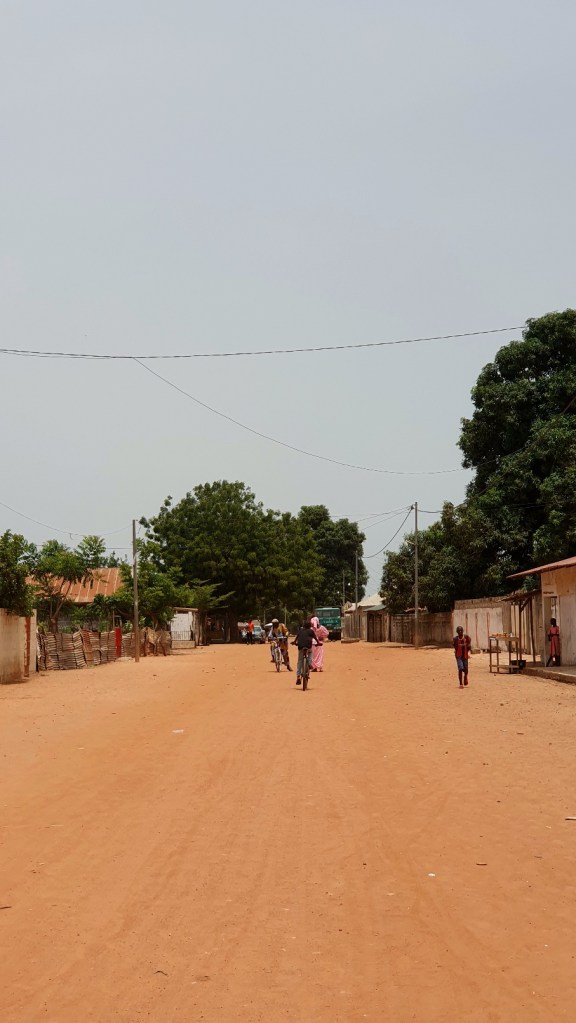
But I call. The pin brings me into a wide side sand street, next to a big welder’s workshop. I stop. People look at me; children gather. Omar’s smile is the first to come through the gate and he himself struts after, laughing, his same deep voice, ushering me inside with arms wide as if to embrace not only me but also my bike, the onlooking children, the day. He brings me into the compound with low white-yellow houses, guides me up a few steps and straight into his mother’s arms. She smiles the same, wide smile when she sees me. With warm eyes she looks at me, calm, and so happy to see me. In that moment the breath I held falls out; yes.
This is where I want to be.
The apartment consists of two rooms: the salon with a carpet, some couches and a cupboard displaying a few colorful plates. The back room is mostly occupied by a bed, a folded mosquito net above it and clothes piled in the corners. Another door leads out from the back room into an enclosed yard used to cook and wash and a small part of it, walled off with sheet metal, contains the latrine.
I get to meet Omar’s nine, yes nine younger siblings, the smallest one just a baby. They gather closely around me. At twenty-four, Omar is the oldest and a provider for the family. The white kittens that he adopted the last time I met him are busy wrestling, clawing and climbing on everything. The door is open and a curtain moves with the breeze. They bring me water to drink, fuss and make sure that I rest.
I think back to the family I just left, each one with their own rooms, sofas and televisions; the tiled courtyard, flowers leaning over the wall, trees giving shade to the yard and cars parked underneath; their laconic looks in contrast with these barefoot rascals sharing two rooms, chattering and giggling, climbing and running all over me now; Omar’s smile and his mother, speaking no language in common with me but wanting to know all about my origin and travels and how long I want to stay and what I think about the Gambia. Here, I have no doubts whether I am welcome or wanted.
Omar brings me around the house and deeper into the compound. A handful of guys are squatting around the cut-up body of sheep. The sky is gray, their hands are bloody. Some hold knives, others point to pieces of meat and divide. Crows and vultures are perched on the sheet-metal fence behind, jumping for the pieces of intestines thrown to the side. Smiles flash when I approach and names bounce around as I am introduced. I watch them cut. The smell isn’t too intense and there isn’t so much blood as I had imagined; not the streams people had warned me about. Just a regular slaughter on the back yard of the compound.
We sit together and pass the time, chatting lazily once the cutting and dividing is done. One by one the guys want to know my name and my origin, shake my hand, ask if I am married. Some glance between me and Omar to see if he is my boyfriend. When the novelty wears off the topics turn back to football and jargon.
Suddenly a big plate arrives. Steaming under the tin foil is a pile of juicy, gray meat, topped with big chunks of raw onion; this is the Tabaski tradition, the ritual of offering a sheep.
We all squat around the dish and dig in with our hands. The meat is hot and I accidentally pick a piece all sinews and stay chewing on the same chunk, unable to bite through. Apart from the small piece of coconut in the morning, I haven’t eaten at all today. I am starving but can’t win over the piece of meat. I chew and chew as the others’ hands work on clearing the plate. One by one they finish and go to sit by the wall while I am still working on the same piece, embarrassment flushing my cheeks. Finally I get through some part of it and throw the rest to the side, trying to do it as casually as the others have. I pick a piece of onion and another small piece of meat, gobble it quickly and then thank for the meal, joining the others. There is still plenty of meat left on the plate and someone takes it away. I wonder if now will be the women’s turn to eat, somewhere out of sight. I wonder if I am breaking any rules by being alone with only guys.
…
The compound consists of one-story houses with four to five apartments in each. A big metal gate is locked up at night to close the compound from the street. The courtyard is wide, turning around the houses and looping back into the back door of the welder’s workshop. Long clothes’ lines run between the houses. A communal water tap is at the back, a small garden is walled off next to it together with a landfill that gets emptied once per year. One of the corners of the compound is reserved for the public latrine for those who don’t have their own latrine connected to their apartment. A gate leads to an open space within high brick walls and an unceremonious hole under the open sky. Every time I go there I feel exposed, heads turning to follow me as I cross the yard holding the small plastic kettle with water to wash my hands.
“Ooooy, toubab!”
The gate makes a loud, creaking noise. While squatting over the hole I keep an eye on the edge of the wall, fearing fingers gripping and noses poking over. At night I avoid the attention, but instead have to share the space with cockroaches running from the small circle of light from my flashlight, a mass of them swarming in the depths of the hole.
Omar gives his one room to me and sleeps himself with his friend in the room next door. His room has blue walls with a single, naked light bulb under the sheet metal roof, a TV in the corner. I dump my backpack in a couch and my self on the bed. The door closes with a hatch and as it slides into place I feel right at ease.
During the day I am the event of the compound. The children climb up on the railings and claim my attention whenever I am hanging out outside of the room, or they come to peek through the door crack whenever I am not; they kick balls to me, take hold of my hands and accompany me if I head for a walk. Adults shout after me and come to greet and chat, asking my name, origin and whether I am married. “You should marry a Gambian man!” Neighbours who have heard about the white visitor drop by to have a look and I am brought and introduced to family members all over town. Being home for the holidays means that every day Omar visits different families, friends and relatives who all want to catch up and ask about his life in Senegal. He always brings me along and we sit and chat and share the meals.
I get tired from all the attention, but everyone is so happy; I am cared for and fed and I can’t complain.
During one visit I sit next to a young woman with an intricate henna-pattern painted on her hand and when I compliment the artwork I learn that she has recently gotten married into the family. She is new in Gunjur and still finding her place in her husband’s family home. The knife is a blur as she cuts green leaves and the other women compliment her cooking skills. Her husband is Omar’s childhood friend and Omar teases her for being soooo in love with her new husband. Her cutting speed doesn’t diminish but she drops her gaze while a smile grows over her face. I wonder what it’s like for her to move from her home village to come and live with a new family. When the husband later enters the compound I catch her glancing at him with the same affectionate smile and I smile too, thinking that oh, yes: she is soooo in love.
In the evening we stroll down the main street of Gunjur. It is dark, the light only coming from flashlights and the few passing motos. I try to watch my step, stumbling on the sand road. This, too, is Tabaski tradition: everybody is wearing their newly tailored dresses and boubous, families in groups with matching designs and patterns, laughter rising to the sky. The street is smack full of people and they slow down as they notice me, the white one, despite all the movement and darkness. “Oy, toubab!” Fingers pointing and heads turning. Jokes shouted at me in a language I don’t understand. Closer to the center are more and more kids, a sea barely reaching up to my shoulder. While they stop to look or shout I stare right back; how can there be so many kids? Does everyone have at least …five? Six? Is Gunjur even that populated?
I notice my friends getting stressed from all the attention; though they know most people in the town, they are not as used to so much shouting after them, and because of me everyone is looking at them, too. We return by dark side streets and shortcuts. Back home I go straight to bed.
…
I notice how the genders are segregated; apart from the few women and girls working some of the shops or street stands, I barely see women at all. Some, including Omar’s mother, wear a full burka when leaving the house. They are not hanging around in groups like the men, like Omar’s friends passing time outside the compound, sitting on stairs, chatting, smoking and looking at their phones. I am guessing the women are at home, cooking, cleaning and caring. I don’t know if they are more shy, more ashamed of their English or just uninterested in me, but finding their friendship and company is generally more difficult for me than with the men. The men are more keen to include me, often for the reason of wanting to flirt with me; advances which I cut short whenever they surface.
I can’t help it, but it frustrates me: the limited freedom I see the women have here. How they don’t go out, don’t drive or bike or speak up. They are judged and criticized if they go out alone, if they go to the wrong places, dress the wrong way, say the wrong things. They are expected to marry, have babies and obey. Nobody asks them what they dream about. Then the men who flock around me say things like “I don’t like the local women, they are so boring. I want a white woman who is strong and independent.” I have heard it so many times and every time I feel so tired. Of course they will be boring if the space within which they are allowed to express themselves is this small!, I want to yell.
Treat them more like you’re treating me.
…
I stay up later in the evenings. In the dark my color is less of an exclamation point and there are fewer people around exclaiming.
I am leaning on the railing one night, just enjoying the stars and the crickets coming on. Everyone is telling me that the rainy season is underway but the first rain hasn’t come yet and I am excited for it, wondering if it might come while I am here.
Omar’s friend, the quiet guy next door whose room Omar is crashing while I’m crashing his, comes up to the house. He is carrying a plastic kettle and sits down on the steps to do his ablution. We haven’t talked, despite having met daily. Now that I think of it, I don’t even know his name.
I greet him and he greets back. I ask him how he is and he laughs and replies without looking at me. I ask him about his day and he laughs again, producing a long vowel.
“Ah, you don’t speak English?” I finally catch on.
“English small-small,” he smiles, his eyes on the foot he is washing.
“Do you speak French?” I ask him in French. He pauses on the foot and looks at me for the first time.
“Yes, I do,” he says.
I relax.
“My French, small-small,” I mirror in French, and he chuckles as he goes back to washing the foot.
He tells me that he is from Senegal, from the Casamance region in the south. He has been here for two years, learned the local language and even some English. He has come to live closer to his father who has been here for over fifteen years already. We chat for a while and somehow, with him so calm and soft and in the quiet of the night, I feel more at home in my fumbling French than I have felt all week in this English speaking country.
…
I ask him to take me to the beach and the next day he does. He leads me away from all the eyes and attention and into the forest. We pass small gardens, big mansions behind barbed wire, low hanging mangoes and rustling leaves.
The beach is empty. The waves come in soft and shallow and I run in on the seashells to meet them. We play in the water; he, of course, can not swim. I try to show him but he sinks like a stone, his shy smile curving his lips.
On the way back he tells me about every tree that I point to; what fruit it gives and how it can be used for medicine, if it loses its leaves and when it can be harvested. My limited French is just enough for me to point and ask whether something is edible and I use that power to its fullest. He shows me the oil palm. He picks up a fallen fruit resembling a coconut. With his teeth he rips off some of the fibers and offers me. I chew, and am surprised to find it oily.
“It’s medicine,” he tells me. I point to the hanging mangoes. He just laughs and tells me they’re not ready. When I point to the ones that have fallen he says they are no good. I confirm it when I turn them over and see the black, rotten spots from where the fruit has hit the ground. Finally he stops, takes a good look around the forest floor, picks up a mango, turns it over and hands it to me.
“This one is good?” I ask him.
“Yes, that one is good,” he replies.
“One day I will walk with you in a forest in my country,” I dream out loud. “And then you will be the one pointing to all the plants and asking if you can eat them.” I imagine introducing him to bitter-sour spruce shoots, blueberries and mushrooms, birch sap and hare mint. I imagine his brow wrinkling at the sour, dry and bitter; him being used to the forest giving juicy, sweet and oily treats. I imagine him wearing a puffy jacket and long pants in a chilly spring forest where the snow remains and the sunlight is still tentative. I wonder what it would feel like against his skin.
We walk in silence for a moment and I wonder if he likes me; if he, too, has a crush on me, imagines himself in Europe. I can’t guess. He hasn’t asked if I am married, hasn’t looked at me with those eyes, but I don’t trust any man here to “just” be my friend.
He takes me to meet his father across the compound. He boils water in an electric kettle and offers us tea, then takes such care to speak slowly for my sake, following my expression to see if I am keeping up, ready to pause and explain the words I am missing. He tells me about other foreigners who have come to the area to buy land and build houses. I can see where my friend gets his calm and kind demeanor.
…
One evening the sky finally wrinkles up in thick clouds. The air is heavy. A few drops fall, as if trying out whether to go for it. Then the sky opens. It’s here.
Omar places buckets in his room and the drops fall in happy steams. Some of the holes are straight above the bed and I see that he is stressed, unusually quiet.
“It’s all right,” I assure him, but he doesn’t seem to hear.
“I want you to sleep in my friend’s room tonight,” he tells me.
“No, no, that won’t be necessary,” I say. Damn it. Is it because we have been hanging out, and now Omar thinks I like him? Has his friend asked for this?
“There are no leaks in his room,” Omar continues.
“I don’t want to sleep there,” I say. There is also no second matress, meaning that we would have to share.
“It’s better for you,” he concludes.
We are in disagreement. A woman here would barely leave the house alone, much less spend the night in the same room as a man who is not her relative. I know that other rules apply to me, but still. I already feel as if everyone is watching and commenting on my smallest movement and gesture as I move around the compound. What would they say about this?
I protest and argue but it changes nothing. I consider taking my bike and my stuff and pitch my tent in the forest, but it’s dark and pouring and they would probably feel really bad about it and it seems like too big of a deal to make. Anger and fear are building up; I hate being pushed like this. The more the thought gathers speed and spins around in my head, the less I trust my friend, this random dude I met a few days ago. I forget all the kindness he has shown me; was this what he wanted all along? Have they planned this in advance? Am I stronger than him, if it comes to it?
The rain thunders down and runs in streams down the roof. Normally this is one of my favorite sounds, but right now I am too upset. The light is flat and sharp on the yellow walls of the sitting room. The back room has a plastic floor cover on the naked concrete but no light. There is a branch outlet, a fan, a mattress. A pile of clothes and stuff in the corner. A curtain acts as a divider to the inner room and I change in the dark behind it. My friend shows me how to open the hatch and where he keeps the key before he locks the front door. The silence feels dense between us. I ask him what side he normally prefers to sleep on and he tells me to choose which one I want.
What I want is to leave.
I lay down on the very edge of the mattress, closest to the door. My friend lays down on the other side. The distance between us is big enough to fit two other people, but it still feels too close. I am still boiling with anger and stiff with fear. I tell myself to not move in my sleep and to wake should he move towards me. I don’t know if I would, but believing so helps.
Being in a country where almost every guy tries to flirt with me, I’ve learned not to give the smallest of hints that could be interpreted as welcoming the advances, yet here I am being sent to share the bed with a man I don’t know, in a conservative town where everything is subject to gossip. Fuck this shit. I want to bite the fucking pillow in half.
Whatever, I think to myself. I’ve had enough anyway. I’ll get through this and tomorrow I’ll go.
…
In the morning I am still on the edge of the mattress; somehow I must have fallen asleep. I feel off, sore and confused. The anger has run off. No one has touched or disturbed me. My friend lies on his side of the bed. I get up quietly, pass through the curtain covering the door and sit in the other room.
I am not sure what to do. I don’t want to be seen coming out of this room and I don’t know what to do outside anyway. I don’t want to wake up my friend. I stay still and read a book on my phone.
Small rays of sun cut through the gaps in the curtain. My friend wakes up eventually and comes out to the sitting room. We say good morning. He looks at me with his usual smile.
“How are you?” he asks.
“Fine and you?” I am still curt and wary toward him, but his smile doesn’t falter and his eyes are soft.
“You weren’t too happy yesterday.”
“No, I wasn’t.” I have no reason to sugar coat. In fact I want to be clear that I felt forced and that I didn’t like it. In a way I feel like punishing both him and Omar.
“You were afraid I would do something to you?”
“Yes, I was.”
“I thought so.” He pauses and we stay looking at each other. I hear a rooster outside, footsteps; children calling over the compound. The moment stretches and something loosens. I like that he brought it up, that he asked me so frankly. That he has allowed me to be frank in return.
“I wouldn’t do that,” he says finally. He leaves silence for me to breathe and the tension runs off.
“What do you want for breakfast?”
He opens the hatch and goes, leaving the door open and me to myself again. The morning air comes in.
He returns soon. From his father’s room he has brought the electric kettle, bags of black tea, cups, spoons and sugar. From the shop across the street he’s brought a length of bread filled with egg and mayo, wrapped inside a newspaper. He sits himself on the other chair and pours water into the cups, breaks open the tea bags, spoons sugar into his cup and pours the water on top. I lean forward to break the bread in half.
“What do you want to do today?” he asks me while stirring.
“I want to go for a run,” I say right away. We had talked about it yesterday.
“Oh, so you want to do some sports?” He laughs through a big bite of sandwich. “All right, let’s do that.”
We run slowly, side by side. I have been longing to move and unwilling to withstand the attention of running alone. In the forest there are no eyes to stare or care. The sand muffles our steps and the trees absorb out breath.
We reach the beach and do our own sets and reps. My friend throws himself eagerly into push ups and squats while I am happy with some stretches and slow movements. I spread my arms and legs in circles over the open sand. The waves come in so soft. I am free.
“Didn’t you bring your swimwear?” my friend wonders.
“Nah,” I reply. Now I regret it.
The residue anger, fear and indignation have all run off me by the time we head back. We walk through the forest in silence. His voice is quiet when he breaks it.
“I want to tell you something.”
Ah, no.
“What is it?” I don’t break the pace, I don’t sigh and my voice doesn’t reveal that I’ve heard this before. I just walk.
“I like you. I know we just met, but I have really fallen for you.” His eyes are on the road ahead and the smile is there, the same soft smile as always but I’ve come to recognize the small variations; when he is amused, when he is intrigued, when he is shy.
When he is hiding his insecurity.
His words hang in the air as we walk. I don’t reply; he hasn’t asked me anything and I have nothing to say.
“I want to be open with my heart,” he says and in that moment I feel a wave of pain in my own chest. He is being so damn vulnerable. No hooks or traps, no pushing me to do or say anything. I think of what he said in the morning; I wouldn’t do that.
“Thank you,” I say. “That’s kind.”
I have decided that I will leave today, anyway.
“I think you are a good person, you have a good heart,” I go on. He is, and he does.
“Right now I am traveling. I am not looking for a relationship.”
I think of how badly I want to leave the persistent men in this town, all the kids who are shouting and following me, the latrine with its swarm of cockroaches.
“But thank you for being honest with me.” I reach out and briefly squeeze his palm with my fingers. I don’t want him to be sad. The thought hits me: in a different time, I might have wanted to go out with him.
I am too used to men “falling”, unburdening their hungry hearts on me. Eager fingers hoping to touch white skin. Hoping a lot of things.
I don’t need that. I need people who join me for a run and who tell me what the trees are called.
…
The sun is setting. The road is flat with golden walls of forest on both sides. I have about an hour to find a place to sleep before it’s dark.
I have squeezed every hand, been wrapped in so many hugs and my cheeks hurt from smiling. My belly is full with rice, my clothes are washed and my phone is charged. Omar has wished me luck, his mother has held both my hands and blessed me, the children have all flocked around me for one last time; happy, all except for one little lip curving down and a small wail escaping into the excited chatter. My friend was smiling again with no trace of the tears falling in the dim light of his sitting room where we said good-bye.
It all rolls back behind me. Palm trees pass; new children shout “toubab!”, new heads turn to follow me and I let it all go. All but the one, the only thing I bring: a soft curved lip, eyes not meeting mine.
I don’t need to get far; just away.
…
(This story told in pictures.)
 Hulkuv loom