Dark blue clouds have gathered behind me and the setting sun is golden ahead; the strange light turns the sand road deep red and the trees around into looming shadows. It is beautiful, but I hope it will not rain. I drag the bike through the sand, my feet sliding left and right, looking for a trail to take me off the road and into the forest.
I pitch my tent underneath a thick mango tree. The foliage from the forest shadows out the rising moon, only some slivers slipping in through the gaps. I stumble on fallen mangoes in the dark; the monkeys usually pick them, nibble at a corner and then discard them when they realize the fruit is not ripe and sweet. In the pitch black of the forest, I go to sleep.
…
I wake up with the first sun rays and birds. The night has been dry and I stay in my tent, read a book on my phone and enjoy the peace and quiet. After the days of being the center of attention, being cared for and fussed over and always surrounded, the silence is nice.
I read until my phone battery dies and I have no idea what time it is when I pack up my tent. The sun is not high yet, but the heat starts creeping on gradually.
I laze around after packing my tent. I have nothing to do and nowhere to go. By the broken fence next to the road I find long, light green palm leaves, fresh and crispy. I tear them apart and crouch down right there to weave them together. I have been thinking about weaving a basket and attaching it to the front of my bike so I can easily but bags of peanuts, bananas, water and other snacks that I buy from the roadside within easy access. The leaves are strong and slippery and the basket turns out all right, but I get bored and toss it aside before I finish it, get my stuff and head toward the big road instead.
Right by the crossroads I spot a Mama standing by a table with different pots and bowls covered with fabric. From a big bag next to her she pulls out lengths of bread – the good ones, the dense and heavy ones – and I watch as people come up to her table and order sandwiches with different fillings from the bowls.
She lifts the lids for me to look inside and I point to accara, the fried bean balls. She fills a length of bread with accara along with oily, spicy onion sauce. I sit down on the rickety bench by the wall, next to a man playing reggae music from his brick-phone, lean my back on the wall behind me and sip hot Nescafé along with the sandwich.
Workers pass, men heading for different construction sites and field jobs, emptying the pots and keeping the Mama on her feet. Interestingly, most people leave me in peace; they glance toward me and some greet, smile, but so far nobody has yelled “toubab” at me or come to ask where I am from. My neighbor on the bench is playing reggae music from his brick-shaped radio phone. We strike up a conversation until he goes off to work, giving me a small wave and taking the reggae with him.
…
The road brings me through dense bushes on silent asphalt, then unfolds into a traffic jam of cars, buses, carts and chaos, people shouting and crossing, unloading goods; a market. I learn that Tanji is the Gambia’s biggest fishing town; I guess it by the smell even before someone tells me.
I want to have a swim at the beach and I want to escape the hoard of guys trying so persistently for my attention at the gas station while I wait for my phone to charge. I turn around and find a steep gravel hill that leads me to the water.
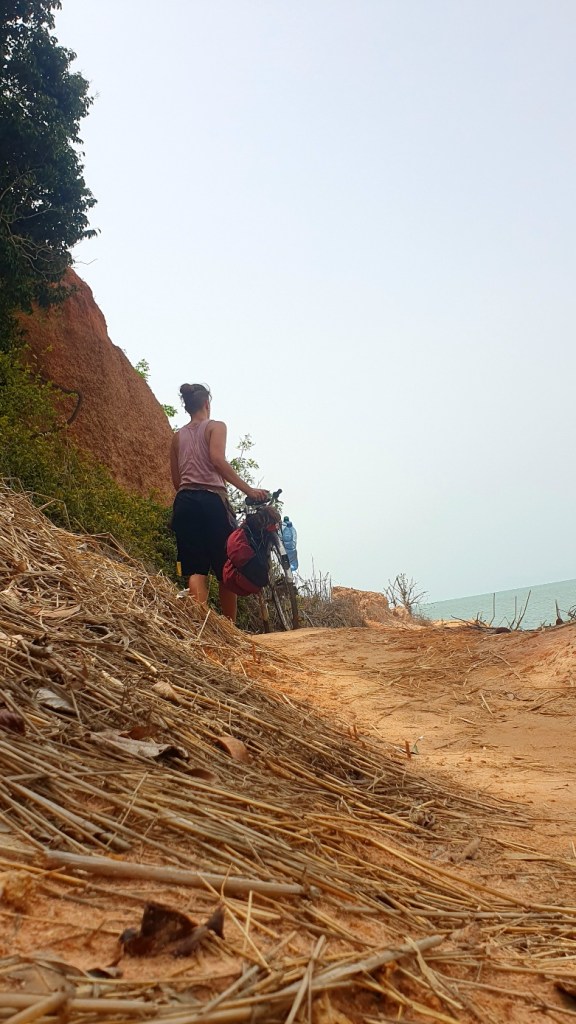
But the beach turns out to be desolate and littered with trash. Small sheet metal houses are struck up along it and the families look at me as I pass. My feet sink into mushy, stinking seaweed and plastic. I climb up a few rocks, lift and drag the bike up after me to take the small path that turns around the cliff. Maybe around the bend I can find some clean sand with nobody staring at me?
The next beach is lined with gentle baobab trees, coated with white paint from the bottom. A man is painting a pink crab onto one of them. Other baobab trees have been painted with beautiful, colorful murals, and so has the wall behind the little beach front. I am welcomed by another man and he tells me that he is in the process of building a campsite on this beach.
I soak in the warm water, rock softly along with the seaweed. I am left in peace to write my diary at one of the tables and I take pauses to watch the tree get painted. The owner has built the little house for himself besides setting up the campsite, dug out a small garden with his own hands. He shows me where a mudslide buried the previous garden and I ask if the wall and the house aren’t too close to the hill, if they’re not in danger of getting buried as well should the next rain be too strong. But he tells me no. The artist painting the tree is a friend of the owner. Later they invite me to share their modest dinner and I take small bites; I don’t want to take their food and I don’t want to refuse, either. They tell me about other campers and what it’s like to work as an artist in the Gambia, then each roll and light up a joint; I have become used to everybody smoking here. I say no thank you to the smoke and to stay the night, say thank you and good-bye and leave to drag my bike uphill as the sun sets. This night I make my home underneath a cashew grove. The full moon is up again and the strong light renders me invisible in the dark shadows, unnoticed even though I am close to the road.
…
In some of the corner shops they prepare omelet sandwiches; they mix the egg and some spices in a mug, sometimes cut in a little bit of onion and fry it over a gas flame, then stuff it into the bread with mayonnaise. I look for an omelet sandwich in the morning but am unlucky and have to cycle quite far before finding it. In Ghanatown I set my sight on a shop and cross the road at the same time as a man starts shouting and waving at me to come over from a shop a bit further up. I raise my hand and then go on to look for my sandwich; I don’t feel like engaging with the same, tiresome “eeeyyyy hell-looooooo! Hey! White!” A wave is all he gets.
When I leave the shop with my sandwich the man continues to wave and shout for me to come over. I think of ignoring him instinctively and finding a place to eat in peace, but then I change my mind and turn around. The shouting man is sitting outside of a big shop and maybe, I figure, he would let me charge his phone there.
Terry gives me the best chair, brings me water and offers to make me coffee. Once he has my attention and has learned my name and country he cools down. We sit and watch traffic pass outside the shop.
The shop sells second hand stuff imported from England and Terry runs it for the British owner who comes there to spend the holidays. They are waiting for a container to arrive on any of the following days to re-stock the shop. Now it is almost empty, with only a few dresses hanging on a rack and a few odd screens on the shelf. The ship will bring computers, TVs, fridges, freezers; shoes, bags, books, clothes and baby stuff; all sorts of things discarded and taken to the recycling station in England. Here it gets re-used. For the profits Terry has built a house, bought a motorcycle and a nice leather jacket. He asks me to watch the shop while he takes the moto to the mosque to pray.
Terry’s friends drop by the shop throughout the day and I let all of them repeat the same things to me;
“Hello, where are you from?”
“What is your name?”
“Are you married?”
“You should marry a Gambian man.”
“Ha-ha-ha!”
In return they invite me to cook and eat fish, freshly caught from the sea. We cut the vegetables right there in the shop. I turn the potatoes in the sizzling oil until they’re golden and the girl working the café next door comes over to joke around and give the guys an earful about the seasoning. I end up spending the whole day in the shop in Ghanatown, thanks to having responded to the kind of shouting I find annoying and normally ignore and avoid. I am socially exhausted but my phone is charged and my belly is full.
…
My tire has started leaking air somewhere along the way. I don’t have the right glue and so I patch the hole with superglue. It does adhere to rubber but goes stiff once it’s dry, making it tear once I pump the tire and the tube stretches. It works for a short while before all the air leaks out again. I don’t want to buy a new tube because the tire is crappy and replacing the tube while not replacing the tire seems like a waste. And so I keep patching and pumping.
I bike through pothole riddled town roads, take photos of mosques and sleep in mango groves. I sit at roadside cafes, drink Nescafe and eat omelet sandwiches, listen to the traffic pass by and chat with the locals. I am amused to discover that the bread is wrapped in Swedish newspapers and I read the articles and the ads. I walk into the Senegambia market, out of season and devoid of tourists, all the vendors jumping to their feet as they spot me. I spend half the day with the only person who does not tug at me or try to sell me things. He is making fans, one after the other; he applies glue on sticks he has picked by hand, attaches goat leather he has prepared himself, then the colorful fabric he has cut and folded. He stitches and trims the edges, over and over again while the fans pile up in different patterns and colors.
That night I get hosted in a huge truck that has been turned into a home; a sturdy kitchen with cabinets painted blue, a sink and all you could need; a bed that folds over a sitting area and a back door that opens and to overlook whatever view is chosen for the night. A funny traveler trio picks me up: a European, a South American, an African. I have asked to be hosted through Couchsurfing by the truck owner later on in St Louis, only happy to find that the truck (with its couch) coincidentally happens to be in the Gambia at the same time as me.
They bring me to a fancy campsite with planted palm trees and painted houses. They pay for me too, and for some reason it’s harder to receive than when others give me their rooms or their food; I have no idea what is expected of me in exchange for when something is paid for me, whereas it feels enough to just be nice and polite and happy in exchange for things like people’s food and time.
But we have fun. We prepare a huge dinner with grilled fish for ourselves and the staff, shout around on the beach and get tipsy together. When I get tired of the conversation I sneak off with one of the rasta guys and he takes me down the beach, toward the music and a simple brick house hosting a club. The small room is smoke-filled, smack-crowded, the people dancing to the blasting music, close up to the DJ-booth; banging their heads and singing along. I stay close enough to my host for people to assume he is my date and let me be while I dance, and he chats with his friends and keeps an eye on me, but leaves me be. Soon I am sweating with the others, the loud beat swallowing me into its pulse.
We leave when I’m tired. On the way back I refuse the arm that my rasta guy tries to put around me and as I come back to the campsite I notice that I am not the only one having stayed up late; I catch two of my new friends in the middle of an embrace, giggling like teenagers sharing secrets. I smile, lay down to sleep in the truck and black out immediately.
…
I thought I would have to cycle for half a day on my leaking tire all the way south to Kartong for my next adventure, but it turns out that I don’t need to after all. I’ve gotten in touch with the only WWOOF-farm in the Gambia and have been invited to join in with building clay ovens for my last days in the country. The ovens are to be built at a local education center and community project only a few kilometers from the fancy camping where I’m staying with my host-trio.
I make another attempt to mend the tube in the morning before I hug my hosts goodbye. The education center is an international project in a small village by the big highway. It is a large compound with fruit trees, garden beds, green houses, big, beautiful houses and workshop spaces. The main focus of the school is to give courses in information technology, organic gardening and to promote entrepreneurship by training all sorts of practical professions; there are small container-houses with wood-, metal- and textile workshops, a bike mechanic and a salon.
My WWOOF-host is Alagie, a tall man with a deep voice. We are building two clay stoves for the school, to make the job easier for the women cooking lunch for the students and staff. Currently they balance the pots on three rocks over the fire in the traditional way. The new stoves will be fed with firewood too, but they will be more energy efficient and more ergonomic for the women.
We use styrofoam to make templates. Alagie drags a big sack from his car, full of chunks of clay. He has dug the clay up himself from a riverbed near his home, worked in the amount of fiber and mineral that is needed. We work the walls up on each side of the template, place bricks inside the mouth, two iron bars for support and more clay on top, a splash of water and Alagie’s long fingers push the shape straight with ease while I struggle to keep up. It’s nice. I ask him why he has chosen the work that he does and he tells me that working with his body calms his mind. We fall back into silence.
The day passes at the school as we work. Students have classes in the round, open classroom with outlets in the ceiling. The women cooking chat and joke with us; they ask me about my country and tease and flirt with Alagie. A group of children are having a workshop further away with some volunteer guest teachers. Over us is lush foliage, birds chirping and mangoes falling now and then, heavy thuds on the metal roofs. By the time the sun is setting we have finished the first oven and we leave it to dry overnight.
I get to sleep in one of the beautiful houses, in a dorm room which I share with no one. Another girl is staying in the other room and we have a huge kitchen and bathroom with running water, high ceilings, big windows, tiled floors and a European toilet. I the bookshelf there’s a bunch of books and I choose three that look interesting and bring them to bed, to snuggle up and read between the clean sheets as water drops from my newly-washed hair. I stay up reading, a slight breeze rustling the leaves outside and mangoes thudding down on the roof occasionally.
The next day we finish the second oven. Alagie shows me how to cut tiles with the tile cutter. He trusts me with the task of bringing back straight and un-broken pieces with the correct measurements as I go off to cut while he sets the tiles around the clay ovens, even though I have never cut tiles before in my life. I take on the task with all my focus so as to not disappoint. I watch him focus as he sets the tiles straight, each one in relation to the previous one. Shift, press, knock. Assertive, soft. By the end of the day, we have a finished oven.
I had wanted to stay longer and build more clay ovens around the Gambia with Alagie, but somehow my visa has run out again; tomorrow already. 14 days go by quickly. In the morning I make myself coffee in the big pretty kitchen and have a go at repairing my tube again; somehow this has become my morning routine. For some reason has exploded during the night this time, right along with the tire. I try out patching the tire with rubber from an old tube this time, without much hope. Then I help put the finishing touches on the oven, wipe clean the tiles and have a big serving of rice and sauce before tying my backpack to the bike around two in the afternoon and burning off toward Banjul and the ferry. I should catch the one that leaves around five and after that I will have about 20 km to get to the border and stamp into Senegal. It should be enough time, even if I have to stop and pump my tire. As long as I get over the border today. From there maybe I’ll burn off another 20 km until Toubakouta, just for the hell of it. It will be dark, but I have read that there, in the lagoon, live algae that glow in the dark when the water moves…
…
(This story told in pictures part one, two, three, four, five, six and a video.)
 Hulkuv loom