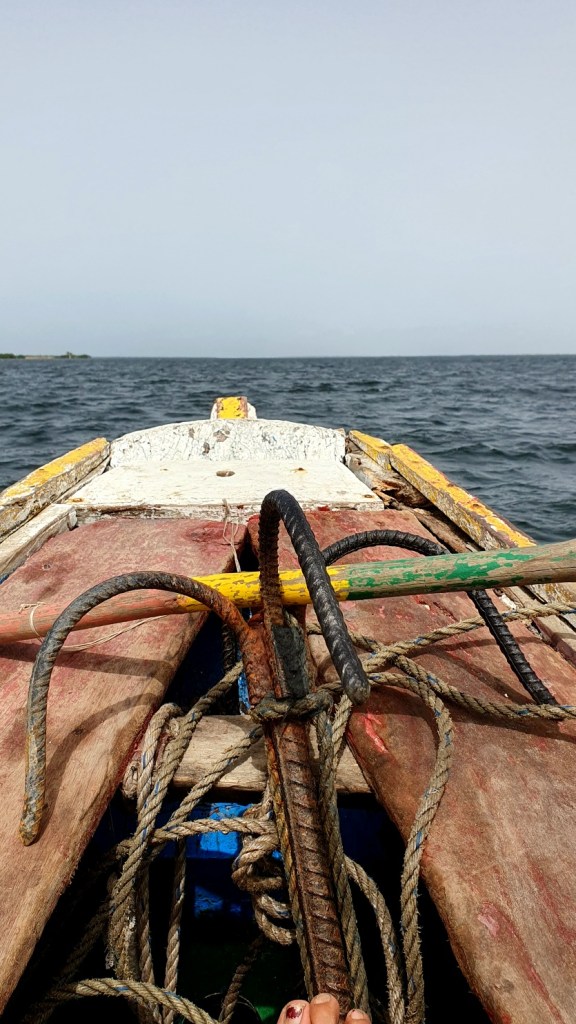
They allow me to sit in the very front. The captain, two apprentice boys and three passengers all sit in the back of the long-narrow fishing boat. The anchor, curved, welded steel, rests in front of me. Ahead of us the open delta, dusty-blue water and sky melting together, a bright line of mangroves brushing by on the sides. My bike is resting with the other parcels. The waves bump us as we split them, the breeze is soft and the sun sharp, beating down from above and all sides. My head is thick and sweet with sleep deprivation, nods against the wood, and my eyes close to the golden splinters from the waves. The humming from the motor glitches as I fall back and forth in reality.
Djrnda is the last pier and I am the last passenger. I stagger out of the boat, the bike lands with its flat tire next to me; several hands let go. I look around. Boats bop quiet in the water around the pier, thin and painted with bright colors just like the one I came with. A few men and boys pull on the nets. The water soft, flat and dull, the pier stretching long into the village. The boat that will bring me further doesn’t leave until at dawn tomorrow. Behind the village I glimpse misty outlines of baobab trees and shrubbery. I want to go there and nap.
I cross gray-white sand, gray houses, white sheep. Wire fences and leaning beams. Only a few noses poke around the corners to look. The sky has grown overcast. There are no cars, no motos and barely any people. It’s like the silence is keeping the air still. The only sound comes from my footsteps, bike tires and the sheep that stops in its tracks when I pass.
A gentleman joins up with me, our steps similar in length and headed the same way. He asks me politely where I am from, what I am doing here, what I do for a living. His voice is barely audible over the sound of our feet. We follow a few streets, cross a little yard and then he turns into his compound. He looks questioningly at me from the gate.
“Where are you going?” Almost offended that I am not following him inside. So I do.
Pretty tiled houses surround the yard, a young mango tree in the middle and a young bull tied to the tree by a rope.
“You can lean the bike there,” he points. Then suddenly screams and running feet surround me, hands poking and touching my clothes, my arms, the tires and brake cables, a chatter of voices and heads bouncing up and down. The mister brings a plastic chair, puts it in the shade under the tree and some of the children are already climbing up in my lap, meanwhile others keep their distance, looking skeptical. I count ten heads coming up to various heights, though I am not sure because they keep moving and bouncing.
“I live here with my brothers and their wives,” my host explains from the other chair.
“The women are cooking,” he adds, and I hear laughter around the corner. Inside the TV is on, showing music videos.
“We want to dance for you!” the oldest girl translates. At that they all rise and scream and run around again – the shy ones are not shy anymore – and it takes a while until it is settled who will play the audience and who will play the star. The audience obediently settles in a circle and the first star takes the stage. With the skinny stick-legs bent, the tongue stuck out in concentration she begins to twerk, hands on her knees, going low and kicking up dust with her bare feet. It seems to be a set choreography; one after another everyone gives the show, the toddlers getting wild cheers as they bend their wobbly knees, the older ones prancing and pouting their mouths, just like in the music videos. Meanwhile the audience claps the rhythm and chants in unison:
“Su-su-TAKK! Suu-su-su-TAKK!”
Afterwards they line up to recite poems and prayers, then dance again, then a circle game, then some want to recite again because they didn’t get it right the first time, and on like this until the mothers call for lunch.
One of the brothers has traveled to Dakar and they install me in his room for the night. Leaving to sleep in my tent is out of question. It is like s hotel; blue walls and a double bed, clean sheets and water for my shower. They bring me fried potatoes and fish and clean towels. When everyone has gone to sleep I go out to the porch, the world turning underneath my feet. The village is still very quiet, now very dark too, except for the thin slice of misty moon. This strange place, white at day and black at night, with its still and silent air and yard with dancing children; I wonder where I will find my self in the morning.
At dawn I wake early and then the village is blue. I close the gate behind me, careful so as not to wake anybody, then head back down to the pier and the boat to take me away.
…
(This story told in pictures.)
 Hulkuv loom