“It is dangerous to walk alone at night.”
I brush my back along the silent houses.
“There are many robbers here.”
I do not heed the advice.
I am disobedient and obstinate and wayward.
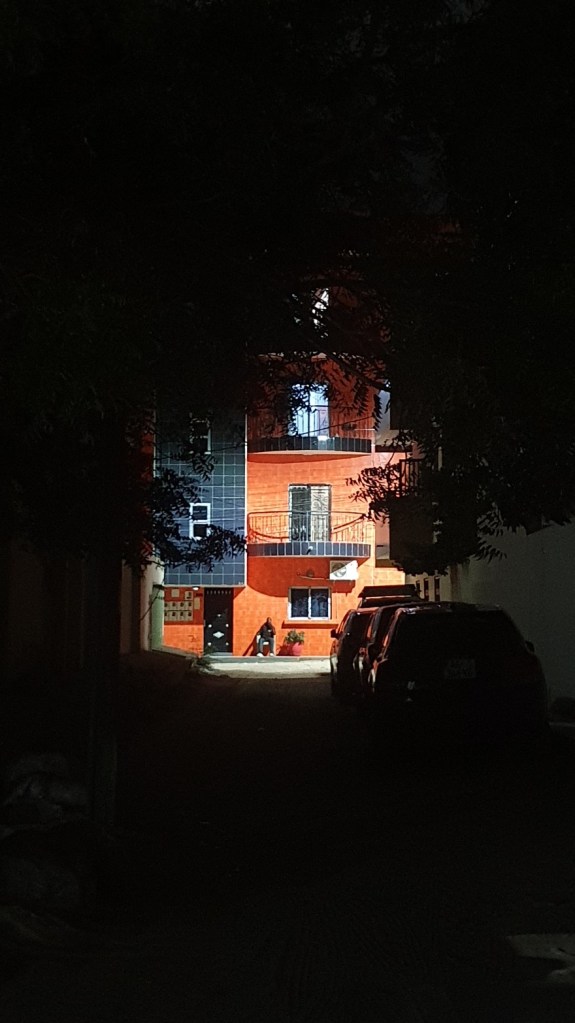
Dakar at night is beautiful.
The streets emptied of the traffic jams, finally wide. The dust settled, market stands covered with plastic. People spread around, huddled shapes guarding, making ataya over charcoal, scrolling on their phones. Heads lifting sometimes as I pass, sometimes not even.
“Maleikum salam,” mumbled back to me. I say hello to the people selling coffee, the people guarding houses and sweeping streets.
No one will touch me.
The dogs won’t touch me. A taxi or moto might slow down, the head turn to me but one calm no-no-finger and a small shake of my head, off they go again. Flat cardboard and plastic wrappings scattered from the day. The high houses looming, looking down with black squares for windows: no one living there yet.
No one bothers me.
I am a soft silent shadow sweeping by; with my eyes I see everything.
My steps improper, flip-flopping along the sand and stone, tired after a night out dancing. It only takes half an hour, maybe forty minutes to walk home; forty minutes of silence and vigilance and stillness. Sometimes I listen to music in my headphones and sometimes I sing along over the empty streets, my voice trying out melodies.
Once when a friend accompanies me home a moto slows down, takes a turn around us, passes closely by my side. The two men look us over. Then they drive off.
“They were looking if you had a bag,” my friend explains. “They would have taken it.”
I had guessed as much. I had noticed them approaching. At the time I carried nothing; only my house keys in my pocket.
Before, I was afraid of getting robbed, beaten, grabbed, held, cut, pushed or hurt in any other way. But it hasn’t happened, and every time nothing happens, the fears subside.
Most people will not harm me; most people are sleeping.
“How fast can you run?” another friend asked me the first time he took me out on a bike ride in Maputo at night.
“Ish, why do you ask?” I replied.
“Good,” was all he said.
It’s taken time for me to learn that other people’s fear is not my fear.
It doesn’t have to be my fear.
Sometimes I do things that seem stupid to them and sometimes I do things that seem stupid to me. I don’t want to cause worry, but I don’t want to be stopped by other people’s feelings either. I want to set my own boundaries.
If I would act on other people’s fears I would not be here; no travel, no Dakar, no Africa.
I received worry from my European friends as well as strangers about the “dangers of Africa” before my travel. Here, it is locals who have taken over, warning me not to go out at night, to stay out of this and that neighborhood. Yet here I am, all fine. Being risk aware, yes, but transgressing many of the lines suggested to me. Is there ever a clear line, a clear path to follow with only “right” things to do to avoid risks? Is there ever one reality we can agree on? Will nothing bad happen to me if I only-
Ha-ha.
The boundary is like the line my feet flop out: a wobbly line, a hesitant; not straight but avoiding the rocks, an eye on every step. Sure, I might stumble, fall and scrape my knees; I need to be awake as well as lucky.
You get the point; I do my best, yet submit to the ride. If I want to walk around the city at night, I try to find a way to do it. I have learned to try and to trust. Now, I am less worried about the future but rather grateful for the past, let happen what will; instead of playing with different versions of what if, I play with:
alhamdullillah,
slava boga,
jumal tänatud,
dieu merci,
graças à deus,
thank god.
The other cats come out to search for food; small shadows in the cracks, brushing along the walls just like me. Like theirs my shoulders are relaxed, yet ears are peaked; we bend and fall and curve around our city’s silent secrets; poke our careful, wayward muzzles in while the others sleep.
…
(This story told in pictures.)
 Hulkuv loom