There is a famous door located on Gorée Island outside of Dakar; it is called the Door of No Return. It leads out from one of the big houses, straight to a dock where, back in the day, a ship would wait. The people deported as slaves passed through this door, were loaded onto the ships like cargo and cast upon the ocean like any other package. As if they contained goods and not stories and souls.
Gorée Island was one of the major nodes in the transatlantic slave trade and remains to this day a frequented destination as people from all over the world come to learn about its somber history. My closest point of reference is the time I visited the museum of Auschwitz-Birkenau, another historical site where crimes against humanity were systematically carried out. That time the sky was gray and the ground was hard, frozen mud. Silence hung heavy, despite the many people.
This day we spent a good three hours sweating in a queue, waiting for the ferry. Packed among locals and foreigners, shifting restlessly in khaki shorts and pretty nails fanning painted eyebrows, children running between knees and ice creams melting onto hands. The two ferries we didn’t make served only to budge us slightly forward, until finally we made the third one.
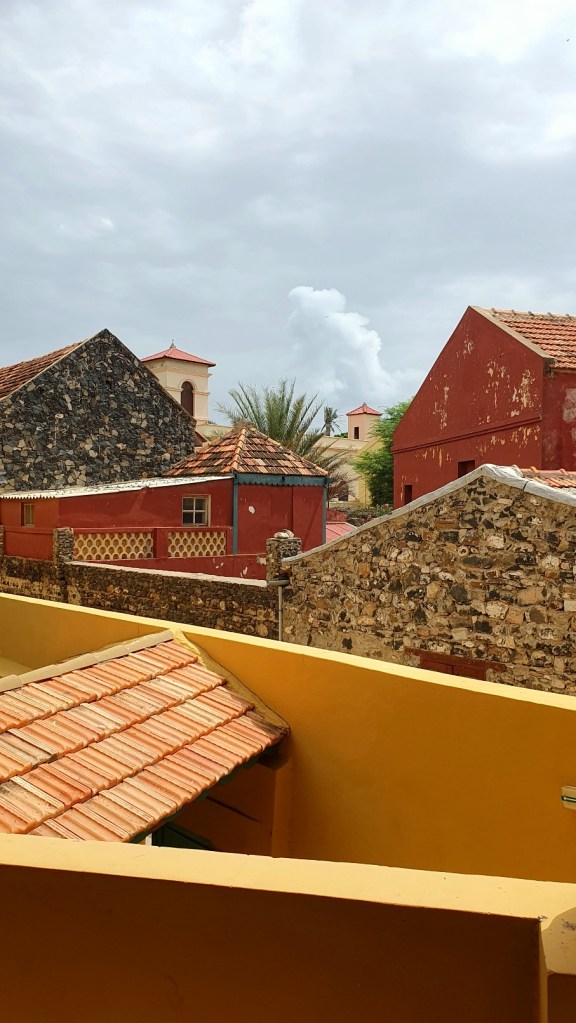
We dock on Gorée and my friend and I push our way out. We are met by clear blue water and a lively beach; people bathing, restaurants bustling by the shore, vendors selling trinkets. The houses are colorful with winding railings and balconies. Flowers grow in pots below the windows, reach over the walls. The streets are neat cobblestone, people sit and laugh on chairs outside and all the doors and windows are open, letting the breeze move as it wants and carry along the chatter and the music.
My friend brings me to the Catholic church with its dim lights and wooden benches in empty rows. We walk up the hill lined with big baobabs and paintings, dreadlocked artists leaning on the railings; we take photos by the memorial monument to the backdrop of Dakar. All around us are other tourists doing the same. The last stop is the House of Slaves; the very same walls which framed the suffering all these years ago, now turned into a museum with the doors open to visitors.
My friend has been here before and excuses himself, telling me he has a family emergency which might or might not be true; him being bored and simply wanting to be polite is fair enough in my book.
I enter the yard with bright yellow walls, a bench, a small fountain and brushing leaves. I pay the ticket and take my time to stroll slowly through the rooms of the museum. The exhibition is informative and well curated. The floors upstairs are made of wide wooden planks that creak slightly. The breeze comes in through the open windows. Even though they have probably been exchanged during the centuries, I imagine the leather soles and trailing dresses of the white ladies and gentlemen, passing over these floors. Below, the rooms are smaller but the doorframes are smooth valves and there is space to stand and move. Now full of printed posters, portraits and timelines, this is where the servants must have bustled back when, preparing the meals, checking inventory and doing the laundry.
And finally there is the next house and the basement where the slaves were kept.
Where they were kept.
The house itself is big and pink. Winding stairs lead to the upper floor where high windows welcome in the sea. But underneath the air is still, the space barely high enough to stand. Thick rough stone walls, stronger than fingernails; windows to barely fit a fist; no breeze roaming here. The floors are trampled dirt, the same filth to share between bare feet, a cheek turned to sleep and the crittering rats and roaches. Black bodies wither in the dark, so far away from home and still not yet passed on to sea, not yet packed and carried further still. That door the biggest hole of light once open, bright blue lines leading only further into pain. There is no “back”. Step by step through that door, chains rattling onto the ship and from there on… where?
…
Laughter from the beach and the voices of vendors drift into the open restaurant. I am eating a delicious chicken yassa while waiting for the ferry to take me back. I remember it took me days of silence and grief to wrap my head around my visit to Auschwitz, unable to really talk or think about it. That time I promised myself to be a better vegan, to denounce suffering even more fiercely. Now look at me, one hand waving flies away while crunching on cartilage.
As a European foreigner I paid double the price for the ferry to come here. The same with the entrance ticket to the museum. On the streets and with my white skin, I am the one most targeted by vendors, beggars and men flirting. All these patterns were born here, centuries back when some whites impoverished big parts of this continent to build their own fortune elsewhere. They drew the borders which I move over freely while others die at sea, their bodies nothing when pushed against lines on the map.
Stepping through the Door of No Return brings us here, right where we are.
…
People live on Gorée Island now. They take the ferry to commute to work and water the flowers. They bring out chairs and sit with their neighbors on the streets, swim in the sea, chat and play checkers. They leave their doors and windows open.
The Door of No Return is finally just a hole in the wall. One side facing water and the other facing the tourists taking pictures. It is a symbol. The violence and pain happened way before anyone passed through the door, and way after. It is happening still, the reverberations carried out through every body.
Even mine.
And my wish for the future, the pain placid and voice quiet, remains the same as ever:
I want all to pass like breeze.
Every body.
I want my steps to lead toward futures of freedom for all.
I want change.
We need to open other doors.
…
(This story told in pictures part one, two and three.)
 Hulkuv loom