They weld everything themselves here: window bard, doors with curvy metal decorations, horse carriages from old car axels, coffee carts from oil barrels. I want my carriage made here, Made in Africa, maybe wonky and with special needs but good enough and above all, easily repairable on the road.
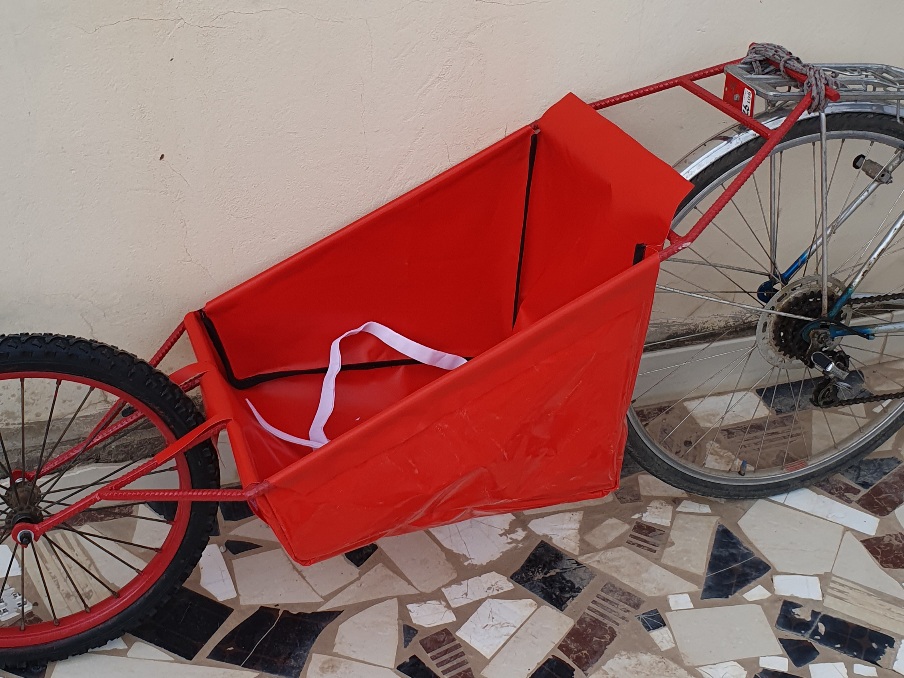
I smash together a frame design after surfing the web; one wheel for less resistance. A bag to hold the luggage rather than a platform; that seems neat. I make the curved design of the net original simpler, measure out and guess the centimeters based on the floor tiles in the salon. Guess the length of the wheel axel based on the size of my smartphone.
I find a welder who agrees to make the frame for 20 000 CFA. He sends me the photo of the finished frame already the next day.
I want a strong canvas for the bags, a big main bag and a small one in the upper space of the frame. The big one I make first, measure lengths and angles using a piece of string. I decide to complicate the design of the small one, create two deeper sections and a shallow division where the back wheel can pass. Later I learn this is a mistake, as the deeper pockets inevitably go against the wheel when I turn. Lesson for next time.
The leftover canvas I roll and keep to make small bags for the back carrier and patches for repairs.
I cut the pieces, glue them together with superglue and ask the downstairs furniture tailor to sew the seams from the inside and cover them with a black binding.
I paint the frame red. The bags are red, too. I tie the end of the carriage to the luggage rack with rope and a little slack, try to make it the same distance. This is a temporary solution; later on I need to find a way to make a joint.
The turning is terrible, the carriage leans to the left and I need to pack it heavy on one side to balance it. But it rolls, it works, and it’s good enough. It is my freedom for now, proudly made in Africa.
…
 Hulkuv loom