I wake up, soaking sweat and panting for air in the tent. I wrestle my legs around, unzip and crawl out into the fresh air. All around me is birdsong, green grass and stillness. My bike, the carriage, my stuff, everything is soaking and scattered on the porch of the house, the tire flat, the carriage tilting, sloppy, sad.
I arrived in the dark, exhausted and hopeless after the rough ride, couldn’t reach the person who was supposed to give me the key and so left everything just like that, pitched my tent in the garden and collapsed to sleep. Now, rested and with more patience to start unravelling, I dial the number again.
Baye Moulay comes ten minutes later. He is a big smile and a hat on top of a thin, tall man. He is living with his lovely, equally smiling wife Zeinab just a bit down the road. He hands me the keys and looks at the mess.
“Can I help you with anything? I’m heading to the village, do you need anything from the store? Will you come and have some rice later on?” He is an absolute sweetheart. As his hat bops away along the other side of the wall, I feel ready to settle in.
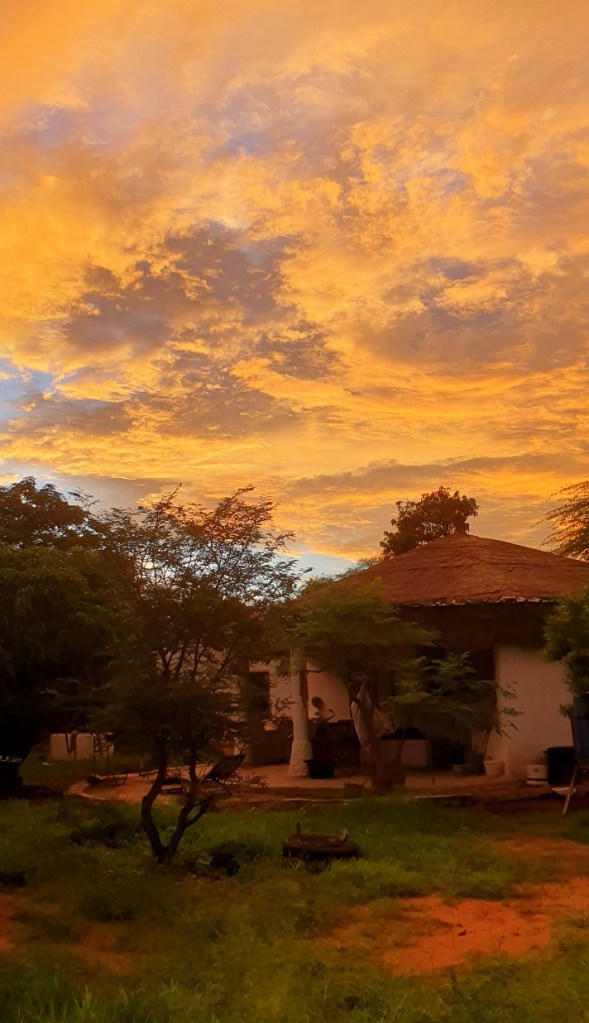
The house is a single room, big and round. The walls are white, the roof is thatched with natural straw. The kitchen is on the outside, a simple bar table and counter with crushed tiles overlooking the garden, a gas stove and sink with running water from the well. The garden is big. Bright yellow birds gather to chatter in the bushes with the bright yellow flowers. Sometimes they venture into the kitchen look for forgotten goodies. Thick brown centipedes make their way along the gray tiles, especially at night. Sometimes they bump into my feet, stop and wait politely for me to move before they continue their way.
Inside the light is dim. The floor has seashells cast into it, cool and a little rough against my feet. A big desk is cast from the wall, following the rounded shape of the house. Small classy designer chairs, a low table and a carpet occupy the middle of the room. Vases with dried flowers and woven baskets are spread tastefully; colorful batique fabrics, blankets and cushions contrast the white walls, yet the space remains minimalist and chic.
I stuff most of my things into the closet and leave the rest in a pile on the floor. I decide to sleep on the couch.
…
A burst of rain later I venture out on my first walk. The sand is wet and heavy. I head for the far-garden to see what it looks like now, step aside for a horse carriage and pass greetings to the young boys whose shaved heads follow me. I turn onto the track and glimpse a light-brown movement further away on the field. Could it be…?
They run toward me and for a moment I wonder if they will recognize me. But Pastek’s tail starts waving wild and she smiles when she hears my voice. Even Pulo comes up for a courteous sniff before resuming the lead. They have a new friend. She stays shy a little behind me as we all jog toward the garden. She has the same warm-brown color as the others and I wonder what her name is.
In the beginning of August The Village is transformed completely. Gone are the dry yellow plots of land, squared up and for sale as they were when I first arrived in March. Instead neat rows of small peanut plants push through the moist, red sand. The air is fresh. Groups of boys and men weed the fields in the early mornings, working their way forward with weeders attached to long sticks. Last time, skinny horses were doing their best to chew through the yellow stalks. Now the roadsides are lined with green grass growing taller than me and all the horses and donkeys have round bellies and perked ears. I take in the changes.
This is where I will wait out the rainy season.
…
Elhaj steps into my garden with a smile in the afternoon. The word spreads fast.
“Long time! I haven’t heard from you.” It’s true; we haven’t spoken since my last stay in The Village. His dreadlocks reach to his shoulders and he is wearing a soft beanie and a long dress.
“Happy to see you again.” His warm smile and calm, unhurried voice reminds me of why I’ve missed The Village. I have loved living in Dakar, but I finally feel like I have time to breathe, walk and talk in my own pace.
“Do you know where I can fill my water bottles?” I ask him. The well in the yard is salty as the house is close to the lagoon, but I have heard that I can go into the village to find freshwater.
“Nooo, you just come to my house to refill your bottles,” Elhaj replies. “We have a water filter. Do you need to refill them now?” No protests or offers to pay help, of course. With my two 10-liter bottles we set out to his house, a walk that will become a weekly routine during my stay.
…
I meet Balla for the first time when he comes by the house to plant seeds. My hostess has left the house and the garden in my care for the month, but all the bigger repairs and some of the gardening are Balla’s responsibility. He enters quietly, with a shy smile and his short locks pointing in all directions from his head.
He cradles hibiscus seeds in the palm of his hand for me to see, then he shows me the young hibiscus plants that have already sprouted, the green leaves and purple stems. He makes holes in the sand with his finger and pokes the seeds into the ground. He takes me around the garden and introduces me to the trees; this is grapefruit, cashew, tamarind. Together we clear a space to plant maize seeds and he leaves a handful in a cup, instructing me to change the water every day. Like this, we slowly find a common ground in French.
Balla is from Casamance, the southern part of Senegal, which is why he is used to the forest and the village life.
“Do you know how to take out cashew nuts?” I ask. I was introduced to the cashew fruits in the Gambia but never got the chance to learn how to take out the nut from the acidic, poisonous shell.
“Of course,” he replies. “You have to burn them. Collect the fallen ones, let them dry in the sun and I will show you sometime.”
Balla comes by the house almost every day to check on the garden. I offer him a glass of water and he smiles his shy smile. Sometimes I see him out on the fields, doing one small job or another. I ask him questions in my struggling French and he tells me about Casamance and dancing as the Konkorou; about working as a fisherman in Mauritania and running from the police who used to target the Senegalese workers; about coming to The Village, and his kid in Dakar. He doesn’t mind repeating words, miming with his hands or waiting while the translator loads. No wonder he is so kind to me, I think; he knows what it feels like to be a stranger.
…
With the moon hidden behind heavy clouds, the nights are truly pitch-black in The Village. The lagoon carries the barking of dogs and the howling of jackals. Bats chase quietly around the garden. A big spider lives under my bed and sometimes comes out to run a few laps around the room. Lizards who I can not see nor hear move in the cracks between the straw ceiling and the walls; I know that they are there only because I find their poop in the middle of the floor when I have been out.
The air is thick with cricket songs.
From my desk I hear a Baye Fall approaching, his song coming from far away on the road, then closer.
“Allah-illah, ill-all-aaaaah.” At the same time the beginnings of a prayer call echo from the village, distant and disrupted:
“Allaaaaah akhbar…” A few birds begin to agitate over something in the bush by the kitchen, debating lively though it is well past their bedtime. I pause my writing and listen to them all. Then the Baye Fall passes, the prayer call ends and the birds settle. All that remains are the crickets and the occasional barks and howls from the lagoon. It is how I like it.
…
Sometimes I bike over to visit the town, rarely running any real errands but maybe buying a juice or something to justify a stroll in the air-conditioned supermarket. To reach the town I have to pass through the lagoon and nearly every time I get lost between the criss-crossing tracks and patches of forest that look the same to me. Often the path is flooded, and I have to take off my shoes and push my bike through the water and mud. Small black crabs scatter from where I am about to place my feet, white herons wade further off by the mangroves. I am only guessing the direction.
Every day, every moment even, the colors are different. Burning red, bright white, dense grey and black, shining green and open blue, stretching on and on. Most days the sky is wrinkled with rain clouds, but somehow that saturates the colors even more.
I enjoy the open space. With time I learn which tilting baobab to orient toward and which tracks are more likely to be dry. The overcast sky sharpens the colors and dark clouds surround the lagoon along the horizons. I push down on the pedals, break the silence and return at dusk, just as the wind begins ripping at the trees.
I lock the door and huddle inside in my small bubble of warm light, writing, sometimes drawing or listening to a podcast while the storm picks up and the pitch black howls outside. I wonder if everyone else also huddles.
I wonder if anyone else even exists.
…
I usually find Elhaj working on something in his garden; weeding, building or painting one of the rooms whenever I come to visit. His family is traveling and he is alone in the house. The dog, still a big puppy, is either barging around or tied to one of the mango trees and the chickens are strolling in the pen. An incubator beeps in the kitchen. It is in his house that many of the village’s Baye Fall live and gather. Most of them are young men, with dreadlocks and boyish smiles. While my two ten-liter bottles slowly fill up we loiter, eat and talk about nothing in particular, uusually with me pointing to different things and asking for their names in French.
Elhaj brings me heavy bags full of mangoes. He comes by my house in the evenings to chat and holds all the patience in the world for my stumbling and infuriatingly long stories. He helps me conjugate and find the words, gently correcting my mis-pronounciations. It is slow and hesitant, but at least I am finally speaking.
We spend long evenings on the porch, looking out on the darkness around us. Sometimes under the naked kitchen bulb, sometimes with the glow from his cigarette as the only light.
“What are the things, there, the ones who make this sound? This ‘drrrrrr’?” I wave my hand vaguely toward the dark and the invisible crickets.
“Grillons,” he replies. I try the word out in my mouth. Elhaj rolls his R:s when he speaks. I don’t know if it is a Wolof accent or his dialect, but I take and apply the mannerism, relieved to do so instead of the conventional French way of muting the R through the throat; this way is closer to my languages.
“Grillons, grillons… And the ones in the lagoon, the ones who sing? Not the dogs,” I try. “The wild ones.”
“Les chacals,” he offers. We sink back into a stretch of silence, the jackals and the crickets singing, inaudible bat wings and breeze. I try out my new words:
“Do you like the crickets?”
…
Baye Ousman is the older gardener working for my hostess in the far-garden. He comes early in the mornings while I come later in the day. His face is kind and mild, and like me he doesn’t speak much French. Instead he teaches me with his hands; he measures the distance between the plants with the palm, burrows his fingers into the sand and scoops out a small dent for the baby salad. Then pushes the sand down hard around the roots, fingers attentive not to hurt.
One evening Balla takes me to Baye Ousman’s house and I get to see his own garden; it is small but packed with trees, bushes and vegetables. I am introduced to them all: the red dots of chili hanging close to ground, the papaya still hard green pods, lentils that apparently grow from a tree, green lemons just getting ripe, avocado trees with their big droopy leaves, cucumber and pumpkin crawling along with their unabashed flowers, and a range of other flowers, orange, red and yellow poking out in every corner. Everything thriving, pushing softly on each other, breathing in unison.
The house is vibrant with Baye Ousman’s children and grand children living together, happy like the plants in the garden. The youngest grandson clings affectinately to his legs and when the oldest son Ibrahima comes home I am thrown off balance by seeing Baye Ousmane’s same kind face, only mounted on a taller body; so much does he resemble his father! We sit together, Balla doing most of the talking while Baye Ousman, Ibrahima and I only smile and nod to each other. Despite not speaking a common language they seem delighted to have me there. Before we leave Baye Ousmane goes to fill up a plastic bag with lemons from the tree. I carry it back home while Balla leads my bike.
…
The baobab tree blooms white and juicy and from the house I can hear the heavy thumps as the flowers fall to the ground. A few days later a small green knot of a fruit has formed, hanging from a long stalk. I glance up. More are coming.
I pull up grass by the roots, amazed at how fast it grows. I carry the armfuls over to the fence and throw it to the neighbor’s little nightmare of a donkey, Max, so that he can have something other to do than crying, sulking and trying to get over to my side to wreck havoc and eat the hibiscus plants.
“You should put your shoes on!” Baye Moulaye lectures me across the wall as he passes. We both look at my guilty feet.
“It’s dangerous! There are snakes and scorpions here!”
“Yes, I will put them on,” I lie.
“Good! Do you have everything? I’m going to the store. You have mosquito spiral?”
“Thank you, I have everything,” I smile as he heads off. I appreciate Baye Moulaye’s concern but am sorry for him having adopted such a wayward monkey as protegé; my feet stay bare as I run to the far-garden, barge through thorny bushes and scorch on the hot sand.
…
Abdulrahman’s house is big and bright pink, two domes surrounded by a beautiful garden. He has built it himself. I spend many days and evenings in his bright yellow kitchen; it is my friendship with him more than anything that has brought me back to The Village. His friend Moses, who is staying there, quickly becomes my friend too. Moses teaches me how to cook stew on cassava leaves and we scream and jump away as the sauce bubbles up and showers us and the kitchen in hot droplets. Other times we laze around, draw or record silly dance videos for TikTok.
Both Abdulrahman and Moses are from Sierra Leone. Abdulrahman has been in Senegal for many years already. He speaks both Wolof and French and is running his own construction enterprise building eco-domes, traveling and giving workshops. Moses arrived to Senegal around the same time as me and speaks neither Wolof nor French. When we go out together people assume that he is Senegalese. They approach him in Wolof and he promptly turns to me as I start waving my hands and deploy my shaky French while the person’s brow tightens in concentration, trying to understand if he is being pranked. I watch how the famous Senegalese Teranga, the culture of hospitality strains, as many don’t seem to have nearly the same amount of patience with a black foreigner as with me, a white one.
“He should learn Wolof!” a security guard snaps at me once when we are at the beach. “He is living in our country!”
“Relax, he came last week,” I smile and lie. The guard still looks annoyed, but I get away with no remarks on my own lack of language.
On the way back we walk over the lagoon and Moses teaches me how to curse and insult in Krio, the official language of Sierra Leone.
“Puli papaya!” he yells at a dog to make him stop following us.
“What does it mean?” I ask and Moses stops to think.
“’Remove your father from here,’” Moses replies, and we burst out laughing.
…
Some weekends my former roommate-sister comes to visit me. She dances out of the car and into my hug and opens her arms to the green.
“It’s sooo beautiful here!” she exclaims. Then she collapses in the deck chair as if pulled by magnetic force. I have to smile. She will not lift a finger for the whole weekend but I will happily provide us with pancakes, lentils (her favorite!) and fresh bread, thrilled to be the one hosting for a change. We go to the beach, play music and gossip, and I am happy to see her eat and sleep away the circles that her new job has painted under her eyes.
Sometimes she brings friends from the city; once a tall and lanky model with a quick and witty mouth. He calls himself a lion and I call him the Bunny. While my sister naps we run in the lagoon, chase crabs and visit the magic well. In the evening he cooks us “bachelor’s bread”, basic thin flatbread made with flour, water and salt and we eat it all with bean stew, loudly sending him back to the kitchen to make us seconds and thirds.
I join my sister and go back to spend a few days in Dakar, to stay out late, dance and sing karaoke. She is living with a Senegalese family who accept me as theirs, invite me to eat, to drink tea on the porch and joke around. Once they even bring me along for an outing with the whole extended family, twenty kids splashing in a pool and piles of sandwiches. Needless to say, my cup is never empty.
…
One day Balla shows up at the house with a white paint bucket. He looks his same calm self but somehow slightly smug. He puts down the bucket and comes to sit.
“Heey! What have you got there?” I shout, elbow-deep into washing dishes.
“Go and look for yourself,” he smiles. I dry my hands, pour him a glass of water and go to glance inside the bucket. Curled along the bottom lies a big lizard, dead, a bloody hole in his throat. The grey-yellow scales are round and smooth like pebbles, the long nails curve from the thin fingers. I have never seen a guy like this before.
“What are you going to do with it?” I turn to Balla.
“Eat it!” he beams.
“Eat? How?”
“We will grill it. And from the skin I can make an instrument,” he continues.
“An instrument? What kind?”
“A musical instrument!” With his hands he mimics a gourd with a stick coming out, strings, and finally the lizard’s skin pulled tight over the gourd.
“You are crazy,” is all I can say. “Is there something you can’t do? You know how to make everything!” Balla’s smile widens and he says nothing. His eyes turn away for a moment and I smile too; I have learned that this might be his way of blushing, smiling and turning quiet every time I compliment him. I find it funny.
A few days later, as I return from another weekend in Dakar, I find the lizard’s skin pinned to the clothesline to dry. I touch the scales. Apparently I missed the barbecue.
…
On a Sunday morning I shower, clean the dirt from my fingernails, put on my only dress and a little perfume. Moses is picking me up on a moto to bring me to church a few villages over. He shows up in his Sunday best too and I hop on. The whole scene makes me smile; last week he taught me insults in Krio. Now he navigates carefully through the sand and drives prudently along the big road, no doubt mindful that I’m scared.
The church is in a quiet neighborhood in the next village, in the bottom floor of a house. The street is flooded after the rains. The assembly is small. I sing the French lyrics projected on the wall and dance along to the woman drumming, then zone out completely during the long sermon which is given in Spanish by the Spanish priest, then translated to French and Wolof simultaneously. The small children run around and play tag between the chairs. I glance over at Moses sitting on the men’s side of the room and see him focused on his phone, no doubt doing his best to translate the cacophony into English.
…
I invite myself over to Elhaj’s one morning to learn to cook supukanye: a slimy sauce prepared from fish and okra. We buy the okra fresh over the fence from the neighbor. Then we pound the garlic, the leeks, the spices and the okra itself and boil it into a sauce. We top off with red, thick palm oil and watch how the bubbles slow as the sauce thickens. We wait impatiently for the rice, get spoons for everyone and fill our bellies. It’s rich, fresh and slimy; Supukanye is my favorite. I get a full dish to take back home with me.
At home I cook stews on lentils, beans and aubergine in my outdoors-kitchen. I bake quick flat bread in the frying pan, I make pancakes. I mix tahini with cacao and sugar into chocolate paste. I nail cooking rice on the gas stove. I learn to not leave food out overnight as hungry beaks and monkey fingers are eager to investigate, and I learn to leave the mangoes to ripen in a plastic bag or to boil them with the skin on. I peel and mash and leave the mush in the fridge for cold sweet spoonfuls later on. Or I mix the mush with salt, lemon, garlic and onions for a savoury mango sauce.
There is always something to eat and I am happy to finally be able to host and invite, to be the one to call out the few Wolof words I know so well by now to whoever might come by:
“Kai, anj! Kai, re’er!”
Come have lunch! Come have dinner!
…
A baobab fruit has fallen into my well after a storm. I watch it float, big and green on the black surface.
I head out barefoot with an empty plastic bag. The sand is moist, the sky overcast. The garden work has torn up blisters in my hands. Everything is glistening green, the fruits are forming fast and the rains are getting more rare. The peanut plants on the fields have burrowed their babies into the sand and I place my feet carefully, trying to avoid them as well as the thorny twigs scattered around as I cross the field. But even so I get pricked; it can’t be helped. I head for the mango grove to look for fallen fruit and I fill up the bag in minutes. Small drops of water fall on me as I brush by the leaves. Some mangoes have bites missing, a sign of monkeys having tasted and then cast the fruit aside. I leave those. The monkeys are plenty here. They live in small groups. If one springs down from a tree or crosses the road ahead then the whole family follows, but they are shy and keep well away from humans.
“That one is no good,” Balla says when he sees the baobab fruit standing on the table. It took me twenty minutes to fish it out of the well with a bucket.
“Really, why not?” I ask him.
“You can not eat it. It’s not ready.”
“And it will not become ready?” He shakes his head. He goes to get a knife and cuts open the baobab to show me the dents that would have become the seeds, white and shrivelled. I turn the pieces around to look. The sun sets and colors the sky warm gold. The oxidation quickly colors the white insides of the baobab purple, brown and yellow between my fingers.
…
In The Village, I am never truly alone. People often drop by to see what I’m up to, and if they don’t then I can always go to any house, sit, chat and stay for as long as I want. I have greeted all the trees, sung all the rain-songs and asked all the birds for their names. I know the village traders and the welder, the criss-crossing trails leading through the bushes, the people passing the house by foot, carriage and moto on their way to work.
One month passes like a handclap.
I have avoided telling people exactly what day I am leaving, partly because I don’t know and partly because I don’t like saying good-bye. Yet, somehow, everyone seems to know.
I pack my bags and clean the house on one of my last days. Baye Moulaye peeks over the wall just as I am chasing away Max the donkey with sticks and rocks from the fence. My feet are bare. He asks me how I am and if I need anything. We agree on where I will hide the key and I thank him for everything.
Balla comes in the afternoon and shows me how to roast the cashew nuts over the fire.
“It is usually children who do this,” he tells me.
“It is the children who do this?!” I repeat later as the nuts explode into flame and I have to jump back.
“Isn’t it dangerous?”
“They are used to it,” he smiles. He shows me how to knock open the burnt shells with a rock and we share the half a bottle of gin I’ve got left.
Abdulrahman and Moses come from a run on the lagoon just as the sun is setting. I offer them water and the still-hot cashew nuts and we bend over laughing as Abdulrahman teaches us profanities in Susu.
Elhaj’s familiar voice delivers a greeting from the dark as he enters the yard later to join us. Once everyone has left, the two of us sit and listen to the crickets, not saying anything in particular.
“When will you come back?” he asks.
“I don’t know.” He takes out a bracelet from his pocket and reaches out to put it around my wrist.
“This is typical Baye Fall-wood,” he explains. “This is so you can remember us.” I stay quiet and let him fasten the bracelet.
As if I would forget a home.
…
The sun is harsh in the morning. My back tire has exploded during the night for some reason and I don’t have enough patches to fix it properly. Everything is scattered. The chain is rusted stiff from all the salt in the lagoon, my carriage is still not done the way I want it to, meaning I can not turn that well, and I have too much luggage. I haven’t managed to sell my big backpacker’s backpack; I haven’t even tried. There are a million things I haven’t done.
I start patching up another tube, one that I’ve patched five times already, and hope that it will last me the ten kilometers until the supermarket where I can buy a new one. I am on the verge of tears when Balla shows up. He takes a glass of water and sits down by the table, looking at me on the floor and patching the tube among my million things.
“I used to do that,” he remarks. “It’s not so hard. We would sew the hole, then glue on the patch. Hit it with a wrench.” I look at him and I have to smile.
“Is there something you can’t do?” I ask. His teeth flash white.
…
I pedal out into the lagoon, the carriage swaying slightly behind me. The sand is moist and resisting, but it works; it all works. The tire holds air. I know the tracks so well by now. A herd of cows passes by.
My heart is fucking breaking.
It’s OK. It’s all OK.
I wait until the cows pass and I greet the boy walking behind them.
I can cycle despite the sadness. Together with the sadness.
The land opens up more and more for every stroke of the pedals. The shape of the familiar space is round and growing smaller like a beach ball, a tennis ball, a marble behind me. It falls back and I focus on it for a moment; let all the good that’s passed, every kindness and blessing, carry up my spine a little straighter.
But never anchor me down.
Yes, leaving is hard. I do not understand why I am choosing this heartbreak over and over again, but I don’t need to understand. And if it’s unbearable I can always go back, I remind myself.
I turn into the town. The road hardens and I pick up speed. I watch the traffic, avoid the flooded parts. Yes, I have been here before, cycled this way twice already, but never on this particular day, with this particular heart.
Yes.
A marble, a bread crumb; my heart lifts as if by sails.
It is not all heartbreak; I love this, too. I want the unknown; to see what awaits beyond my small, limited imagination. Beyond my familiar bubble of light. The world is so, so big. So unimaginably endless. And I pedal right into it, excited to try.
Good-bye, Thiafoura. Take care, and thank you.
…
(This story told in pictures and video, part 1, 2, 3, 4, 5, 6, 7, 8, 9, 10, 11, 12, 13, 14, 15 and 16.)
 Hulkuv loom