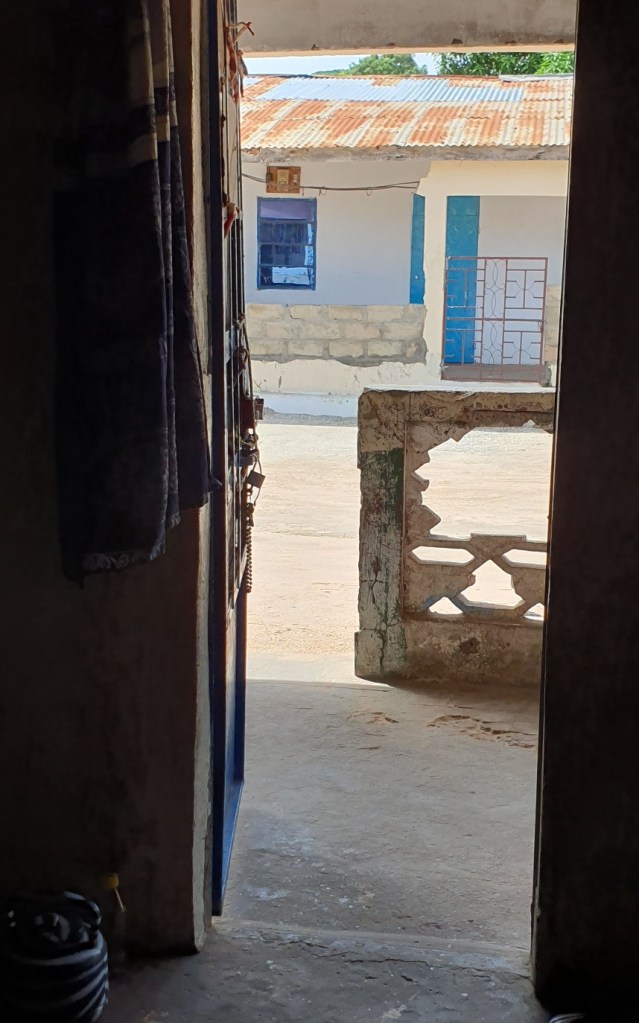
When he wakes up in the morning he goes somewhere. I don’t know where and I don’t ask. I wake at my pace, alone on the mattress that we share. I wrap a fabric over the shorts I sleep in and open the curtains and the door, let in the light and get a bit of air passing through the two rooms. I make the bed, organize the few belongings in the sitting room, sweep the floors and beat the carpet against the railing outside. Barefoot children patter out from the rooms next door, climb and cling on the railings, cuddle curiosity to my face and ankles. Veiled neighbors walk by and pause to look and say good morning. Inside, I stack the empty bowls from the day before, usually brought from his stepmother’s house, sometimes from the next door neighbor; we don’t have a space to cook, so they take turns feeding us.
When he returns he is in a good mood. He smiles when he sees me. I am happy to see him, too. We say good morning. When we are inside and nobody sees, he steps close; takes my hand or pushes a quick kiss to my cheek.
The first time I slept in his room was against my will, during a rainstorm three months ago. I worried about what people would think, or that he would try something. Now this is my home. My bike is leaning against the wall in the sitting room and my bags are in the corner. I keep it tidy.
He goes out again to get us breakfast. Cups, spoons, sugar, teabags for him and a nescafé package for me; an electric kettle of hot water. He brings all this from his father’s apartment across the yard. From the store outside of the compound he brings the bread I like; sometimes filled with egg, sometimes boiled potato, sometimes just mayo. I serve him tea the way he likes it, with a little sugar in the bottom. He places the newspaper-wrapped bread between us and tells me to eat. I break it and give him half. We munch the bread, sip the drinks and talk about the day.
“Do you have any plans today?” I might ask; sometimes he has planned to meet a friend or run some errands with his father.
“Nothing, I am free,” he will say most days; there is no work for him and most errands are spontaneous. “What do you want to do?”
People don’t hug here, don’t really touch openly.
The sun was already high the morning I rolled into Gunjur. All my stuff was soaked from the thunderstorm the night before. I turned off the asphalt and into the familiar road, now riddled with wide puddles. Turned again onto the wide sand street, passed the small shops, the school, the welder’s. The compound gate stood open and just as I hit the brakes a figure stepped out; a familiar, small shape; straight back; that swagger.
I hadn’t even told him what day I would come, yet there he was, his steps in sync with mine.
And he turned his head straight to me. And he saw me and the smile broke into a million pieces everything, everything that had been up to this point; his day and mine; erased it and I forgot all else because it was truly unimportant. My wet baggage and awkward arms; the months of his voice notes I hadn’t replied. I could nothing but smile.
“You are the second woman I’ve loved in my life.”
He takes me to the beach. He takes me to his father and his stepmother’s so that I can learn to cook traditional dishes and play with his baby sisters. He takes me to the football game and to reggae night at the local club so that I can dance. He takes me on visits to his neighbors, his elders and friends. He takes me to the welder to fix my carriage and at home he teaches me how to properly mend my inner tubes, his specialty; from the age of sixteen and for nine years on, he was working as a vulcanisateur.
He takes me on walks in the forest, just the two of us. He tells me the names of the trees, picks fruit for me and watches my reactions as I try. At night we lie in his bed, talking to the sound of the fan.
“Do you remember the first time we met?”
I have to admit I have forgotten. His memory of me is earlier than mine of him.
“You came for Tabaski, do you remember, we had slaughtered that sheep? Do you remember who slaughtered it?” I only remember several people preparing and cutting the dead animal; blurred faces, bloody hands, crows landing nearby and picking at the pieces of guts thrown for them.
“Then we ate it, do you remember who was the one grilling the meat?” I only remember a plate being brought out, full of meat and raw onion, many boys sitting on the low wall and me on the edge, many conversations flowing at the time, only occasional English. I thought it was a child bringing the dish? Or who was it?
“And then we were all eating around the dish. And the others finished but you were still eating, and I thought “I will stay here and eat, maybe she will feel shy when she sees that the others are finished and she will stop, too, even though she is still hungry.” So I ate and only stopped when you had finished.”
I remember this. I remember exactly this. Somebody; just not that it was him. His quiet shape next to me blurred behind the sounds and the movements of the others.
He was kind to me long before I had even noticed him.
…
His father takes care of me just as much. He always checks in before going to work, wishes good morning and good night, stays to chat. He has recently re-married and is raising two daughters, a two year-old and the baby, only three months. He is excited and happy. His wife, my friend’s stepmom, opens her home for me. I set my alarm to go to the market with her and spend the day in her home cooking. She always prepares food for herself, her husband and their children, her sister’s husband and children as her sister is out traveling, and the neighbors, two single men who contribute a little to the cost. Now she also prepares for me and my friend.
She carries the baby on her back while the two year-old totters around the backyard-kitchen. She lets me do the easy things, like peel, cut and pound. The rice and the frying she does herself, afraid I would get burned or mess something up. I jokingly call it wife school.
I am dead-tired the evenings when I return home from her house. I bring the food in a bowl and we eat in his sitting room; concrete floor and empty walls, single light bulb and dusty shadows, a few things in the corner. One small table, two broken office chairs. Neighbors’ cats sneak in through the open door and beg for bones.
Sometimes his father joins us for dinner. Some evenings we chat, on others we are all tired and spaced out. Three spoons, same bowl. Always rice. They slow down for my sake, but when I lay my spoon down the last disappears quickly, their silent eyes on the diminishing rice.
One evening his father’s face is excited, bursting with something. We sit down and he brings forth a bag.
”I bought you something,” he says, smile barely holding back. From the bag he takes out a mug, black and shiny.
”This is for you,” he places it in front of my friend, then reaches into the bag again.
”And this one is for you,” he goes on and places another mug in front of me, a white one. He cracks up, almost giggling.
”Get it? Because he’s black, and you’re-!” his laughter interrupts him. ”White!” he finally manages. We smile, too, say thank you, laugh a little. Dad-humor is dad-humor everywhere.
“Are there many people patching inner tubes in Europe?”
He is lying on his back and looking at the ceiling. He has told me how he wants to go to Europe. That he wants to work hard, do anything. He wants to earn money to build a house, marry and provide for his family.
Children are running in and out of his room all day. He lifts them up and eats at their bellies while they squeal, makes his voice funny and sings their names. His own daughter is with his auntie in Casamance.
In his life, he has studied for four years at a Coranic school and for almost one year at a conventional school. He speaks five languages but can barely write. He works in construction, knows how to drive anything, does any physical labor. He tells me how he rented a car with a friend last season and went to the forest to collect the small, yellow scrumpled kaba-fruit. He climbed the trees and cut them down with a machete. They filled up nine sacks and sold it all for more than two months worth of salary.
The only time I see him slow down is in the evenings when he rolls his joints. His fingers are sensitive, deliberate. He carefully closes the paper between his fingertips. The tip of his tongue, so light between the full lips, reaches out, wets the length of the paper.
I watch. I wish he would touch me like that, too.
“God has sent you here to me and no matter what happens, we will be together. Somehow. I trust god’s plan.”
He always does his five daily prayers. His voice is beautiful when he prays, deep and melodious.
I mend the boubou he prays in. I offer him kind words. I sometimes pay for the food he brings, though usually he refuses my money. He once asks me money for weed. I give it. Other than that, he never asks for anything and I don’t offer.
I wonder if it is enough.
I know that he loves me. I love him, too. But I don’t know what that means.
Does he love me because he hopes I can bring him to Europe? Am I beautiful to him because I am white and he associates whiteness with money and a security he’s never had? Could I hold that against him as he is sitting in his spartan room, not knowing when the next job might come?
…
He leaves me alone when I want to. He is either immune or oblivious to all my distancing-habits, my shut-downs and descents into silence. Or he sees, but doesn’t mind. He just gives me the space and lets me come to him when I want.
In truth, I am tired. All the attention is getting to me. In the morning the neighbors gathered when I went to the tap to do my laundry. Look, the white one is washing. They always look when I cross the street, call out, want something.
I really want to not mind it so much, really wish I had more patience. I want to hide in the room but even when I do I am just waiting to be interrupted; someone calling or coming by just to see if I am there.
“I just feel like I’m a strange, white animal,” I laugh on one of our forest walks. Exasperated; trapped between eyes and with no way to assert any boundaries.
“You are not an animal.” His tone is serious, sentence definite.
His eyes pour love on me from across the bowl at his stepmother’s, with her and all the children gathered around. I am too slow and his stepmom is urging. My lap is full of rice and I feel ashamed and annoyed.
I wonder what he sees.
His eyes pour love on me when I try to bring the missing words into my sentences with my hands; from the forest and the sky I reach trying, trying so dearly to invite him into my future and my past; into my laughter and my wonders.
And I wonder what he sees.
His eyes pour love on me when we talk in his bed and he doesn’t impose or question what is probably an alien in his world; someone who doesn’t dream of marriage and settling down. Someone, a woman, who is traveling alone on a bicycle, claiming Africa; claiming happiness and freedom.
I really wonder what he sees.
”I will love you until I die.”
But this little love is temporary, tentative; forced to squeeze into cracks between cultures and losses in translation. I don’t know what to really think between the layers of interpretations, wishful thinkings and projections. Yet, there is something, something important. We can barely speak to each other, but he is the closest friend I’ve had for a long time.
”I want you to fall in love with someone else and do all the things that you dream of. The person to marry and have children with, it’s not me,” I tell him. He only smiles. I don’t know if he believes me.
”I don’t want to break your beautiful heart,” I say. He smiles.
”Don’t worry.” He doesn’t. He just brings me breakfast and is happy to see me every time he comes home and I am there, suggests things for us to do to spend time together and receives me in the softest of ways.
Once I slip out of my thoughts, being with him is easy.
“I know you are doing your thing.”
And he lets me leave.
He doesn’t drown me in emotion, doesn’t make me promise or affirm anything, doesn’t get cross. His beautiful eyes pour tears and he looks away, but he squeezes my hand, says good-bye and lets me go.
And I go.
We don’t hug. People don’t hug here, don’t really touch openly.
I don’t have a name for what to call this sort of love, so ”love”, simply, has to do. And maybe it doesn’t need more of a name than that.
Maybe it’s good that we are without a common language. The lack demands a different sensitivity when we reach out to feel into each other, forces us to slow down and step outside of our learned expectations. Always feeling. No hopes, promises or projections. After all, isn’t the act of approaching someone with sensitivity and care nothing else but an act of love?
I had two weeks of playing house; sweeping floors and smiling good-mornings; washing his clothes along with mine; receiving all the attention with its blessings and demands. Now it is behind me, his kindness and his smile.
Once rolling out of Gunjur, I cry, too.
…
(This story told in pictures part one and two.)
 Hulkuv loom