I get nervous again, the day I am to leave Gunjur after almost two weeks of stay. Scared of the movement and change, even though crossing the border from the Gambia will technically bring me back into the same country I just left. But Casamance is said to be different; it is Senegal but also not.
At the border I use all of my remaining Dalasi and have a snack feast: tapalapa with beans, sweet drink, boiled eggs, doughnut balls. I get my passport stamped with no troubles, then bike the few kilometers to the Senegalese border check, stamp in and sit down as the sky opens into a rainstorm. I wait at the station as the ground around me turns into a brown river.
I notice the differences straight away. The trees are bigger, the villages smaller. People don’t shout after me, but reply calmly to my salam aleikum:s. Children are walking home along the road in the golden setting sunlight; people move between villages. I pass a crowd of people by the side of the road, a huge speaker set blaring afrobeats from the yard and I dance along on my bike as I pass. Probably a wedding. People smile at me.
And then there is forest. Really: forest. The trees rise high, bushes and shrubbery cover the ground, all sorts of wide-leafed climbers scale meters and meters up, tangle and drape over everything. Stubborn stems wrap tight around the trunks and cling to the branches; it is all wild around me. I recognize yellow pumpkin flowers three meters up a tree. Wild camping might be difficult here, I note.
I pass Diouloulou and turn in to order food from a mama preparing by the roadside. She smiles and serves me small, deep-fried fish pies, fresh from the pot with spicy onion sauce. I eat and watch her work, filling and closing up the dough with a fork. It is about to get dark.
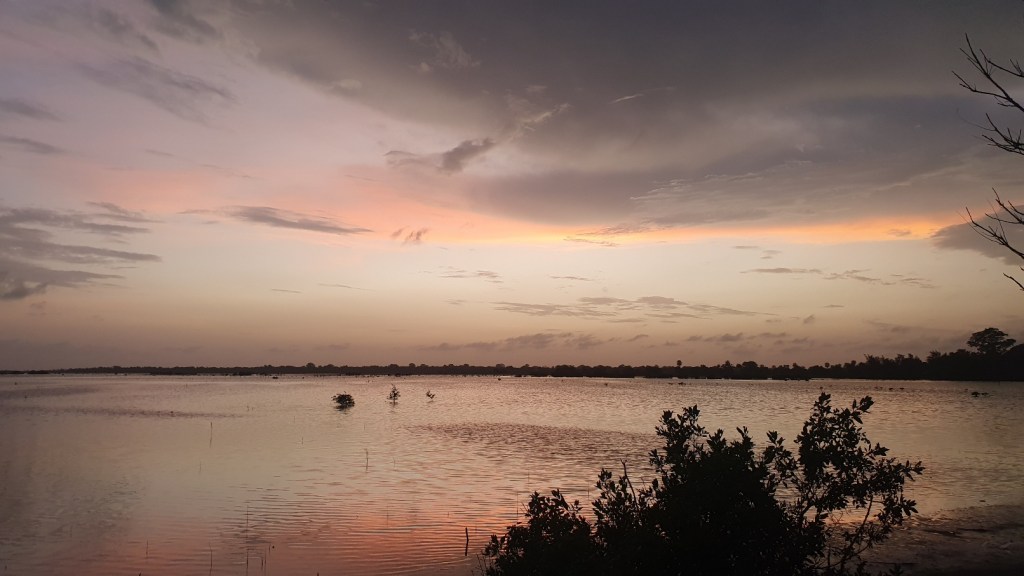
The road passes along a lake and the last rays of the setting sun color the sky and water deep orange between the black and blue treeline. The night sky is coming on deep purple ahead. I get off the road, wade out into a half-flooded field and hope for no snakes and no rain. The darkness closes the sky quickly while I pitch my tent under some trees where the ground is less swampy. I read books on my phone and fall asleep to silence, alone for the first time in two weeks.
In the vague blue morning light I wade back up to the road. It is significantly worse here; sand riddled with potholes. The minibuses, motos and trucks all slow down, sick-sack and bump through the holes as they pass.
The road turns gradually more hilly, winds smoothly up and down, left and right through the high forest. The sky is gray and all the leaves are dripping with water. Bird calls echo and my freewheel is clicking away. Few cars pass, and on my way downhill I let the bike roll, enjoy the wind in my face and the ease of it all.
In the afternoon I reach Bignona and the first food for the day. I look for a restaurant rather than the market in order to sit indoors, which turns out to be wise because as soon as I step inside, the sky opens again to a downpour with no end. I lift my carriage further in under the roof. A delicious thiebudjenn is brought out to me by the mama, fatty brown spiced rice, vegetables and fish on top, steaming hot. I look on as people hurry into shelter, slowly eating my way through the rich meal.
The air is fresh and lovely after the rain. Heading out of the town, I figure I can find a place to camp pretty easily; the satellite image shows mostly green and not many villages. But the green turns out to be more impenetrable forest, steep trenches and wet leaves. It is all very beautiful, but I feel my hopes of finding a place to camp sinking. With the rain, the chances of making a fire and having a hot cup of something will also be zero.
On top of a hill I stop and look down into the village below. People are running along the road in the distance. Some are fastening fabrics around their heads, others are turning off the road and into vegetation and houses. I see the asphalt behind them change color quickly, going from moist-grey to wet-black. The water blurs the forest in the distance. And it’s coming this way.
I secure my hood and look back to make sure the plastic covers the carriage. I hear it coming.
The rainstorm approaches, then stops a few meters ahead of me. The mass of heavy rain closes in, then thins out, backs away and moves on as if pushed by and invisible wall. A few drops hit me, but that’s all. The color difference on the asphalt could have followed a line.
Hours later I am waiting out the rain again, this time in a small roadside shop. Water thunders down and I am pressed inside with people from the village. I sip my coffee and break off a piece of my chocolate bread for the shop owner’s daughter. She has been staring at me the whole time, eyes wide. Her hand reaches up for the bread instinctively while her eyes remain in mine. I look at the map while I chew and sip; it’s about 10 km left to Ziguinchor. I don’t want to arrive there today, but rather find a place to pitch my tent on the way.
I don’t really understand the landscape ahead from looking at the satellite image; winding water and sand, maybe? But I don’t feel like turning back or staying in the village, and so I decide to push on. Surely I will find a place to camp. The sun is just setting when the rain ends.
I head out to the road to go on. This turns out to be a mistake.
…
(This story told in pictures and video.)
 Hulkuv loom