The sun is setting; there is barely an hour left of daylight and I need to find a place to camp. The road turns instantly horrible from Tobor; I rattle out from the asphalt and onto a sand road, full of potholes full of water. They are laying stone but haven’t gotten very far yet; the stones are stacked along the road, some places already set and with high curbstones in place that keep the water from draining, so the puddles lie deep and wide on the road. I have to lift my bike and balance my carriage on the slim curbstone-edges to not submerge my luggage while I wade through the deeper puddles. I’m happy I’ve changed my runner’s shoes into slip sandals.
The cars keep coming. The lights blind me, I have to block my face with my hand and still I rattle in and out of potholes, pray that the cars behind will see my carriage and not hit me. Trucks pass me centimeters away, spraying water all over me. Then the rain begins again, going from a few drops to a raging downpour.
All along the road there is water; delta; no place to camp or even step aside to rest. I can only go forward. The dusk turns dark and I have to stop every few meters and let the cars pass while squinting at the road to see the potholes in their headlights. It is stressful. Everything is wet, everything is the noise of engines and water. Between the cars I push it, lean into every stroke, zig-zag in the dark and thunk into just as many potholes as I avoid, sweating under the rain jacket and thinking only please, might this end.
And then, suddenly, the road turns upward. There is a big bump and I am back on asphalt, heading further up. On my sides I make out the shady outline of forest – and that should mean steady ground, right? A place to camp? I glimpse down, but before I make out too much the tree tops open up and I am on a bridge. Streetlights light the straight railing and the ambiguous distance down. A line of lights lies white on the horizon; that has to be Ziguinchor. Below is black water, above the black sky. I stop and just look at it; it is beautiful.
But the rain is not over and I need to find a place to sleep. It is not so late, maybe around 21, but after a full day of cycling and with my circadian rhythm tuned to the sun, my eyes are falling shut and all I want is to lie down. I cycle into town and take the first turn out again in the roundabout, pass plastic-covered market stands and wet people. I study the satellite image again for the first sign of steady ground but as the city thins out I find myself surrounded by more delta, this time in intervals with dumps and fields. No. It is dark, it is raining, I am wet and tired; I just can’t go on. I don’t want to, but I give up the idea of camping and turn off the road to a small, lit-up shop. People are gathered around the iron bars. I lean my bike and go to greet.
“Salam aleikum, good evening,” I start. They look. A few mumble. My hands go to twiddle with flaps on my jacket and to hide in the pockets. How I hate to ask for help.
“I am looking for a place to sleep. I have a tent. Do you know a place?” I start out in my limping French.
“There are no hotels here,” one of the men says. They are all looking rather sharply at me. “You have to go into town.”
“No, no hotel,” I say. “I have a tent. I just want to know if there is a place here, so I don’t disturb. Like, under a tree, a football field…”
“You have to talk to the village chief,” the shop keep tells me. “Go with her,” he points to a girl who has just received two lengths of bread through the iron bars.
“She is his daughter.”
“Ah, OK,” I say. “Thank you.”
The girl leads me across the road and into the nearest compound. I lean my bike against the wall before coming in. The family, mostly women and children, are gathered around their two dinner bowls when we enter the house. They look me down. I introduce myself and they fetch the father, the village chef. He listens to me as I ask if I could maybe camp in their compound, gesture toward the trees, try to say that I have a tent. I don’t know if he understands, but when I have finished he orders the hallway to be cleared out for me and one of the daughters immediately begins to move the chairs and the stuff; sleeping outside is apparently out of question.
Which turns out to be wise, because no sooner have I carried my bags inside than the rainstorm begins again, turning the whole yard into a mud puddle.
I notice that somewhere along the road, probably on all the bumps, my carriage-bag has let go from the frame and has been dragging along the ground, with water and mud having sprayed in from the back wheel. Everything, everything is soaked and muddy. There is water at the bottom of my backpack and I have to wring all my clothes out. I don’t dare to think about the state of my computer, and I don’t want to take it out to look while I am here. I grit my teeth.
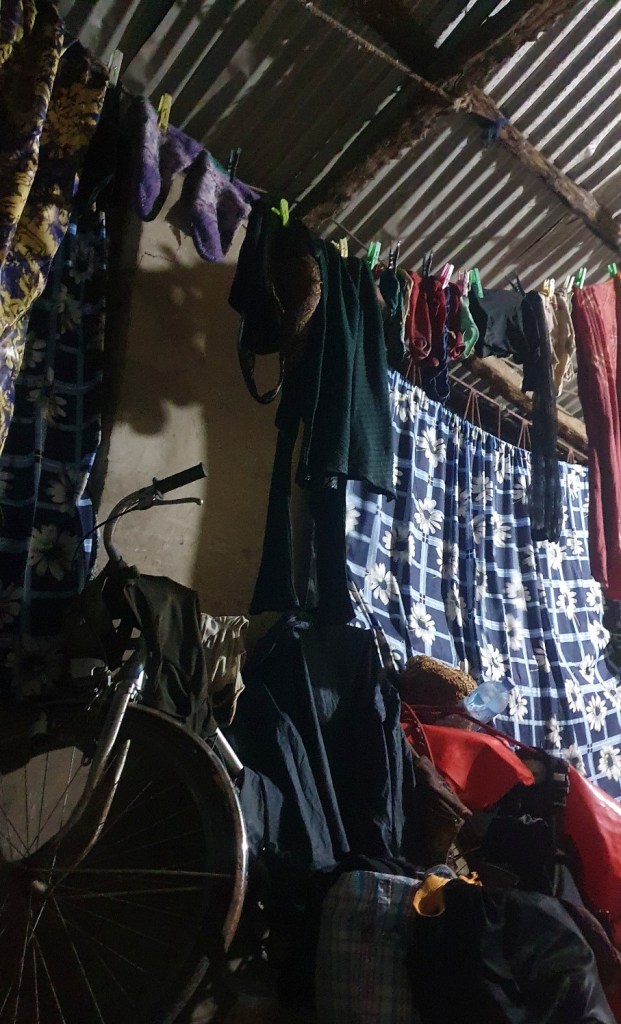
They make room on the clotheslines for my things. They bring me a simple mat and they bring me a pillow. They invite me to eat but I see that they have only barely enough for themselves, so I decline and tell them I have eaten. They are not overly curious about me, not smiling and overbearing; they probably take me in because of a sense of duty, and that thought makes me feel even worse. I try, but I am too tired to small talk and too wet and sorry to be of any interesting company. I just need to lay down and sleep. And dry. They leave me to it, file out from the hallway and turn the light off on the way.
I feel exhausted, ashamed for my neediness, guilty to be a burden and to disturb. But while all my belongings are dripping down next to me, I know that none of that matters. In the end I am grateful to have the rain on the outside, my body sheltered and resting on the inside. Guilt or shame, I know I will feel better when I wake up tomorrow.
In the gray light of dawn I pack my still-wet stuff. I dig through my little pouch and leave a few jewellery items in a messy pile on a chair. When the village chief comes out to greet me good-bye I press a five thousand-bill into his hand; I’m not used to pay for hospitality and I don’t know if I am doing the right thing, but if there’s anything I’ve learned here is that a gift is a gift and it will be received. I can’t bother with thinking about what would be an appropriate amount or what image I am giving as a white traveler; I just want to get going. I point to the chair.
“This is for the women,” I say. He nods and hums.
“Thank you for everything,” I add. I lead my wet bike through the mud. My stiff muscles ache as I jump on and water splashes as I take the road back into wet Ziguinchor.
…
(This story told in pictures.)
 Hulkuv loom