At the border they write my name and information into a wide notebook, one long line of many in the pages scribbled full of blue ink; lines drawn by hand and ruler. I dust off my Portuguese and try to chat and joke with the staff. They smile and joke back. I rest by the border post, with nowhere to hurry and no needs to fulfill.
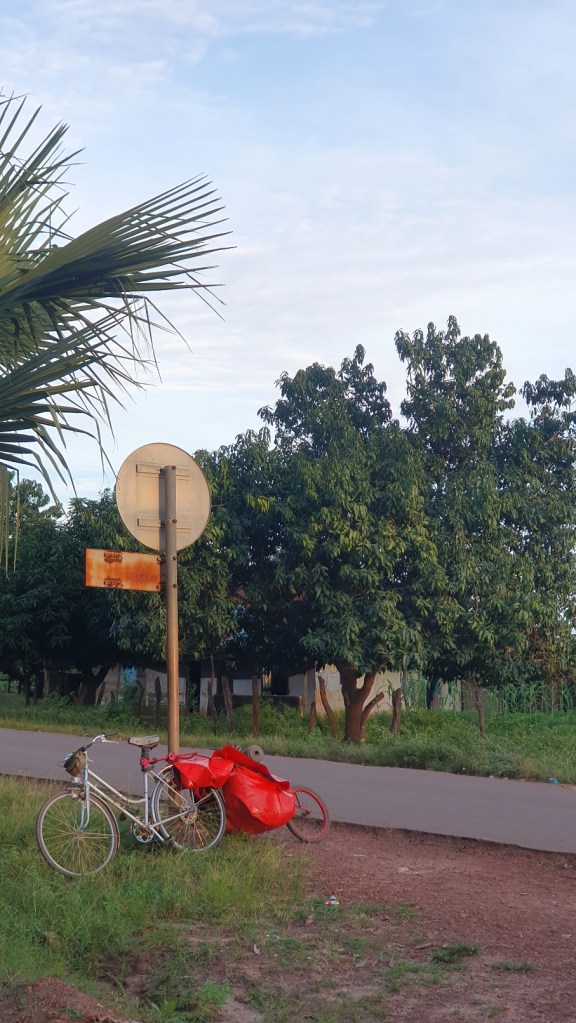
The sky is blue and a band of thick, bright green shrubbery runs along the road. Trees stretch up and bend over the road like ribs, framing me, casting grateful shadow. From here on, the women passing are more often carrying things on their heads: pots, basins, long sticks of firewood hanging down in front and behind them. They are wearing the traditional, colorful fabrics.
It is silent; not many cars pass and the noon is wrapped in thick, humid heat. The bike and carriage creak and clonk softly. I pedal slow-slow. Occasional houses glimpse through the shrubbery. The asphalt is full of potholes but it’s better than the mud road just before the border.
Then suddenly there is a snap and a shuffle, the bike veers to the sides and the noise of something stuck in my back wheel makes me hit the brakes and come to a stop. I turn around. Behind me the carriage has broken, simply snapped in half, and is dragging on the ground, held to the bike only by a few elastic cords. I stand there, dumbfounded. At least I didn’t have anywhere to hurry or any needs to fulfill.
It takes me half an hour until someone passes who can take me on. Two men on a tricycle only carrying a few iron bars. They take on my carriage with some of the bags. The rest I take on my back and we head toward the next village to find a welder. I make use of the potholes to gain speed, push down on the pedals in the uphill while they take time to maneuver around.
The next village is less than five kilometers away. The men leave me with the welders, refuse my money even when I say it’s to buy something nice for their children, and drive off. The welder takes a look at the carriage with his ten apprentices gathered around. He offers me a fair price and leaves me in the hands of one of the boys who cuts and welds on reinforcements and then slaps on some red paint. While the metal cools and the paint dries I go across the road to buy a SIM-card, and stay chatting with the men running the little shop. They are from Mali. I ask them what they are doing so far away from home.
”The people here in Guinea Bissau don’t like to work,” the older one shrugs. Across the road I stop to buy a coffee and chat with a bus driver from Senegal who confirms; despite Guinea Bissau being poorer than his home country, he’s earning better money as a bus driver here than just across the border.
I pack on my stuff and cycle on. The road is calm, the asphalt good enough. Small villages pass by and gradually the yelling increases, grown-ups and children alike coming out to look as I pass; here, the word they yell is ”branca”.
As the sun sets I start looking for a place to sleep. I pass by a small construction on a shop by the road. One of the men there spots me bellows.
”Ooooh! EY! Hello! Hellooooo!!!” Normally I ignore and pass on when they yell like that, not wanting to reward their behavior with attention. And I am already tired from the past few hours of being yelled after. But right now I do need to buy a lighter for my campfire and find something to eat, so I make an exception and stop.
Brahima comes to talk to me. Now that I’ve stopped he calms down. He speaks English and thanks to that has met a lot of tourists on this road.
“Look, this is my friend!” He holds his phone to my face to show a photo of a white older man. “He is from America! He was here!”
Brahima is the shop owner and is building an expansion to his shop to run a little restaurant. I ask him for bread and mayo. From behind the counter I see rows and rows of plugs mounted on a wooden board – a charging station – and so I ask to charge my phone, too.
”I have solar,” Brahima explains, and I learn that this is the norm here in Guinea Bissau; many villages don’t have electricity in the houses and use one charging station powered by solar panels or a generator where everybody goes to charge their devices for a few coins.
I follow Brahima to look at the construction. The men have dug out a foundation and laid the first three rows of cement bricks during this first day. The main constructor is a little younger than me. He quickly smacks the cement into the gaps with a cigarette hanging from his mouth.
”He is the best in the area,” Brahima tells me as we watch.
”Would he teach me to do this?” I ask. Brahima laughs and asks the guy in Creole. The man smiles, but doesn’t look up from his work.
”No problem,” Brahima concludes. ”You’re free to stay and build!”
”And when it’s finished, I can come here and cook for you?” I ask with a smile.
”But of course!”
In the meanwhile the sun has set and we stay sitting outside of the shop. Every other minute someone crosses the road and Brahima gets behind the counter to serve bread, cooking oil, bags of washing powder or to hand over somebody’s phone. The small shop seems to be doing well.
”I haven’t been here for long. It’s low season now,” Brahima explains. ”Around May we have the cashew-season. Then everyone has money, everyone comes to sit, drink and spend. You’ll see. We’re going to finish the restaurant by then.”
A girl from the house next door brings bowls of rice and the men invite me to eat. One bowl is for Brahima and his colleague, the other for the workers who eat by the side. The white rice comes with a thin sauce and small fried fish. They put pieces of fish in my side of the bowl and urge me to eat, and I return the gesture.
”Can I sleep in the foyer of your shop tonight?” I ask. The room is empty and has plenty of space for me and the bike; I doubt I would be in the way.
”Of course, no problem,” Brahima replies. We sit outside for a little while longer, the road and the village all black around us and the only light coming from the shop’s single light bulb and the few passing motos and minibuses. The people move by torchlight or else are completely swallowed in dark. Even in the shop Brahima’s colleague searches the shelves with the help of his phone light. Later Brahima brings me a bucket of water and lets me wash myself in his house next door. His wife is in Senegal with their daughters who study in the French school there.
”The education here in Guinea Bissau is not so good,” he explains.
I roll my mat out on the concrete floor and Brahima and his colleague lock the two iron gates to the shop around me.
”See you tomorrow then,” Brahima says through the bars.
“A manhã,” I smile.
—
During my two-ish weeks in the country, Brahima was one of the few workers originating from Guinea Bissau that I talked to; so many of the others I met were from other countries, which surprised me. Writing this half a year later, Brahima has continuously kept in touch and sent photos of the construction progress. By now, May 2025, the little restaurant is finished and running.
And Brahima loves meeting foreigners and asked me to share his place with everyone. If you happen to pass by, you can pay him a visit right here.
…
(This story told in pictures.)
 Hulkuv loom