I wake up in the hostel.
I have spread all my stuff on the bed and the floor of the hostel.
I buy flour and make pancakes for myself in the hostel.
I pack my stuff and prepare to leave the hostel.
I was supposed to be hosted by a local for two weeks.
I was supposed to volunteer and teach English, was supposed to get closer to Creole and polish up my Portuguese. I had looked forward to that. Instead my host turned out to be sour and absent minded, his four neglected daughters moping around barefoot in the half-finished house and the garden, his youngest son recently abducted by his ex-wife.
I will be at your place in two days if all goes well, is it still OK? I had texted in order to confirm my stay for the third time. Not a word that he was in the middle of a family crisis.
He would, sure, take me on walks to visit friends and family, but only to leave me sitting aside while he ranted about his situation. No English teaching for me. His children still called me ”branca”, not having learned my name even after three days together. On the fourth morning I took my stuff, gave an excuse and pedaled my bike straight into the capital, simply fleeing the discomfort.
”Can you send me a request and leave me a review?” he had asked before I left, thinking of the Couchsurfing app.
”Yes, sure thing,” I said, thinking that as soon as I turn my back, I will never see or hear from this man ever again.
I was supposed to not pay for my stay here, was supposed to be not just a tourist but a part of community, really get to know the country, but honestly I am so tired; the way they yell ”white” at me here feels harsher, colder; sharper than the other places so far. The way they don’t answer my greetings.
”Vá embora!” some teenage boys yell once as I pass on the bike. Go away from here.
”Puta!” a man spits as he passes me on the street. I turn around astonished.
”What did you say?”
I have never been met like that during all of my time in Africa.
I was supposed to love Guinea Bissau, but as I drag my bike up and down the stairs of the hostel and throw my bags on the ground by the bunk bed, I feel done with it; I will stay for a few nights, take the photos, apply for the visa to Guinea and then pedal the hell out of this country. Why fucking force it?
And so I head out; sour, cross, tired. I am hungry. I need to buy antibiotics for a UTI I’ve had for three weeks. The road is blocked by construction work and cars honk at me. I yell back.
I was supposed to like here, but I don’t.
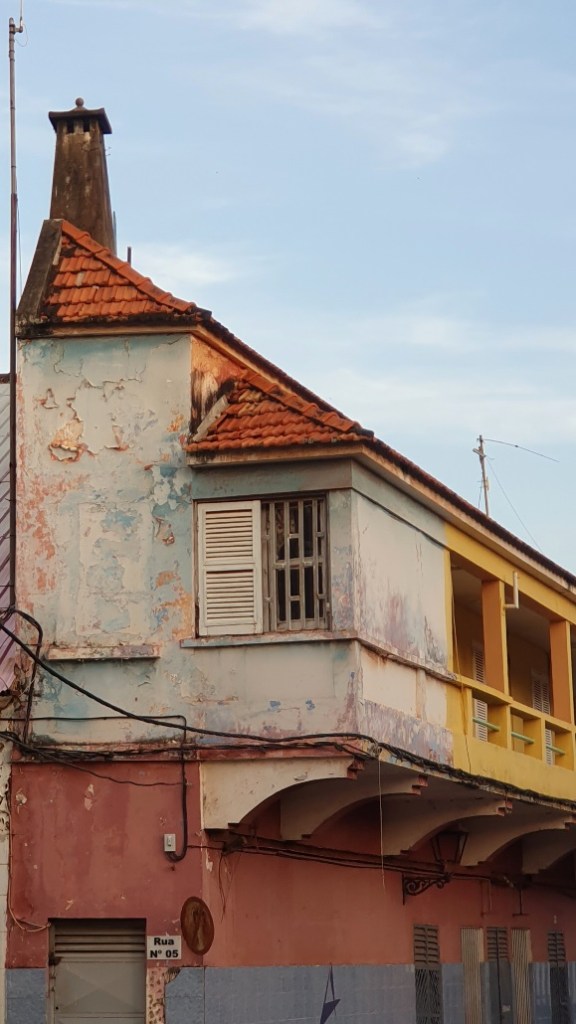
I turn down the street into the old town. A few mamas deep fry golden-yellow dough balls by the side of the road. They laugh and joke and beckon me close. The sun sets golden on the red, white, turquoise, yellow and orange houses; the asphalt is black-black and empty. Kizomba music plays from somewhere, seductive beats echo between the houses; people stroll by and chat, holding hands; teenagers laugh.
And suddenly it’s not so bad.
I bite down into the soft fried dough ball, hot from the oil. The mamas joke and laugh with me and a man stops to chat. He buys me an ice cold ginger drink in a bag for a few coins.
Sweet,
spicy,
hot,
cold,
golden.
I continue down the road and photograph the colonial houses, the angles opening into tight streets where the final rays of sun make the cracks in the paint stand sharp; green leaves growing from the cracks stretch strong, hungry to catch the last of the light. I stroll down to the port and look at the huge, colorful pirogues so far below the bridge; the tide must have lowered them down. The men tying plastic covers over them smile and greet me gently. I head for the port market; dirt-grey stalls and bad-smelling mud puddles, but more smiling faces. The stalls light up in preparation for the night. I chat with a Nigerian man serving spaghetti from a pot as big as a bathtub. Then I head back up the street and run into the man who bought me the ginger juice. He sits on a bench with a friend and gives me the wifi password for a network belonging to a hotel nearby. We sit and surf quietly together. People pass selling popcorn, balloons and blinking lights; children cling to their parents, tourists wearing shorts and nice handbags. The night falls and the houses light up around us. When I tire I say good-bye and head up to the roundabout, more music and vendors, cross the street to the hostel and my bunk bed and my stuff.
Only one other guy is sharing the dorm room with me, already sleeping sound in the other corner.
The next day I apply for the Guinea visa online and to my surprise I get it within a few hours. I talk to a couple traveling by motorcycles who convince me not to take the road south as I had planned; during this season it is likely to be in the state of a river. I check the map: it’s about 260 km to the northern border post and then a longer route down to Conakry, with a few options along the way. It’s good; it’s alright.
I don’t head out early in the morning. I take time to arrange my bike and linger to chat to the man in the reception, then the men exchanging money on the street. I feel emotionally rested.
I know it will take time to get out of the city; Bissau is built wide around a few big roads, with pockets of greenery between the neighborhoods. Getting out of the city takes time and patience along the busy main road, but the highway is new, wide and empty the last few kilometers out of town. I huff up the hills, wave back and catch the kisses from a Nigerian seamstress and her colleagues I met on my way into the city as they shout and wave from their small shop across the highway. It lifts my mood. By afternoon I am back on sand roads, mud and potholes, determined to pedal out of this country.
…
(This story told in pictures part one, two and three.)
 Hulkuv loom