Moist asphalt, interchanging sand, potholes; gray all around. The sky pressing down. Sometimes the forest grows high around the road, dense and with all sorts of leaves climbing up and filling the gaps. Sometimes the foliage forms a packed roof over rows of trunks standing in shadow: an old palm plantation. Sometimes the trees are few but even bigger, gigantic heavy elephant legs reaching up without end, open up into a crown somewhere high above, far away, the sky shining gray between the stems.
I climb a steep hill and take shelter from a downpour in a small shop underneath one of these big trees. The owner is from Mali and his wife gives me the last of the rice to eat. They are timid and kind to me. I sit on the porch while the children flock and dart and totter back and forth. She washes the youngest who screams. The rain thunders on and on, streams downhill.
…
Two hundred and sixty kilometers is not too big of a distance to cycle. I take my sweet time. It takes me five days to reach from Bissau to the north border by Gabú. I count the kilometers. The sky is often low and cloudy, the nights rainy and the mornings wet, but if the sun is out it’s so very hot, leaving me panting in the humid air. Everywhere along the road are villages and every village explodes into screams as soon as someone spots me.
”Branca, branca!” People run out to look. Children gather, people in the next compound shout and reach up their necks.
It makes me tired.
…
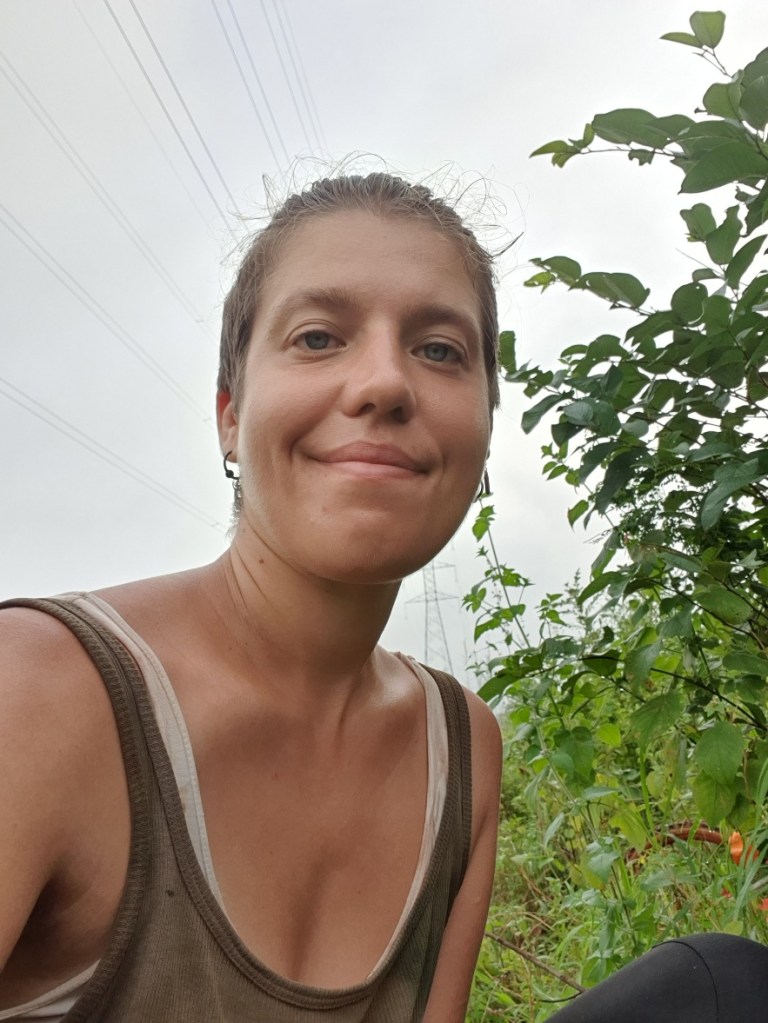
I wake underneath power lines. The vegetation is thick between the tracks running criss-cross; groves of trees, tangling shrubbery and fields of high maize and millet. I worry about snakes. I hang the tent to dry in the gray morning, hoping the dew will somehow drip off despite the humidity pushing in from all sides. I hear villagers talking, walking along the trails behind the vegetation. I keep low and still as they pass, don’t want to intrude in their space.
As I leave I see a teenage boy, perched high on a wood stem in the middle of a millet field. He saw me first. He is calling out now and then, throwing rocks at the crows who approach the millet weighing down the stems. When he sees me he gets silent. I catch the white flash of his eyes between the leaves; his gaze follows me, unblinking. I raise my hand. He raises his.
…
Sometimes the road opens to vast wetlands, the green so bright it might as well shine, with the forest retreating to the horizons. The bridges are always full of bathing boys, jumping and splashing, all of them shouting, turning and shouting even louder after me as I pass. Figures wade further away on the fields: old men with small caps on their heads, their worn shirts sagging around thin wrists and the trousers wet up until the thighs. The road is flat and I gather speed, fly past. The sun scorches down. When trees finally close up and offer some shade again, you can be sure that what awaits is also a climb.
I creak on like that. The carriage is holding up. I charge my phone in the charging stations in the villages and chat with the locals as I rest. I buy bread with cucumbers, with mayo. I get invited to sit on benches and to drink ataya. I buy watermelons from huge piles by the road, save them in my carriage for the night. Mostly I pass through nature and villages. The small all towns have lively markets, shouts and minibuses waiting to depart, groups of students in clean uniforms, chickens and goats strolling by. They change, yet remain similar.
…
A group of women and girls are selling bananas by the road. Roadside snacks have been harder to come by here, comparing to Senegal and the Gambia. There it was easy to find small amounts of carbs to fuel my pedaling legs, even in the small villages, but here it is only in towns that I can find peanuts, bananas or small deep fried snacks.
I slow down and stop. I point to a cluster of bananas that a young girl is holding and ask the price. I don’t catch her reply. Suddenly they surround my bike, pushing bananas to my face, their hands on my handlebar, saddle and shouting from all sides.
”Take these!”
”Give me cent franc, cent franc!”
”Give me a gift!”
”Look at these! Five hundred!”
Their bodies so close, rowdy; the girl with her bananas is pushed to the side, silent behind the rest. Someone reaches out a hand to touch my skin.
”Calm down, please,” I say. The woman blocking my bike replies;
”We are calm!”
”You are white! You are rich!” someone else shouts. I get annoyed. I gesture to the young girl to come forth from behind the crowd; I want the bananas I pointed to to begin with. I pay her as the mass of bodies scuff and agitate around me, put the money in her hand and the bananas in my bag, push through the bodies without looking back. Behind me they continue to shout.
Anger fuels my legs for a while after that. Later, stepping out from taking the experience personally, I feel sad; there is something so desperate about the voices ringing after me, this idea that the white bodies have come to help and save; that “over there”, life is better, and that here is nothing but misery.
…
I haven’t stopped all day because of the shouting. By the evening I am forced to stop to find food. I pass by a town and the market surrounding the main roundabout. I slow down, then tense and move on again as heads turn and people shout the same
“Branca! Branca!” I take half a tour in the roundabout and stop to think. I want to leave, but I have to eat. On the other side I spot a shack that looks like a cafe. Good. I’ll get a coffee and sit down to think.
I lean the bike outside, approach over the rubble and pass between the staring eyes of children and adults.
“Boa noite, tem café?” I try at the man behind the counter. He has dreadlocks and is rinsing some cups. I glance behind him and spot a big pot.
“Tem comida?” He looks at me. I gesture at the cups.
“Cafe?”
“Cafe Touba,” he replies and I nod and give him the thumbs up. He says something to his colleague and it suddenly all clicks.
“Vous parlez Francais?” I switch to French, and now he looks more attentive. “Where are you from?”
“We are from Senegal,” they both smile. I consider their locks.
“Are you Baye Fall?” I ask, and they nod. “Really? I know many Baye Fall! You two are far away from home.” They laugh. They free a spot for me in the corner to sit on a wooden bench, move a small table to me. Speaking my struggling French feels suddenly like coming home.
“Do you serve food here?” I ask.
“Yes, thiebudjenn.”
“Can you make for me?” The second man scoops rice onto a plate from a big pot, loads it with steaming vegetables. A small crowd of children has gathered outside the cafe to peek, and everyone who comes to the counter lingers with their eyes on me. One of the women who comes in starts to chat with me, then takes out her camera and begins to take photos and film me. I frown and cover my face.
“I don’t like that,” I say, and the Senegalese turn to disperse the crowd. The first chases the children away with a few rough words and a wave of his hand, the second tells the woman to stop with the camera.
The plate is placed in front of me and I gesture the only other guest sitting on the bench to join me. He smiles and thanks and I dig in, scoop tired spoonfuls into my empty stomach. It is a blessing. My neighbor’s name is Moussa and he is from Guinea.
“From Mamou, the crossroads of Guinea!” he says. He was doing his degree, ran out of money and now has found work as a baker in this town.
“Do you miss your family?” I ask him. He sighs.
“Sure,” he says. “My Mom is still there, my siblings too.”
I eat my meal and night falls. I still need to charge my phone and find a place to sleep, but I take the time to rest, leaving the problem to later.
“Where will you sleep?” Moussa asks.
“Well, I don’t know yet,” I say. “I have a tent. Normally I just sleep in the forest.”
“In the forest?!” His reaction is the same as everyone else’s; “You’re not scared?”
“No,” I shrug.
“If you want you can sleep at my place,” he says after a while. I take a second to consider, then nod; I haven’t felt any intrusive intentions from him.
“If that doesn’t bother, then yes please,” I say. “I need to charge my phone too. Is there a charging station?”
We thank the Senegalese brothers and I follow Moussa to the outskirts of town and his little apartment that he shares with a friend. They each have their own rooms and I install myself in the salon. We maneuver the bike inside. Moussa helps me by shining his torch while I unpack and roll out my sleeping mat. There is no electricity in the area. Moussa brings me a bucket of water and in the dark I wash myself on the back porch.
We walk through the dark toward the sound of the generator and the charging station, follow the small circles of our torchlights. On the way Moussa greets all the neighbors who are sitting outside. His way of talking is thoughtful, his voice calm and low and I remember that he, too, is a foreigner here, probably still not fully comfortable in Creole.
“It is thanks to the nice landlord that I can stay here,” he says, and it pleases me to hear that he is being received with kindness and hospitality.
In the morning I awake by the sun rays reaching in through the gaps between the walls and windows, door and roof beams; flecks of bright gold on the bleak blue walls and rough, gray concrete. Moussa shows me the bathroom; a hole in the ground on the backside, enclosed by sheet metal reaching barely to my shoulders. By the next house the neighbor woman sweeps the ground with a low broom, a baby tied to her back.
We go over to the Senegalese brothers and have cups of cafe Touba for breakfast. After the coffee I wave good-bye to Moussa and to the Senegalese; the time has come to set my sore butt in the saddle again and continue.
…
The sun is setting golden and I want to find a camping spot for the night. The roadside offers a pretty cashew grove and I spot a small sand road leading in, but a guy on a motorbike has been following me and I don’t want to get off the road while he is looking. I stop. I suspect what to anticipate; endless conversation, prying, curiosity and kindness masking insistence; his asking for money or offering me accommodation because sleeping outside is so “dangerous.” Him insisting his will and me deflecting; him seeing me as an opportunity.
But I have a plan, too.
He catches up and stops the moto.
“Hey, hello! Where are you from?” he begins.
“Hello, how are you?” I give as a greeting, smile tight.
“I saw you passing by in the last village! Did you see me? By the police. I am an officer!” He goes on fast, not letting go of my eyes. He is not wearing a uniform.
“Oh, OK, no, I didn’t see you.” I hurry my words. Meanwhile I change my weight from leg to leg, grip my bike.
“Where are you going? Where will you sleep? Are you going to the next village? Is someone waiting for you there?”
“Yes, yes, next village, exactly,” I nod, agree with everything. I keep shifting my weight, breathing tensely and rearranging my face.
“So where are you staying?” he says, slower now. “In the next village? Where did you begin?”
“In Bissau.”
“Wow, you have traveled far! You are very beaut-”
“Sorry, sorry,” I interrupt him, shifting my weight and pressing my legs together. “I need to go into the bushes. I just stopped here to go into the bushes, you know? Really, sorry, my stomach is not good, I ate something,” I pause and make sure his eyes follow my hand indicating my stomach.
“I really need to go into the forest, please,” I continue when I see apprehension on his face. I make a show of looking for my water bottle, cutting the interaction right there. Whatever he imagines about white tourists, us getting diarrhea is not unknown among the stereotypes. He seems to get the drift.
“Oh, OK, alright,” he says.
“Yes, thank you, thank you,” My back is already turned and I make for the woods. He starts his engine, turns and drives off. I stay by the forest edge to see that he is really gone. Then I march down the path, remorseless and happy to have another trick up my sleeve to shake off annoying men.
…
(This story told in pictures part one and two.)
 Hulkuv loom