I stop in Gabú not because it is the last town before the Guinea border, but because I have taken note of the big, high storm cloud in the distance. Cumulonimbus. As I rolled into town, so did the cloud from the other side. Inside of me a little voice whoops at my ability to attune to the weather; when did that begin?
The heat rising. I turn down the road leading to the big antenna and leave my phone to charge. I sit in the shade, read my book and chat with the passers by and the boys who are manning the station. Around two they all go off to pray and I am left alone. One of the men comes back and invites me to eat attchéké; I have heard of it, but never had it.
“My neighbor prepares it to sell and she has just finished cooking,” he says. He works in the military in Dakar, but has come here to visit his family.
“And to eat attchéké,” he laughs. “My friends tease me because it is all I eat here. No rice!”
We walk over to his compound and knock on the open door to his neighbor’s. The TV is on and a toddler is crying but stops abruptly when he spots me. The young mother comes out and startles, then smiles.
“We wanted to see if you have finished preparing the attchéké!” my new friend booms and her smile widens. Her eyes are warm.
“Yes, it is ready,” she says.
“Serve my friend here! She has never tried it.”
They lead me inside and place me on the couch. She goes into the kitchen and brings a plate with white gains, generously loaded with a mountain of fresh onions, tomatoes and cucumbers, a crispy fried fish and a generous click of mayo on top. She places the plate on a low side table in front of me, brings me a spoon and then leaves me to it. I take a bite and I fall instantly into a love story that begins right there;
Inga + Attchéké = SANT.
…
When I head out toward the market the wind has picked up. The storm cloud has moved in to cover the sky. Vendors hurry to cover their goods and move merchandise in under roofs, people scurry back and forth with the trash blowing around. I ask a shop keep permission and he nods and gestures his hands for me to lift my bike and carriage up under the roof next to his shop. The wind has begun to lift up the sand. Above us the clouds have formed a cylinder, moving, rolling slowly. The first rumble of thunder vibrates over the town. I jolt across the street between the motos and bicycles criss-crossing and bumping along, squint my eyes to protect them from the sand. I give the woman selling doughnuts a few coins and return to the shop, clutching a warm plastic bag full of the soft goodies. The men have brought out a bench for us and I offer a round of the hot, greasy cakes. I watch as the first raindrops hit the ground.
Then the sky opens.
The road turns into a river, streams of water carry along plastic bags, cardboard pieces and cigarette bumps. Thunder roars. Water streams off from the roof, the hammering sound of water on metal deafening. I sit on the bench with the others, munching my dough balls, and do not wish to be anywhere else at all. I know it will not last long.
…
The clouds have parted and the sun is peeking out its descending light. All the colors stand out, bright and cleaned by the rain; the dark red road, the heavy-green forest; the black shadows sinking in the edges. People move around the puddles, voices flowing with new energy.
The road out of Gabú is uphill, sand and gravel with the water running down in streams. I make slow progress. Behind me two boys start uphill on their bicycles, pass me, pause and then pass me again. They wave playfully and I wave back, making as if to race them. Wet leaves rustle and drip. I pass old men on bikes, women with basins on their heads, motos passing up and down. Small villages pop up along the road every fifteen minutes or so and between them the forest hangs dense and wet. Bird calls echo, the carriage creaks, the tires crustle the gravel and sand. New rain is coming.
I stop in a village and approach a few women sitting by the road.
“Good evening,” I start. “Is there a place I could spend a night here in this village? I could sleep by the football field.” I have already peeked at the field behind them, but instead I am lead to the village Chief, introduced in their yard and installed underneath a small pavilion with low straw roof and open sides. I would have preferred sand to the concrete to drive the tent poles into, but this is better in case of more rain. I tie the lines to the pavilion poles and make it good enough. The Chief invites me to eat rice and sit beside him, looking over the yard and into the darkness until I excuse myself, say good-night and crawl into my tent.
In the morning I am the center of attention. The children come to look at me and hang around nearby. The oldest son of the house, about my age, comes to ask me questions. I answer out of a feeling of obligation while packing and preparing to leave; my Portuguese feels too weak and I don’t like his hungry eyes, his remarking every now and then how I would make a good wife in Africa. Maybe he sees me grow tired and distant as he suddenly suggests:
“Do you want to see the bakery?”
“The bakery?” I ask.
“Yes, we have a bakery here. My mother had it built. All the bread from the village gets baked here.”
“Really? I’d like that.”
“Yes? Let’s go then.” He gets up and I follow, as do the kids hanging around. We head toward a small wooden building across the yard. I can see smoke rising from the chimney.
Heads turn as we stomp in. Two young men are working the dough on a counter, their hands rhythmically stomping out balls of dough, then rolling them into lengths. A third man is minding the fire and others sit on chairs and benches along the wall. Everyone’s eyes stick to me but the boys, who return to their work. Rap music is playing. The sun sifts in through the walls woven with plant stalks, falls in through the small holes in the roof. The rough clay oven in the corner is big, rounded and with a mouth black with soot, breathing heat into the little shack.
The men not working seem to have the village bakery as their spot to hang out. They boil kettles upon kettles of ataya, roll joints and talk. From time to time their voices rise into disputes, only to quickly settle down again. I am given a chair and then made to answer the same questions of where I am from and whether I am married. It is quite boring, but I want to eat the fresh bread and the border is not too far away, so I have time to linger and still make it today.
From the moment I’ve entered, the topic has become white people and every single one of my actions has become object to attention and comments.
“These people have money like crazy,” someone comments. They think that I can not understand them, or maybe they simply don’t care; I can barely draw a breath without someone saying that that’s how white people breathe.
“What do you think about our country?” someone asks me and I almost startle at the first actual, open question posed to me. But as I begin to reply he looks down into his phone and hums, distracted.
“It is beautiful,” I simply say. There is no point in telling them that so far Guinea-Bissau has been the most difficult African country I’ve visited, where I have felt the most as a strange white monkey under people’s eyes. It is not what he wants to hear and I don’t think he would understand. And besides, how could I complain? On the other hand they give me everything, everything, my white skin winning me unimaginable hospitality. However I turn, I feel caught in a trap.
“Is it OK if I film? I have never seen anything like this before,” I lie; make use of the hospitality. Actually I just really like the way the light is falling and the mood with the music. They smile and allow, and I take the chance to get close to the white flour staining the dark skins, the dough-colored cloth gently folded and the skillful reaching of the baker into the oven, feeling his way with the help of a torchlight; then the golden brown lengths that land in crispy thumps in the steaming pile.
If I can be nothing else than a strange, exotic Other, then I might as well make use of it.
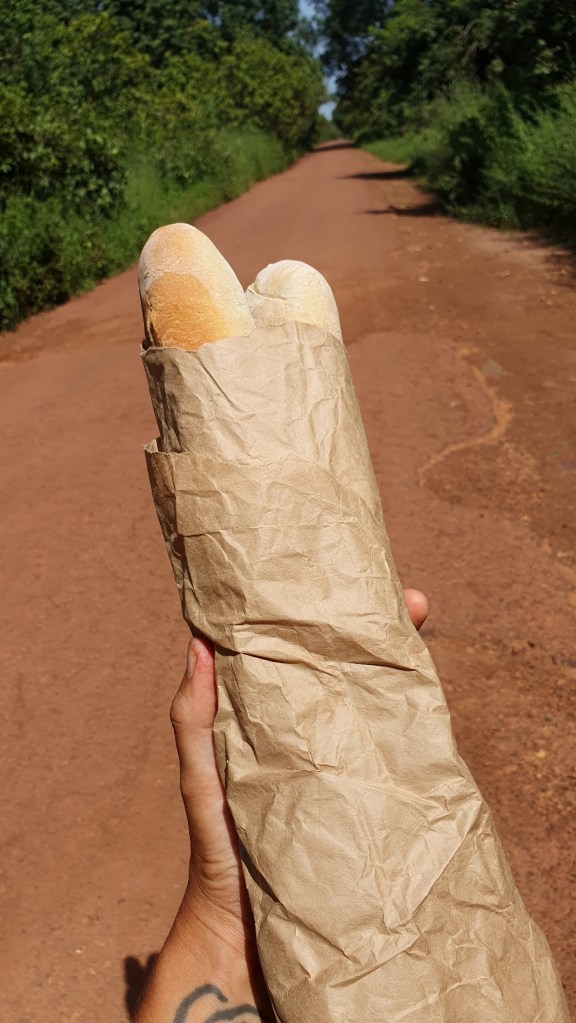
I get through the intrusive and loud demands for my attention and am rewarded with two lengths of hot bread for the road.
“Stay for another day, we can cook chicken!” the oldest son exclaims, and I shake their hands and thank them before getting on the bike to pedal toward Guinea.
…
(This story told in pictures and video.)
 Hulkuv loom