“Come pass the night in my village!”
The old man smiles at me and turns off the road. I follow his creaking steel bicycle, slide on the sand track littered with goat poo and twigs. Leaves stroke gently against my ankles, the carriage wobbles behind. Chickens, children, woven fences, small round huts. People turn their heads and I follow the mister. He takes me to the biggest house, the only one built with bricks and plaster, surrounded by more of the low, round huts with straw roofs that I’ve seen from the road. Women and children gather around me, but they stay calm and keep a little distance.
“This is my oldest daughter.” His hands bring her forward and she smiles. She is about my age and holds a toddler. I lean in to pinch his little cheeks, smile at the eyes open wide and fixed on me, not yet decided for confusion or terror. She smiles at me, pleased to see me as if she’s been expecting me.
“Welcome to us,” she says on behalf of the yard and the huts, the children and neighbors gathered around, her proud father.
I pitch my tent under a tree nearby. They watch me from the yard but don’t come any closer, let me install myself in peace. The night falls and we gather in front of the big house by flash lights; the children with their legs like sticks, a group of women, maybe neighbors and sisters, the oldest daughter. We reach out to each other in mutually bad but mutually hopeful French. She takes the lead as my host, just as is expected of her as the eldest; she makes sure I get a bucket of water to shower and a place by the bowl to eat. She smiles a lot and misunderstands my questions, laughs when she is insecure but takes me by the hand and leads me, points to where I am supposed to sit. Someone comes by with a bag of peppers for sale and the oldest daughter makes the trade by flashlight. Someone brings a speaker and we dance. The women whoo and shout, laugh, teeth flashing white as I get up to shake and groove to the afrobeats, and I shout and cheer them right back. Groups of girls and boys wander by the house to greet, dance and chat, new people pop up in the sharp, slim circle of light, then disappear again into the night. The youngest fall asleep sprawling on the plastic mats rolled out on the ground. At some point I crawl into the tent too. I don’t know what time – my phone is long dead – but the party goes on for long after I leave.
…
The village wakes before me.
By the time I crawl out from my tent and brush my teeth, everybody is already out and about. Women duck out of the low huts and sweep the sand yards with short brooms. Dogs stray, looking for scraps. I want to pack, thank and be on my way.
“Wait,” the oldest daughter says. “My father is out. Wait until he is back and say good-bye. He will be back soon.”
“Okay,” I say. I can wait for a while.
The women take me for a tour. They speak even less French than me but it doesn’t matter; with their hands and shining eyes they tell me everything about the village life. We go to the neighbors’. Their hut has green leaves growing in a spiral all along the round roof, reaching eager for the sky. Among the leaves are big, green water melons, nestling round and heavy.
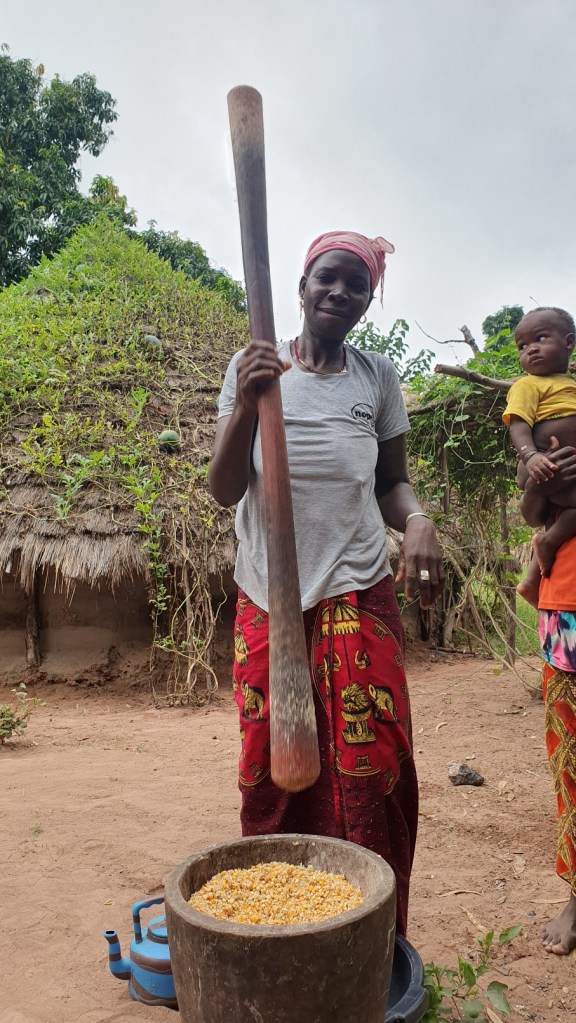
The neighbor lady has begun the morning by crushing hard grains of maize in a big wooden mortar. The pestle is longer than her upper body. She lifts it up above her head and brings it down on the grains with rhythmic, powerful thumps; the same thumps that echo all around the village. I ask her for a photo and she smiles and holds the pestle even higher, then brings it down with one hand and equal ease. Another neighbor joins, her baby tied to her back, and the two of them work in tandem, alternating to bring down their pestles with even rhythm.
She empties the mortar into a wide, flat plastic tray, moves over to the side and shakes the grains. Again the rhythm is even and her method thorough, hands well familiar with the work; side to side, up to down. The heavy grains fall below and she throws off the lighter skins, lets them fall down in light brown clouds onto an old rice sack. A chicken sets herself to stroll besides, eyes attentive, picking gracefully at the peels. When she has finished cleaning the grains she sets the tray aside and leads a goat to the sack. She smiles at me and I film the wiggling ears and the eager muzzle making quick work of the breakfast.
The women continue the tour and we stop by a small stool dug to stand low from the ground underneath a mango tree. Before it is a lower metal stand and a wheel with a handle. Some other random metal objects stick up from the ground.
“My father works here,” the oldest daughter explains. I look bewildered at the setup, not grasping her meaning.
“What? How?” I ask.
“Tools. He repairs,” she says. She grips with her hands around an imaginary shaft and brings down her arms as if chopping with an ax.
“He makes tools… Oh!” I grasp. He is a blacksmith. I look at the station again, realizing that the small metal thing has to be the anvil and the wheel somehow bellows to make the fire burn hotter.
We go to sit in the yard again. The neighbor woman brings a watermelon and someone cracks it open; the meat is white on the inside and so sweet, juicy and full of smooth, black seeds. The sun stands at noon and I am restless to leave when my host finally returns, three small fishes hanging and tied together by a grass leaf. I go forward to shake his hand and thank him.
“But no, stay for food,” he says. He holds up the fish. “We will prepare this!” My heart moves and swells and for a moment I consider staying, wish I could stay for some days, a week, with these lovely people in this quiet, remote village in northern Guinea. But then I think of the time I have to keep and the endless kilometers of unknown road ahead of me.
“Thank you so much,” I repeat. He looks disappointed; they all do. But I have made up my mind.
Guided by the oldest daughter and with an entourage of children I lead my bike up to the road.
“Let me!” she says suddenly, hands the toddler to one of the children and makes for the bike handles. Slowly I let her take my place, making sure she has the full weight of the bike before I let go. We pass by the village market and people look and shout jokes to her. She smiles and jokes back, somehow proud, and I wonder what it means to her to be leading my bike. I wonder if she imagines being the one about to sit up in the saddle and start down the road, the village in her back and all the possibilities ahead.
When we have passed the market she gives the bike to me again and picks up her toddler. She and the children stop then, as if they’ve reached an invisible line. They give me final words of blessings, the good-luck:s suddenly more solemn, eyes lingering, smiles insecure. They wave and I wave back, turn back the pedal with my foot and press down while lifting myself up in the saddle, wobble in the sand before gaining speed. I look back at them where they stand, the smile of the oldest daughter and the children around her, then turn to face forward, leaning in toward the unknown. A pinch of pain tugging my heart; happy-sad, but with all the possibilities ahead.
…
(This story told in pictures and video.)
 Hulkuv loom