I could have taken the road through Boké and skipped about 300 kilometers, but I wanted to see Fouta Djallon, the mountain region of Guinea, and so I went through Labé. And I’m happy I did. I went to sleep already with the sound of a waterfall singing not too far away. Finally; right here, in the outskirts of the city.
In the morning I left all my things in the bushes and went through the forest and toward the sound of running, splashing, playing water. The track lead down to a wide stream, gravel well hardened by many feet before me and the rocks beaten smooth by wet clothes washed against them. I made out a few skinny backs, two or three boys sitting by the water. I followed the track as it turned along the stream and climbed down a few rocks. Next to me was the stream was falling down the same height.
I waded, the water cold and clear, reaching only to my knees. On the other side of the stream was a big, flat rock, half of it in shade. The loud, persistent “schhhhh!” of the waterfall drowned out all else and the morning sun sent its rays golden through the leaves, lifting the yellow sand right through the clear streaming surface, sending shards of splashing light straight into my eyes. From upstream I could now and then hear the children’s shouts, but down here was nobody to notice me, and so I stretched out in the shade, got comfy and opened my book.
…
We stop by a side-steam where water gushes and purls over low rock-steps, down and onward, away to split into different rivers and then toward south; Conakry; the sea. (Just like me.)
“Who built this bridge?” I ask our guide.
“My parents, their parents,” he says. Logs and stems are stacked into a high triangle and rickety steps fastened across. Planks hang in waves over the still surface. A cord indicates that passage is closed.
“They built it with wood and vines before. Later they started using metal wires. But right now the bridge is broken.”
“Come on, you will get a better photo ahead!” the guide urges me on and I ignore him from my kneeling position. We are here, coming up on the beasts of water, I have passed the fear of dying on a moto and bribed and argued with about a whole village to come here, so I am going to take my sweet time photographing what I want.
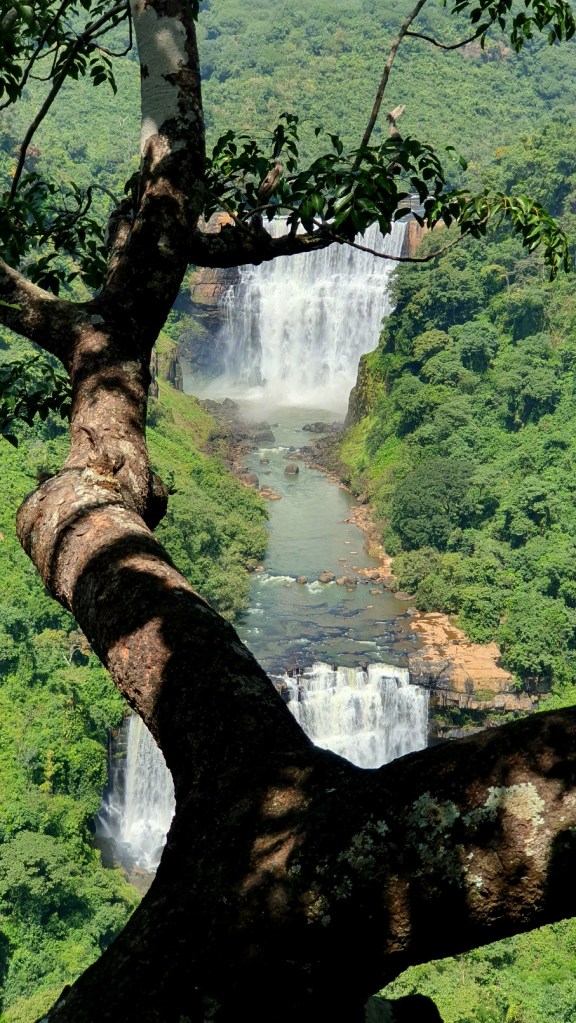
But they were mighty indeed: the Kambadaga falls. Two waterfalls after one another, tumbling straight through the valley with the steep forest walls rising on each side.
We stay at the vantage point from which we can see straight into the valley; well over the backs of eagles. I like the lone tree growing just on the edge, leaves moving softly with the breeze. Imagine having grown up to the sound of these falls. Away are more mountains, rock walls pointing straight toward the sky, so deep blue and open from here.
They call Guinea “the water tower of West Africa”, because so many rivers have their birthplace here. But where does the water come from? How does it rise up into these mountains? Are clouds and air and sun and trees really enough, really really enough to lift these masses of water, tumbling down in never-ending mass?
Truly, every capillary is nothing short of a miracle.
…
(This story told in pictures part one and two, and video.)
 Hulkuv loom