I wake up to small lines of yellow street light falling though the cracks. A cricket sings. The body is scattered, limbs just coming into shape, resurfacing from sleep-breath.
“Don’t be afraid!” he yelled every time I asked him to slow down. There was no need for us to go at the speed we were going, leaning in curves and abruptly stopping and starting for potholes, passing others by centimeters. The too big helmet wobbled on my head.
“Even the Mamas here aren’t afraid to ride a moto! My wife wouldn’t be afraid of this!” he yelled over the noise. I clenched my teeth.
He didn’t listen.
Behind the filthy visor I cried and prayed and held on for dear life.
I don’t know what time it is. My arms, legs and abdomen ache from the hours of holding on to the motorcycle; I remember it when I move. My head is still sore from the headache that forced me to sleep in the first place. I drag the heavy limbs along the mattress. The familiar rectangle comes to my fumbling hand and lights up. 23:08. A text from him:
I need 50 000 more to pay for the motorbike.
Fuck it. I am alive.
The air is chilly. I put on my wool jacket before I lock the door to my room behind me. The light is folding out from the main hospital building and into the yard in a sharp square; somebody is probably manning the reception. I ease the iron gate, spill silently into the street.
It is pitch black. I follow the familiar road with its cracks and abrupt slope, ease carefully down to pass the stream where for a moment I am immersed in breeze rustling the tall grass and frogs singing all around me. Then climb up the steep other side and onto the main street.
The big street is also pitch black. People move, brush past me. A few headlights pierce the darkness and I step to the side and off the crumbling edge of the tarmac every time they come. Shapes are gathered around the small shops and cafes further down, huddling and mumbling; tired shoulders slouching and iron bars black against the dim lights. Nobody remarks me, stares or calls after me like I’m used to.
At night I am invisible.
Maybe anything could happen; I could get beaten, robbed and raped. But what would they take? My arms are shaking gratefully, my legs weak but slightly more steady by each step;
I didn’t die. I am not hurt.
By whatever grace that holds me, the oxygen runs hot and cold in my blood, circulates through the same circuits as before, lights up my heart and my brain and I keep on taking the steps already set out for me, simply following what has been written not in words, but by the translucent weave of things to be; set in motion beyond anything I could dream of controlling: simply the world unfolding as it should. If I walk into disaster then that is simply what has already been written.
There is nothing to be afraid of.
Labé is amazingly badly lit at night. The main roundabout is dark and empty too, but the bus station is lit and lively with vendors, travelers, bus boys, cars and vans coming and going. Enormous bundles are lifted, strapped to roofs, un-strapped and unloaded. I approach a group of men standing around one of the cars. I greet them and they turn to look at me.
“Are you coming or leaving?” I ask.
“We just came and we’re leaving again,” one of them replies. Their eyes are friendly.
“Where are you going?”
“We are going to Conakry.”
“We?” I ask.
“Yes,” the men reply. “We go together.” They point to five different cars, all strapping luggage onto roofs and counting passengers and bills.
“There are bandits on the roads, especially around Mamou. It’s safer to go together.”
“But aren’t the roads really bad?” I ask. “Isn’t it more dangerous in the dark?”
“Yes, they are bad. But it’s also more calm during the night.” I wish good luck to their friendly eyes, imagine five yellow pairs of headlights crawling in a row over the black mountains, passengers crammed tightly, heads swaying through the bumps, the radio on low. I pray they will all arrive.
The market was so big and rowdy during the day, cars cramming through the crowd of people, stalls and vendors creeping onto the street to fill every centimeter with vegetables, shoes, phone cases. Now the stalls are closed, the tables all removed and the street lies dark like the rest. A few small shops and cafes are lit up further in the side streets.
I want something sweet, an easy pleasure, comfy carbs; coffee and chocolate bread, I think. That will do.
I head for the cafe that is only a sunshade and three rickety benches below a steeply sloping street. A few thermoses, packets of cigarettes and lollipops are stacked for sale. Men loiter on the benches. The man preparing the coffee recognizes me and smiles.
“Cafe Touba?” he asks.
“Well of course,” I smile back. I can feel everyone’s awareness shifting to me. I sit.
A group of children spot me from across the street and come to gather around me.
“We are hungry,” a boy says. “Give us something.” He looks serious, looks straight into my eyes. Maybe he is around ten.
“We haven’t eaten today.”
“No,” I reply and sip my coffee.
“Give me money.”
“No.”
“Give me a ball.”
“No.”
“Where are you from?”
“Estonia.”
“This is my brother.” He gestures to an older boy leaning against the bench.
“What is your name?” I ask him.
“Moussa,” he says.
“And how old are you?”
“Fourteen.”
“And you, what is your name?” I turn to the younger one.
“Ousman.”
“There is an orphanage there,” one of the men says and points to a house across the street. During the day the doors on the lower floor were open and the small space inside was full of firewood for sale. Now the house is like the others, a dark shadow. Some youngsters sit on the railing-less passage on the second floor, dangling their feet.
“Where is you country?” the boy asks. He is still looking at me, as are all the children, gathered in half a circle around the cafe. In the poor light they are barely more than black shapes; hanging clothes, stick-legs and shaved heads with big, unblinking eyes. Some lean haphazardly on the benches or the poles holding up the roof, some are are further away and tense up a little whenever I move, yet they stick around.
On a whim I put on a fairy-tale voice.
“My country is far, far, far away from here,” I reply. I smile to the little boy. “And it is very, very small.” I speak slowly, stay with the intonations to have time to think and to give them a chance to follow my accent.
“We are only one point three million people. Can you believe that?” I continue. “How many are you in Guinea?” The adults mumble and I sip on the hot coffee; they are entertained, too.
“You really are small,” says the older boy. I look at him and nod approval.
“A-haa, you see?” I feel light and playful.
“My country is a very flat country,” I go on. “Here in Guinea you have big mountains. You have waterfalls. We have none of that!” I let my hands make the story, looking at every child.
“And the ground is different. Here, your sand is red or yellow. For us, it is black. Can you imagine?”
“The white! You are from France!” one of the men sitting across from me suddenly shouts, slurring his words.
“Of course not,” I reply. “Just listen to my accent.”
“The white! You should give me something!” he goes on. I lift my cup.
“I paid for my coffee.”
“Here in Africa we suffer!” he interrupts, drunken resent in his voice. He continues to ramble.
For a split second I feel so, so tired.
But then I remember that I am alive, I get to drink coffee and breathe in the sky. And there are infinite ways to play.
“I wanna love you,” I sing right into his rant.
“And treat you right.” I sing higher, let my voice ring and smile him dead in the eye.
“I wanna love you.
Every day and every night.” A pair of sharp headlights beam down on the steep street with its overturn rocks and loose gravel and moto squeezes by. The man finally shuts up and looks at me, confused.
“We’ll be together
with the roof right over our heads.
We’ll share a shelter,” I clap my hands. His confusion makes me smile wider.
“Of my single bed.” I want them all to clap along with me. I imagine that they know the song, but they just look.
“Is this love, is this love, is this love,” I sing. The man is quiet now, his train of thought derailed. Someone remarks his confusion and quiet laughter shakes their shoulders. I guess they were all getting tired of him, too.
“Pa ra-ra, pa ra-ra, pa ra-ra…” I let the syllables die out. It is still my hands clapping. I raise my empty cup.
“Thank you for the coffee!”
The drunk guy gets up from the bench and staggers onto the street. One of the kids says something which makes the others laugh. With a step he is in the middle of the crowd of children. Some leap to the sides but Ousman isn’t so quick, caught between the man and the bench in front of him. He receives the first slap on the back of his head.
“What are you doing, bothering a tourist like that!” the man yells. He aims another slap at Ousman’s back, which he manages to duck.
“Leave the white alone!” he shouts.
“Hey! Stop hitting them!” I shout. “There is no need for that!”
The next moment it ends. The drunkard staggers away along the street and the children gather slowly around again. Neither them nor the adults have made a sound. I watch them take up their places again, lean their skinny limbs and cross their arms to watch me, to wait and see if something else interesting is going to happen. But I am tired now.
“Thank you,” I say again. The owner nods.
“Do you know if I can find some chocolate bread at this time?” I ask. “Maybe a nearby store?”
“Yes, there is a shop. You can go and ask,” the owner says. “The kids will show you.”
“OK,” I say. “Let’s go.”
I get up and they gather around me in a loose troop, Moussa and another teenager in the lead and Ousman by my side, a serious shadow. Others follow behind. They take me through a tight alleyway and I reach to shine a light with my phone, realizing later that I am the only one who needs it; the children know every hole and every puddle. We turn a corner and another, squeeze between sheet metal walls pushed close together, give way for people to pass and arrive finally outside of a shop. Light comes out through the bars. Inside red tins and jars neatly stack the blue shelves. Moussa approaches, mumbles the question and receives a head shake which he turns to pass on.
“Do you know another place?” I ask.
“Maybe the station,” Moussa says.
“OK, take me there. Actually it is good you come with me,” I say, a thought forming. “I am scared to walk alone in the dark.” The biggest lie I’ve told in a long while.
We walk as a loose band up the sloping main street.
“You speak French very well,” I remark to Ousman. It is true; his French is clear and confident, his vocabulary broad. “Where did you learn?”
“I learned it at school,” he says.
“Do you like school?”
“Yes, a lot.”
“Good. You are very intelligent,” I say. “It is good that you study and work hard.” He remains quiet but there is a small shift in him after I say these words; his back a little straighter, eyes brighter.
The point of walking along the empty street was really so that I could dig around in my pouch without eyes prying from the shadows. My hands have learned to slip bills, too.
“This is for rice.” I pass the folded bill to Moussa. His fingers instinctively close around the paper. He looks at me, his eyes the endless deep of a child who has not been one for most his life.
“Thank you,” he says. His voice is quiet but articulate; surprised and sincere. In his eyes I see the responsible big brother; the one who will make appear the bowl of rice around which everyone will sit. It breaks my heart.
“You can leave me here,” I say then and stop. “I can find my way now. Thank you so much!” There is nothing for them to do but to listen; I have stopped being “the white” and become an elder, and so they must obey. I smile and raise my hand to wave.
“Take care now!”
“Thank you,” Moussa says again. They lift their hands in silence, stunned by the suddenness but already turning away.
At the station the men are still packing and huffing, tightening cords and lifting parcels. I come into the light and feeling alive now feels like a beautiful sorrow, a heavy hole in my gut.
I can not feed all the children on all the streets; tomorrow these ones will be hungry again.
But at least tonight they will eat.
A smell of weed pokes me and I smile. Weed, here? In the Gambia maybe, but in pious Guinea? I see a guy leaning on one of the cars and I smile at him as I pass.
“Smells fresh,” I remark. “You smoke?”
“No no,” he replies. Then, when I have just about passed:
“Do you want some?” I laugh, turn and lean against the car next to him. He holds up a joint and I marvel at how he managed to conceal it.
I learn that he is from the Gambia. Of course; the country of weed. In the eight months he has spent in Guinea he has learned to speak French better than me, his accent smooth with all the consonants carefully folded and soft, unlike my Nordic slaughter underlined further by the Wolof angularity gifted to me in Senegal.
“I’ve taken some private classes,” he says to disperse my praise.
“Well so have I!” I laugh. He laughs too. His eyes are intelligent and I count the languages he speaks on my two hands. He tells me he works with installing windows and I am surprised to learn that Guinea would offer job opportunities worth migrating for. Then he quickly switches to Pular as another guy comes up to us and stretches out his hand to greet. The little paper bundle and the folded bill slipping between fingers does not escape me. I chuckle and think that maybe installing windows isn’t the only job opportunity.
I will die.
I will never arrive.
I am alive, alive,
alive.
The dark street tilts slightly and the sudden silence is shocking. I worry I have taken a wrong turn; the road stretches with every step. I avoid all the eyes of potential robbers and tense before the headlights. Just walk straight, straight, straight.
Finally. I recognize the small stalls and shops that line my street, now mostly empty. I slide down the gravel by the roadside to end up by a Mama’s stall and cafe. She smiles when she looks up; she knows me well.
“What will it be tonight? Attchieke or bananas?” I smile too.
“Attchieke tonight, please. I am hungry. Is there fish?” She lifts a cover on a plate and I choose one of the two crispy-fried fishes still left. She gestures me to enter and I take place on one of the benches, another bench acting as a table. She cuts tomatoes and onions in her hand, portions the attchieke and clicks on the mayo. The light is dim, almost gray from the one naked light bulb. The shadows bring in the night in sloppy angles, the spaces under corners deep and endless. A man walks in, greets and takes place by the entrance. Two teenage girls come in.
“This is my daughter,” the Mama gestures one of the girls who gives me a brief smile. They sit down by the basin filled with dirty dishes and get to work. They talk in murmurs. The Mama chats with them, the other guest and me. She addresses me in Pular and I reply in Swedish. She smiles at that. We chat back and forth, exchanging shared kindness despite the one-sided meanings. I receive my food and wash my hand, mold the attchieke into balls in my palm and pick pieces of onion and fish with my fingertips. A touch of mayo; my hand oily, sticky, yet this way of eating is in itself the biggest comfort; no hard metal between my body and what is to become my body. People pass on the street, the girls wash the dishes and the Mama cuts onions in her hand. And I sit there, eating and watching the night pass. Unremarked, simple, effortless.
As if I was a part of it.
In the next shop the two girls are slumping on the counter. They rouse their sleepy eyes and I wonder why they even work this late. Don’t they have school tomorrow? One of them stands and the other closes her eyes again.
“Do you have bread and chocolate?” I ask.
“Just bread,” she replies. I give her the coins and she goes back to sleep next to her sister. I figure I can have the bread for breakfast but by the time I pass the stream and the singing frogs I have eaten half of it.
A little trolley stands in the middle of the road, weak light shining down from under a parasol, lifting it out of the complete darkness. I look at it while climbing the hill. A woman slumps in a chair, a small speaker plays afrobeats and a girl dances, skinny arms and legs beating out to the sides and above.
On a whim I walk into the cafe just next to the clinic. The small wooden box is full of men and smoke. Music plays. Conversation stops and all eyes turn to me when I enter. I greet the owner.
“Nescafé?” He knows me too.
“Do you have chocolate?” I ask.
“No,” he says. I cling to the door frame, not sure what I want.
“Go sit,” he smiles. He has already started scooping coffee powder into a clean cup for me. I go to sit but get blocked by a young man stepping through the tight space.
“You the white!” he declares. “You are very beautiful!” I face him blankly.
“I want to marry a white!” he shouts. All the men sit quiet, looking at me with their cigarettes smoking away. I sigh. I am so tired.
“Is this the way you talk to people?” I ask. “Is this the way your mother taught you?” He seems to stagger. I straighten my back and raise my voice.
“What happened with ‘good evening’ and ‘how are you’?” I ask. “Here you come, shouting ‘white, white, I want to marry’, but do you not know how to greet? Have you not been to school?” The guy opens his mouth but nothing comes out, and the tension runs out of the room. Snorts erupt here and there, the cigarettes are raised back to smiling lips, the eyes return to the screens.
“She’s right,” someone remarks. But I am not done with them.
“And you?” I say to the room. “You just let him talk to me like that? Is that a way to make a woman feel welcome?” My voice is upset but I smile at the last part, shake my head and laugh at my own amusement of shaming them. Greeting, after all, is their holy ritual.
“Africa, ah!” I push past the guy and take a place.
“Sorry, eh?” one of the men says.
“That guy is crazy,” another offers. I watch through the corner of my eye as the cafe owner smiles. The young guy stomps out without further comments. The owner brings me my coffee.
“I knew you were a real African,” he told me the first time I’d come there. Because of the way I had lingered and clung to the doorframe. I wonder what he thinks of me now.
None of them know that this is the last time they will see me.
I sip the coffee and watch the movie playing on the TV, white men with guns crawling through mud in a Nordic forest with suggestive, Nigerian afrobeats coming from the speakers. When I leave I find the guy loitering on one of the motorbikes outside.
“Why did you have to talk to me like that in there?” he sounds offended. Hurt, even. I scoff.
“You were the one who began saying stupid things to me!” I shout back without stopping. For a moment I get upset too; why am I even supposed to deal with this, in French on top of it all? But the anger runs off quickly; I am alive. The sky is starry, my belly is full and everything is fine.
I slip in through the hospital gate.
Labé, Labé; crazy, lovely Labé.
I will miss the goat coming into my room. The morning sun on the yellow wall and the pile of slippers by the door, the first colors I see.
I wish I had more time to explore the streets and the markets, that I could keep being a regular in the small cafes and corner shops; after only a week I am attached to the smiles of the people who receive me, want them to keep receiving me.
But I have a date to keep.
I see life rolling and stretching out beneath me into a billowing weave; white shiny fibers tangling into millions of lifelines and fate-lines; my feet stepping where they have been set to step, have already stepped; knots knitting and un-knitting, stretching and braiding to form my future, growing into my nerve-fibers extending the already-translucent lines through my skin and into time; rippling with every breath.
I have no idea what’s to come, yet I have seen it all a million times.
I lock my door and fall back onto the mattress. Small, yellow strips of light fall in through the blinders. A cricket sings. Tomorrow it’s time to pack up and hit the road.
…
(This story told in pictures.)
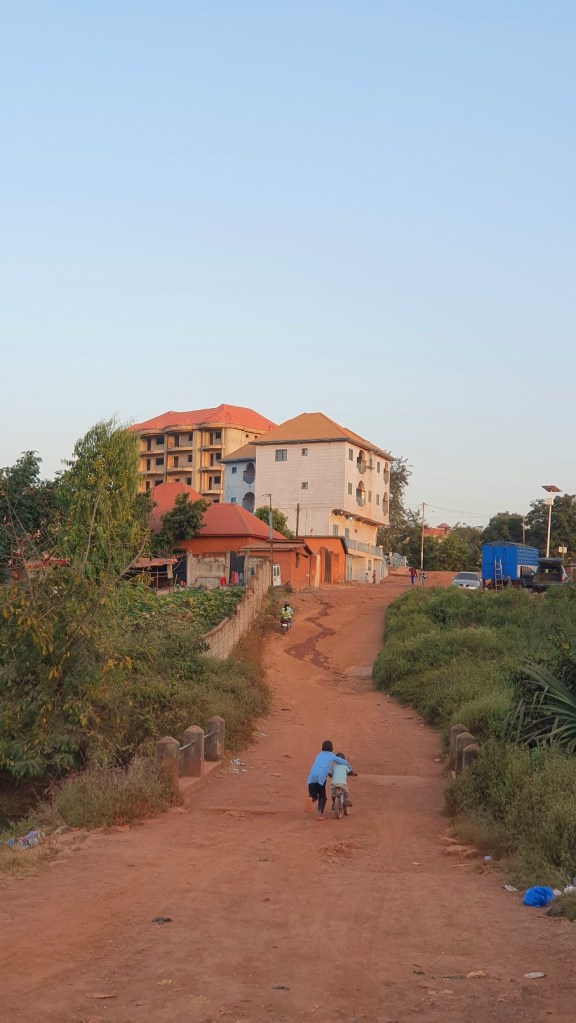
 Hulkuv loom