Truckers are among my favorite people. They have taken me across Europe and into Africa, hosted me in their cabins sometimes for days on end, given me food and taken care of me as if I was their own daughter. Luck served me the opportunity to hitch a ride with truckers in Guinea and they took me across the country, hosting me in their truck for almost 24 hours.
“Sure, we can take you,” Thieno had said when I approached him. They were parked at an abandoned gas station. The engine was running and his two colleagues were unloading big, metal doors from the back.
“We are going empty to Conakry. But we are not leaving until five. If you haven’t found anyone by then, we can pick you up. Let’s exchange numbers.” I could barely believe my luck. I had been looking for a hitch in the heat all day in Labé, someone who could take both me and my bike, preferably for free. I struggled to understand him; his French was hacked apart by a heavy stutter, but his eyes were friendly, his stance calm and serious.
I waited for them at a little checkpoint in between two fields outside of Labé. The three officers invited me to sit with them on a rickety bench and I offered them my oranges while the sun set golden over the grass. I listened to them gossip and joke in Mandinke, looked at the shy puppy sniffing for scraps while keeping a safe distance to our legs, and slowly ate slice after slice of sweet oranges. Further away, smoke rose as farmers burned dry grass. From time to time a moto would pass and zig-zag around the potholes down on the road. When Thierno called I handed the phone to one of the officers and she explained exactly where they would find me.
The truck arrived and parked, leaning into the ditch. Thierno jumped out from behind the wheel and came to meet me while his co-driver, a younger man, and the apprentice, only a teenage boy, made their way out from the passenger’s side. The co-driver went to open the hatch in the back while the apprentice presented the truck’s documents to the officers. They lifted my bike and my carriage inside and lay it in the middle of the empty container as if it weighed nothing, then closed and locked up. I reached up and gripped the handlebar by the passenger’s side, seized by the familiar rush of excitement; I can’t believe this is happening! My feet then on the ladder, a hold of the handle inside the door and I heaved myself in – what a familiar move – around the passenger’s seat and onto the bed. The apprentice followed and took the spot beside me, the co-driver settled in the passenger’s seat and Thierno took the wheel. The doors closed, the cabin rocked and heaved up from the ditch and off we were again.
From up in the truck’s cabin the landscape stretched and billowed out far ahead, the mountains rising bleak-blue behind the golden forests. The sky already took on shades of pink and purple. I felt like royalty. The men chatted in low voices but remained mostly silent, with Thierno focused on the road.
The potholes were many and the climbs were steep, keeping our speed down despite the container in the back being empty. On some stretches we would slow down to walking speed, crawling in and out of the holes. Small villages popped up along the road, with long stretches in between. We passed people walking and jogging between the villages, in shorts, worn plastic sandals. Thierno slowed down for the groups and the co-driver handed down sachets of water from the fridge; they were received with grateful hands. Other times Thierno honked his horn to groups of children who laughed, jumped and waved from the roadside. Approaching a woman carrying a plastic basin of water sachets on her head, we slowed down again while the co-driver exchanged a bill for several sachets, passed them on to the apprentice who placed them in the little fridge under the bed. A cold soda found its way into my hands.
“Are you hungry?” Thierno asked. “Do you need to eat?”
“We eat together,” I said, longing for nothing than to share a bowl of rice with these men.
The night fell, the landscape around us turned pitch black and our headlights only grazed a small circle just in front of us. The radio mumbled. The apprentice had long since let his head hang between his arms, elbows resting on his knees, bopping along the cabin’s rocking. I followed suit.
Around midnight a loose cluster of lights spread out on a hill ahead of us. I remembered passing towns in a truck, one night in rainy Austria, the streets like lines of light with small white and red dots glittering along them. Here, the lights were separated, speaking of individual houses rather than street lights, and with more dark areas between them. Very few lights moved at all.
We struggled uphill and parked by a dark market, closed for the day. The main road was sand, littered with trash and lined by walls with closed gates. I quickly snuck behind a corner to pee, limping on numb legs. When I returned Thierno was handing out bills and instructions to the co-driver and the apprentice.
“What do you want to eat?” he asked me again.
“Anything,” I said.
“You go with him,” he gestured toward the co-driver, and I realized with a pinch of disappointment that the men didn’t have a habit of eating together.
I followed the co-driver into a small cafe and we ordered two omelet sandwiches. I tried to pay for both, but the co-driver shook his head and pushed away my hand. He handed over the rolled-up bills and gestured me to follow. When we reached the truck he gave the other sandwich to Thierno, then turned around to leave again.
“I need to find some rice,” he said. The apprentice was gone on a similar mission. I unwrapped my sandwich while Thierno put his aside for later. I invited him to eat mine but he shook his head and kept scrolling on his phone.
“We’re going to sleep here,” he said when everyone was assembled again. I was curious about how the three men would normally divide the two bunks in the cabin, but as they had just paid for my meal I suspected that they would offer me one of my own to sleep in, maybe even leave the whole cabin to me for the sake of modesty and hospitality, and I just didn’t want them to go out of their way any more.
“I sleep there,” I said and pointed towards the container. Thierno’s eyebrows moved together slightly.
“Are you sure?”
“Yes! I have everything there.”
They let me in and I rolled out my sleeping mat and sleeping bag.
“Lock the door, please,” I said to the co-driver, who nodded. He closed the door and the container turned into black space, my weak headlamp lighting only a small circle. I heard the click of the lock. The container swayed a little as the men climbed up into the cabin and moved around. I could hear their muffled voices and a few passing footsteps outside. The floor in the container was dusty but I had plenty of space. I crawled into my sleeping bag, safe and cozy next to my overturned bike.
It felt like five minutes later that I heard a knock on the door and the shuffling of iron as it was unlocked and opened. I snapped awake and peered out to see the barely-visible outline of the apprentice; it was still dark outside.
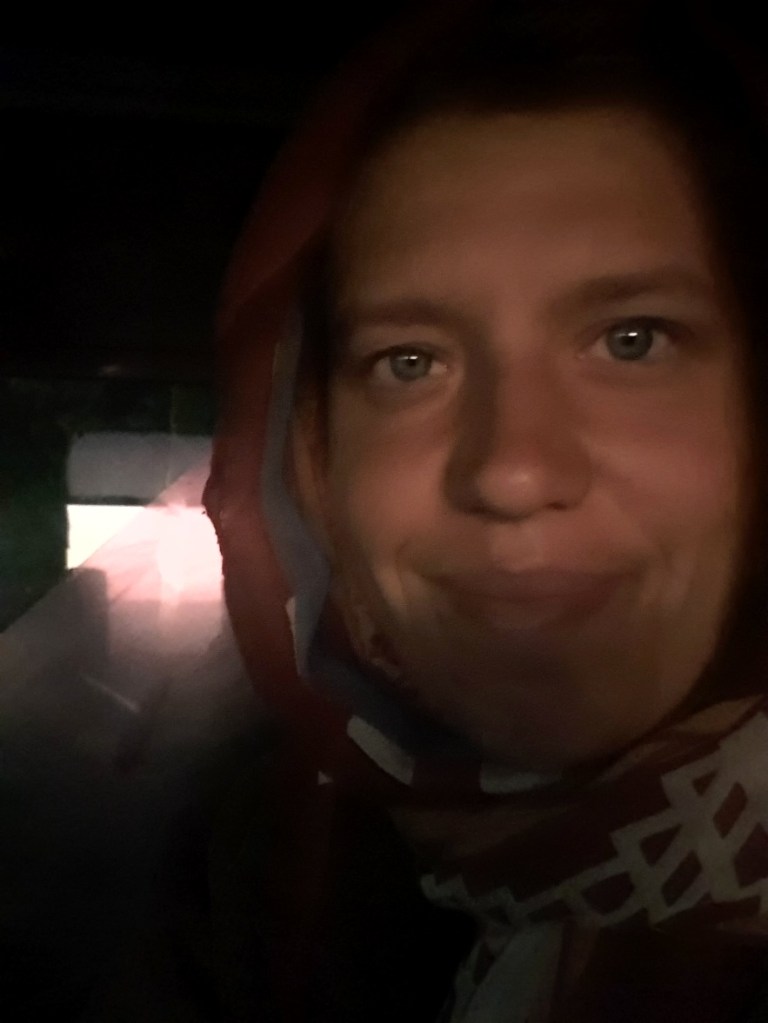
“We’re going.” I rolled up my things again and pushed them into the carriage. I quickly found my toothbrush and bottle of water, ran around the corner to pee and ten minutes later I was sitting in the cabin again. The engine was going. I waited alone while the men were fixing and preparing, washing their faces and checking the truck. The sun was just tinting the sky into a shy, grayish pink; a promise more than a color. A reassurance. I was wearing my wool jacket and my scarf tied around my head, exactly as I had one year ago on this day. The air came out in white mist. That day I also woke up at dawn, also cold in a forest outside of Venice. I remember it well because then, as now, it was my birthday.
I could never have guessed where I would be a year later. And now, I still have no idea.
We get going, roar slowly down the steep gravel streets, torn apart by running water. We pass between houses that sleep. I know that ahead lies the road to Mamou, said to be the worst part of the road so far. The co-driver has taken the wheel and Thierno is reclining in the passenger’s seat.
“Lie down!” he orders me and indicates the bed.
“But…” I hesitate. Not being awake and present for this part of the road feels like betrayal.
“Sleep,” he orders, and I realize there is nothing to argue about; I am very sleepy, and there’s no point to be polite about that. I lie down, pull to the back to make enough space for the apprentice to sit on he edge. He has slumped his head on his arms again and is already sound asleep.
From the bunk I can see the co-driver’s shoulder and a thin line of sky from the side window. We drive at crawling speed. The cabin rocks and bounces back and forth, tosses me against the walls, sometimes swaying so hard that the air is knocked out of my lungs. I hit my head and back as the bunk rocks. How could I ever sleep like this, I think to myself.
The next time I open my eyes the sun is high and we are driving down a highway at normal speed, honking from time to time at the traffic. The men are engaged in a conversation and when I sit up and look out the window I see a whole road with two lanes and a metal divider, flowing up and down, over and between hills soft hills. Beyond them lie fields and small red roofs of towns shine from far away. Behind them, more mountains rise.
We stop for lunch at a market, with roadside restos on a line along the road, tables stretching out side by side under sheet metal roofs. Trucks are parked tightly on the side of the highway, big cargoes and roaring engines passing inches from each other, attentive eyes, coming on and off the busy highway. Thierno pays for me again, leaves me on one of the many benches to have my omelet sandwich and nescafé while he goes off to find rice.
After that the traffic grows denser and denser while we pool towards Conakry with everyone else. The horn goes hot. The last nescafé I have at the truck garage, while a football game is on and my phone is left to charge. The co-driver and apprentice have already gone off and Thierno is the only one left. He still has some things to organize before he can head off to his family for the weekend.
“Take care of yourself, and god bless you,” he says with his stutter and kind eyes. When it comes to my experience of truck drivers, he hasn’t changed it; he looks at me like a father.
“Thank you, really,” I say. I had expected it to take three days to reach the capital, but here I was in one, fed and relatively rested.
“Bless you too, and your family.” He nods and lifts his hand in reply and I kick off, turn out from the dusty garages and into the chaos on the main highway to pedal towards the heart of the city.
…
(This story told in pictures and video.)
 Hulkuv loom