“I’m going to wash your shoes!” she shouts over the yard, my shoes already in her hand and heading for the big, foaming basin where the rest of the family’s shoes are already soaking. I open my mouth, hand raised, but then I accept.
“Oh, OK, thank you!” I have never washed my slippers since they were gifted to me three months back in Senegal, worn daily while cycling all this way, through water, mud and dust. Here they wash their slippers daily and they are just so, so kind to me.
Kadiatou comes by to clean and cook for the family every day. Her toddler is afraid and cries at the sight of me. Today he accepted the fish cake I handed to him; we’re getting there. Kadiatou’s face is soft. In the evenings she pounds millet into flour in the big wooden mortar, rhythmic thumps. She cooks it into a runny porridge with round clumps, mixes with sugar and portions into bags to sell on the street. She brings some for me to try, hot and comforting with a tinge of ginger.
…
Conakry is loud and dirty, with sewage water filling the streets and plastic packages accumulated into permanent heaps, walls even. Asphalt is missing on most of the streets and the cars drive carelessly, using their horns more than their brakes. Everywhere is loud and polluted, the sun is unforgiving and as night falls the chaos on the streets goes on as before but in pitch black. Rats run freely, unabashedly. And in all this, people live.
Something touches, brushes past my cheek. I am on the highway, cycling while glued against the edge, taking care not to hit the concrete divider with the pedal or the carriage. The sun is setting and cars are flying past, horns blaring. A truck has already almost killed me against the divider, had I not slammed down on my brakes. Now as I look up I see something gray distance itself from my face; metal, a beam and another one; a ladder. Two guys on a moto, the one sitting behind holding a metal ladder cross-ways have passed me. Another centimeter closer and it would have torn my cheek apart; twenty and it would have knocked me over the head and off my bike. I swear under my breath, cold sweat running down my back as I push down harder on the pedals and just pray, hope, please, to arrive.
In the next big intersection, a car hits and flattens my carriage wheel, drives off and leaves me shouting on by the road, ankle-deep in grey water. People watch quietly, gather quietly, try to give me advice until finally someone saves me, bends back the wheel with strong hands and a smile and with all my tears and adrenaline I can be on my way again. Conakry.
Barry is my host. He is the son of Mama Aishatu’s sister; Mama Aishatu from the NAD orphanage in Mauritania where I spent two weeks half a year ago.
“Just let me know if you ever go to Conakry,” she had said. In the lush, green forests of Guinea, the Mauritanian desert has felt far away, but Mama Aishatu’s hospitality anything but.
Barry is alone in the house with his younger sister. He has given me his room with an AC and a private bathroom while he himself sleeps in a little, sweltering room on the roof.
“Inga, come! I have someone I want to introduce you to!”
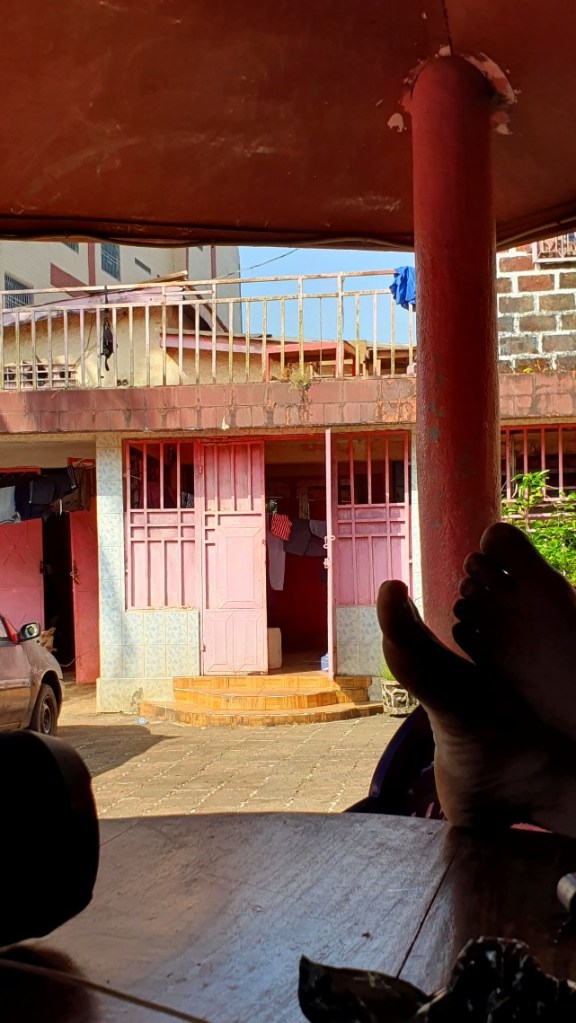
Barry is a tornado. His clothes sweep behind him as he walks and he is always talking. He introduces me to costume-clad gentlemen with trimmed beards. They shake my confused hands in the yard where I have slouched out in slacks, the doctor this and director that. Some days Barry sets up office in the gazebo, draws out long extension cords to connect his laptop and podcast-microphone, carrying over his spinning office chair and instructing Kadiatou to bring his meal to him there. The breeze shakes the purple flowers reaching in from the sides.
“Come, sit! Do you need the wifi password?” he shouts while waving his arms and I have no choice than to bring my laptop and connect, knowing that instead of writing I will get to speak with ChatGPT to demonstrate all the languages I know and then get to hear all about Barry’s projects in whichever pace his mind is jumping between topics the that moment. In the beginning I wait for pauses in the stream of words, but pretty soon I learn to interrupt.
“My big project right now is my newspaper,” he tells me and shows me the website. “We’re already a big deal here and we’re going to be a big deal all over Africa!”
“Aren’t you afraid to do investigative journalism here in Guinea?” I ask him, thinking of the military dictator in charge.
“No,” comes to answer. “I am focused on the truth. Later I will apply for asylum in Spain.”
I roam around the streets in the days; dirt, dirt, dirt everywhere. Cars honking, splashing gutter-water around them. To walk I climb up and down concrete slabs and jump over holes. I hide from the midday sun in small cafes by the streets; tiled benches and windows with iron bars, black coffee and omelet sandwiches, men sitting around and chatting in low voices, maybe half an eye on the football game, half an eye on me. But they leave me in peace. A boy comes by, takes a sack of water sachets on his head. The men say something to him, he smiles and jokes back before going along on his errand. These slow, deep Fula words and smiles. I feel right at home.
Natasha arrives and I am thrilled to meet another solo woman, another hitchhiker, another Russian-speaker. She is a travel influencer from Moldova, wearing floral dresses and dancing in her videos. She makes herself instantly comfortable, her energy resembling Barry’s but not nearly as explosive. She calls me into the bathroom to help pour water over her hair while she scrubs it and I am happy at how easily at ease she seems. Barry’s sister brings a plate of rice and sauce for us in the room and we share it while sitting on the bed. I watch while she films a short video for her channel, explaining her route to the camera and zooming in on the rice. When Barry calls her to be introduced to his suit-clad visitors she fills the role perfectly, standing straight, elegant and ladylike, asking all the right, polite questions in her easy French.
We go to the city center and the big mosque, the church and botanical gardens, look at the Soviet art in the opera house. We get picked up by two men in a car who ask us if we are lost and we smile, laugh and ask innocently curious questions in soft voices, wow at the replies. Under the surface I giggle; it is fun playing “the lady” alongside another player, negotiating the intrusive attention into something that will benefit us. They bring us to a restaurant where we have attchieke, give us a ride and drop us off, registering our fake numbers with content smiles.
Barry brings me to a local bar and we have the local beer. It surprises me; Guinea is conservatively Muslim, but the bar is big and neat, has clean cool faux-leather seats, AC and a big screen showing football. Afrobeats blare. Guests are sitting alone or in pairs by themselves. The local beer is good, like the other African lagers.
“Could you get a hold of alcohol in Mauritania?” I ask, and Barry laughs.
“Of course!” He tells me about growing up there, about the youngsters taking cars out into the desert to party, bringing music and substances. A new side of Mauritania opens. I remember Mama Aishatu mentioning a son who was “making a lot of trouble” for her, and whom she had to send back to Guinea. I smile as I connect the dots.
Going back we share a large plate of spaghetti at a street cafe.
“You, you really are a true friend!” Barry tells me. He shows me photos of his phone, past friends, weddings and pictures of himself, all in a jumble. He tells me about his dreams for the newspaper, for starting a foundation and I listen and smile. The moon lights up the torn apart streets, occasional sharp headlights cut through to illuminate the shapes of walking people, straying cats and scurrying rats.
The next morning I do what seems right and depart at five in the morning. I hug a sleepy-eyed and puffy-cheeked Barry, smile good-bye before he begins to speak and head out into the barely-pink light. The point is to get out of the thick of the city before the traffic hits, but half an hour in I get my first puncture, followed by the second one another half an hour after. It takes ages to repair the holes, squatting in the trash and exhaust with cars, trucks and motos blowing past. By the time I am on my way it is high-time anyway and I grit my teeth again, choose dusty side roads, avoid and hold on for dear life. Finally the dust settles; the orange sand sinks away and green hills rise; the breeze carries fresh air and I breathe, fill my lungs with something clean, finally, while the road calms, opens up and lets me relax.
…
(This story told in pictures part one and two.)
 Hulkuv loom