Avstickare n. (Swedish) detour; excursion; spontaneous deviation from a planned route.
…
The distance to the border and to Freetown is as small as a laugh; I have plenty of time, and so I take detours.
The road flattens out into smooth hills and obedient asphalt. The mountains lie behind the fields. Their blue shadow is nothing but a pretty backdrop now; they can do nothing from there.
A stream is running, happy and wild, under an old iron bridge. I climb down on the rocks to wash and cool my face, let the loud hush drown out everything. On the other side some men are knee-deep in the water, topless and washing their t-shirts. I stray into a trail well concealed by trees and shrubs, down to where a clear stream divides off from the river, running quiet and determined, reflecting the occasional patches of gold falling in through the thick canopy. Stepping stones guide the way and I can hear children and women calling from the village, but I push off the trail and further in among the hanging vines and thick trunks, feet sinking into moist leaves.
I sleep where the water carries the silver moonlight in glimpses, vines turned into still snakes, the layers of leaves holding me.
…
In Forécariah the trees reach high and grand, their canopies forming a bright green, regal arch over the road. I cycle slowly under their held silence. I buy fruit from women on the street, loiter at a cafe while my phone charges.
I sleep where they already cut a path into the forest, careful for the sharp palm branches sticking up and covered in shadows from the few passers-by on the road.
…
The two guys at the print shop just stare at me when my answers to their questions turn more and more bizarre; did I arrive on what? Did I cycle from where? Am I heading to who now? They are also from Sierra Leone, it turns out. The older has been in Guinea for five years, the younger just arrived.
“Say ‘hi’ to Salone from us,” they smile after we have posed for photos.
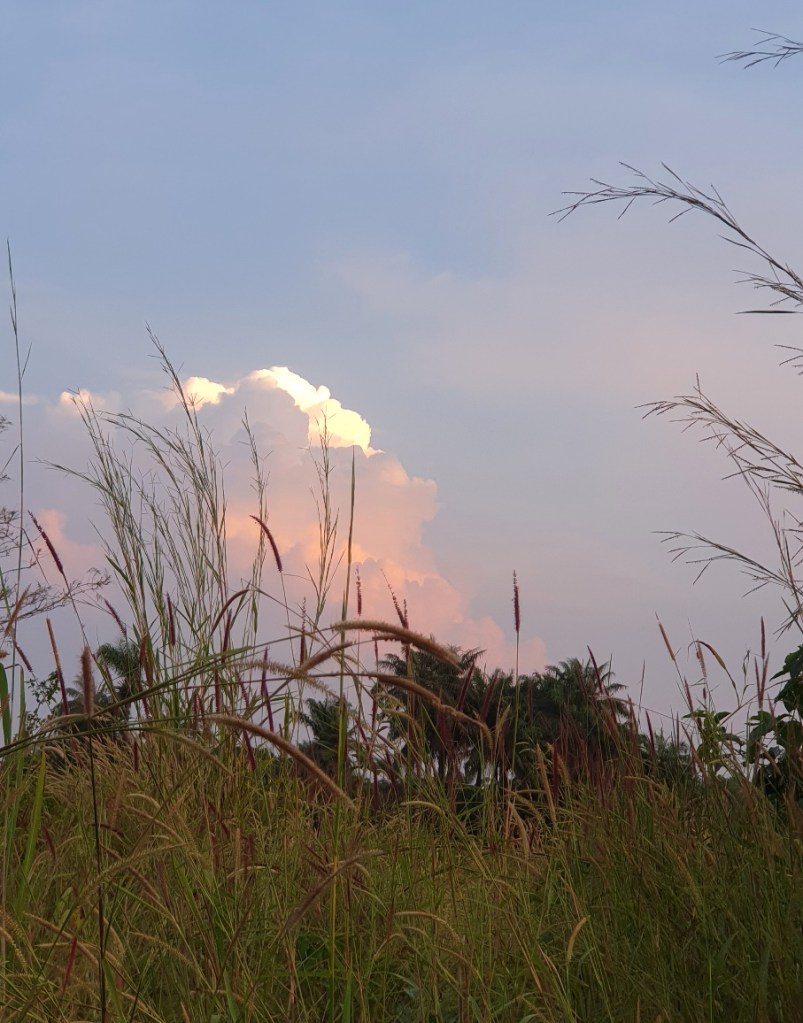
In the setting sun I turn down the gravel road and into the fields, let the tall swaying grass swallow me and listen to nothing but the breeze, the birds, the freewheel. I pitch my tent on a resting field, old mounds from cassava-plants still buckling the ground but overgrown. The sun sets, fluffy storm clouds pass in the distance but the wind does not push them my way. In the dark I make my fire and enjoy my coffee, fruit and book. Little dots of fireflies blink squiggly lines between the straws and disappear to where they need to go. The full moon rises and illuminates my little tent as a lighter triangle against the bushes, lit from inside by the fairy lights I so like to read by.
I sleep where nobody else comes to look, below small poking insect-feet and the immense cascade of moonlight.
…
The cafe walls, tables and benches are all bending, rickety wood, all smooth from the touching, leaning and wear. The outside is white as it pushes in through the gaps in the walls. The men loiter, watch the game, smoke cigarettes alongside their coffees, lean and chat and comment. The brother in the bar already knows I want a black nescafe with no sugar and an omelet sandwich. I sit and watch the men watching.
In the border-town they start giving me more attention, shouting, wanting to sell me things and exchange money. I try to ask for a place to sleep by the mosque, struggle, consider going back, but in the end I just ask if I can sleep in full sight next to a gas station and the man allows me. He shows me where the toilet is. His wife looks at me with worry and their children with curiosity as they turn off the light and leave for the night. The town doesn’t calm; the bustling of the market, minibuses leaving, motos honking, truck engines roaring and flickering flashlights, headlights, shouts; it all goes on well into the night, weaving into my fluttering dreams.
I sleep where they have made a low wall by the entrance, sweating and breathing the dust off the concrete with my bike leaning besides. Only at dawn do I see the letters painted on the wall spelling “mosque” and wonder if I should even have been allowed within.
…
“This is not the visa,” the border officer tells me as he looks at my printed-out visa approval.
“Yes, it is,” I say.
“OK, come,” he says then and we go into the office. I hold back a laugh and wait patiently on a chair, give my information to the lady and watch them write and make the stamp. Ten minutes later I’m good to go. I say nothing, compliment the officers’ handsome uniforms, bright turquoise and with the Sierra Leonian colors sewn to the sleeves, wish a good day and get going. My money is already exchanged, the torn Guinean Francs with the over-proportioned values now neat and pretty Leones.
It is dawn. Groups of uniformed school children cross the road and stop to look and yell at me; here it seems to be “opoto”. Women are already busy selling breakfast by the roads, the motos honk cheerfully as they pass me.
The road is good, billowing smoothly over hills. I pass wide rivers, water flowing over rocks, the forest dipping its branches in on the sides. The bridges are old and stone; maybe from the English, I think. The landscape is intensely green: grass fields exchanging with luscious bushes, palm trees reaching up with playfully swaying leaves, the sky brightly blue with soft, white clouds; the colors of Sierra Leone are exactly as on the flag. The villages are small but look well-off with big concrete houses and new, red metal roofs. Almost no traffic passes. On the side of the road are wide white lines in patches; when I come close I see it is pieces of cassava, laid out to dry in the sun. Smaller brown sections turn out to be grains of rice.
I sleep where they have already made a path in the dark forest and erected high walls woven with palm leaves, enclosing a big, empty area. It is too spooky; I pitch me tent behind the temple to hide and to have my diarrhea in peace.
…
When I reach the ferry, the sun is soon to set. On the other side I see dim angles pushing up in hills: Freetown. I am reminded of the ferry to Tangier, seeing similar triangular mountains on the other side of water. I buy fruit to eat, the yellow ones they call “plums” but that are very different from the plums I know; harder, more sour and with a pit reaching out rooty tentacles. I buy fufu and spicy sauce. I deny five different people asking me for money while I watch the water gulp against the smoothly descending rock. In the end I only give to the one woman with a baby.
I wait and let the calm of the forest seep away. After the ferry crossing I have ten more kilometers to pedal through loud, hectic city. Then I will arrive at the destination that’s been on my horizon for a month and a half. The sun will set and my phone will die; I know nothing of the traffic or whether I will pass by dangerous areas; my butt is full of saddle-sores and I suddenly feel so, so tired.
But I can literally see it. Just one last push. After that, I’ve arrived.
…
(This story told in pictures part one, two and three, and video.)
 Hulkuv loom