The light is bright green from the walls when I wake my first morning. Downstairs and outside, the morning has been on for a while; music plays, roosters crow and neighbors walk up and down, greet, sell food and goods. Megaphones shout out pre-recorded messages as people pass on their rounds: “top-up, top-up!”, “wata wata – kam buy wata!” Rocks skid down the hill.
I feel timid when I step out in the hallway on that first morning. I nurture a shy hope that this could be home for a month, aware that it might as well not.
John has gone to work. The three younger daughters, Margit, Esther and Anna, play, shout and bicker. The three older foster daughters, Zeynab, Adja and Katiatou, are already busy running the house; cooking, washing, sorting clothes. John’s wife receives me: Nurse Kadi. I learn that she is a midwife and that the room curtained off from the living room is her clinic, the only one in the area. Four beds are crammed together, mosquito nets folded up above them. Young nurses in blue uniforms bustle about, sort papers on the overburdened desk, sweep the floor, joke, chat and giggle. Nurse Kadi runs the place, herself pregnant. When she gives the instructions they listen with solemn concentration. The room smells of antiseptics and a smell I will learn later on is the strong, musky smell of giving birth; the smell of a body opening up.
Getting the tour on that shy morning, getting used to all the sounds and greeting the people, I have no idea that this house will become more than a home to me.
…
Sierra Leone is just different. There is something here that touches me.
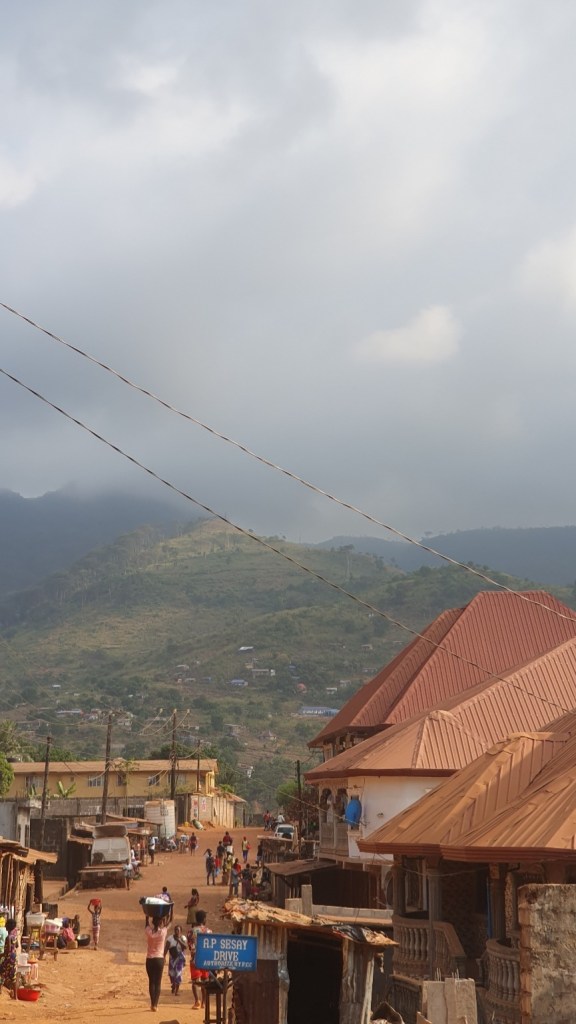
It was not long ago that the country was torn apart by civil war; everyone remembers, everyone has scars. Downtown, the men missing arms and legs gather on crutches and in wheelchairs. Everybody has lost somebody; everybody knows the smell of blood. And to this day the country struggles, topping heartbreaking lists like “the country with most women dead in childbirth”. The Ebola pandemic came from here and now the monkey pox-scare. The government fills their pockets while still, in the forests, the people are bleeding the ground as well as each other for diamonds. The roads barely exist in the suburbs spreading out on the steep hillsides in Freetown; no cars can pass to bring the cement, barely motos can make these climbs; everything is carried by men in hanging pants, the rocks cut by hand, hands rough and dirty. Water pipes are not yet drawn to the families living uphill, not to mention electricity; people have to walk up and down, women balancing the yellow gallons on their heads while rocks skiddle under their slippers and the babies bounce on their backs.
And they carry. They build, they climb.
Churches and mosques are built wall-to-wall; in this country Christians and Muslims can and marry without either party being forced to convert; families are mixed, people pour in from the villages, bump together, bicker, play and work side by side. In the evenings, children in marching bands practice on handed-down instruments. Music is playing and there is always a sermon somewhere. I get the sense that with all the pain in their backs, the Sierra Leonians’ gaze on the future rests calm and determined; as if to say that “we choose to do this together.” Struggling, but always choosing unity.
…
Pentagon is an area growing up from the hillside, with big houses coming into being. The road down to the house is a steep hill which only one or two motos brave. Further down is a small stream which marks the end of Pentagon. On the other side is a football field, and behind it the next hill. Water is not coming to the house and has to be brought from the other side of the stream, across the field. The electricity comes sporadically, depending on the mood of the generator uphill. Nurse Kadi’s clinic is the only one for miles around and she treats everybody, though mostly women and children. Births, pregnancy check-ups, malnutrition and malaria, with occasional moto-boys with busted heads and scraped-up elbows. I imagine what a struggle it must be for a woman about to give birth to have to come to the clinic, over these hills and through the stream, in the dark and in pain.
I imagine what would be if she would not be here at all.
One night I wake up to a scream. I get up quickly and into the hallway. My heart tightens in worry; burglars? Did someone fall? But the house is quiet and dark; the power is off again. I make it to the landing, the few steps above the living room where the older girls sleep on the couches. Adja meets me, I see the white of her eyes in the dark.
“Is everyone OK?” I whisper.
“It’s just a patient who gave birth,” she says. I can hear it then: the faint cries of a new voice. No wonder the others are sleeping; they must be used to this. A light from a flashlight moves behind the curtain.
“Do you want to see it?” Adja asks and I nod. We go down and I poke my nose through the curtain. Nurse Kadi is alone in the clinic, the patient behind the drapes on one of the beds. The patient’s sister sits on another. In the corner bed, the woman who gave birth a few weeks ago but has nowhere to go is sleeping next to her baby girl. Kadi looks at me and nods me over. In her arms the new, wrinkled bundle of skin, moving inside a blanket. The smallest thing I have ever seen.
“Did everything go well?” I ask. My voice comes out thick somehow. Kadi nods.
“Yes, everybody is OK,” she says.
I stay to look for a moment. Here they are; giving birth by phone lights. A dog barks in the distance. Everything else is quiet in the night. Kadi holds the baby while the mother rests. Soon she will pass on the baby to the sister, they will talk while she fills in forms and documents and passes on information. Now only the shifting of bodies against fabric, black shadows and sleepy eyes. Breaths of relief after pain while everybody else is sleeping.
…
(This story told in pictures.)
 Hulkuv loom