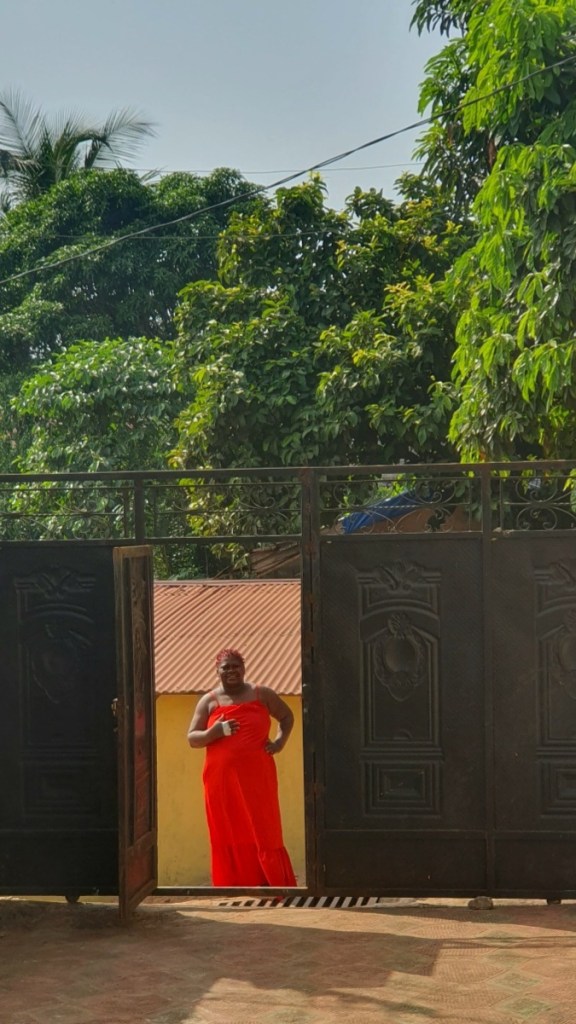
To enter the house you have to pass the clinic and turn into the narrow space by the little shop next door, right under the half-finished stairs to the clinic extension. Duck under the sheets hanging to dry, watch your feet from the rocks and washbasins lining the wall on the left. A chicken, cat or dog may hurry out of your way. You can kick your slippers off by the narrow staircase among the others before coming up. Here, on the little porch, is where everyone gathers.
We cram in chairs, sit on the ground, the stairs. The stove is brought out from the kitchen, the iron trap with the glowing charcoal, and our focus centers on the pot on the fire.
We work on washbasins full of cassava leaves, or fish, or groundnuts, clean them or package to sell. Nurse Kadi on a chair in the center, the boss, calling to the sellers and neighbors passing on the road, giving instructions to nurses from the clinic who might poke their head out to ask something, ordering her daughters. The older girls are doing the laundry downstairs, foam rising up to the elbows, scrubbing fervently against plastic washing boards. The younger cling around just to be a part of the action, sometimes too restless and whiny, provoking until the women threaten them – “Stop it! A de flog you! A de beat you!” – but of course no one listens and the threats ring empty.
Margit, the youngest daughter with her serious face, is never late to lecture me on how things ought to be. The middle sister Esther is playful and always happy to dance with me, while Anna the pre-teen is more calculating, pointing her princess-pinky and strutting. The three of them swing between sweethearts and bandits, jumping between agreement and fights. The foster daughters Zeynab, Adja and Kadiatou are nearing twenty. Zeynab and Kadiatou are quiet and collected while Adja is the lively one, never missing a chance to dance – “to flex” – to joke and jeer, sometimes roaring straight out just to express herself.
“She is feisty,” Nurse Kadi says. That’s a good word.
The foster daughters work hard with calloused hands to run the house. That is the deal, and in exchange John and Kadi pay their school fees. Besides that, all of them are trained in the clinic and can administer shots and bandage wounds with all the correct sterile procedures.
“Of course,” Kadi says when I express my surprise. “In case the nurses aren’t here.”
Not only the family lives here; the house is a home for sisters, aunties, neighbors, and even patients in need. Like the new mother who gave birth some weeks ago but got rejected by her partner for another woman; when she arrived home he had changed the locks. Now she is cleaning cassava leaves with the rest of us, helping around the house until she finds a place to stay. John’s mother lives in the house and Kadi’s mother comes by every now and then. Her young age surprises me.
“She gave birth to me when she was sixteen,” Kadi tells me. “She did everything for me so that I could get my education.”
Most men go to work away from home. Households and neighborhoods become matriarchies during the days as women run the scene. Women pass our porch to greet, exchange gossip or share in the work, sometimes turning off from the rounds they walk to sell goods, with a baby on their back or a toddler by the hand.
“He was born here,” they usually tell me, glancing at the one bundled to their back.
“Go bring the salt, Margit,” Kadi instructs, and Margit jumps on her feet and skips into the kitchen. The lid is lifted, the pot is stirred. There might be spaghetti, or leaf stew, or groundnut soup inside. Another day it is me making pancakes and rolling them with honey, jam or sugar with cinnamon for the crowd on the porch. Someone shouts into the yard from the road and a chorus of women’s voices replies. One of the moto-boys peeks in and spots me on the stairs.
“Oooh, opoto! My love!”
“Ey leffa mi, abeg!” I shout back. He always comes to bother me.
“Mi na basta pikin!” I yell, and the chorus of women’s voices explodes laughing; they taught me the insults just the night before. The guy smiles and raises his hands in defeat.
“I de sabi spik Krio!” one of the aunties comments through the chatter that follows.
“A de sabi spik small,” I laugh. I like the diversity of Krio, the intonations babbling like brooks and sounds tying threads into English, French and Portuguese along with Temne, Mende and Yoruba. Having picked up only a few phases helps me suddenly to understand the lyrics to the Nigerian songs I so love. And I like the bold manner of speaking; this is the country where I learn the insults along with the greetings, fresh off the street as people bicker and clash.
“We are more spicy,” my friend had joked, months before I came into his country to see it for myself.
I didn’t know I missed being among women as much as I did. Here they are unabashed, their voices loud and eyes direct, sometimes rowdy and quick to wit and playful mockery. It’s a contrast: in Senegal, the Gambia and Guinea, the women were more quiet and bashful. Sometimes they were ashamed of their French, fearing that I would judge them, preferring not to speak with me at all. Here, it doesn’t take long to reach friendly jargon, laughter and banter.
And there is always time to play or dance.
“Kam flex!” Adja shouts from the washbasins, sticks out her tongue and shakes her hips. From my place on the porch I respond, going low while the women cheer.
“Snap me, snap me!” Margit commands and I comply. Sometimes they forego me and tell me to film and take photos of the cooking and preparations, eager to show and tell. Another day I follow other curiosities:
“I want to try that some time,” I say, watching as a baby gets tied to her mother’s back in a lapa. I have long wondered what it feels like.
“OK, kam,” Kadi says.
“Now?” I startle. The baby is so small; I had imagined trying it with someone older, a little stronger.
“Yeees,” Kadi says. I bend forward as the little creature is placed on my back with its sleepy-limp arms and legs spread. An extra cloth is folded between her little head and my shoulder blades. They hang the lapa over me and show me how to fold it into itself over my chest. Then I can stand and fold the lower end over my stomach. The little body just hangs there, a hot bundle tight on my back, covered in the fabric. I can feel her breathe. I move carefully as she merges with me, awestruck and emotional. Amused, as she comfortably sleeps through what to me feels like a big, human moment.
The women on the porch let me in so easily, into the language and the cooking; a quick joke with bracelets dancing on the wrists, red painted nails glisten in the sun; hands working fast to draw fine-fine braids over tilted heads and reaching out to tug on my hair when I ask if it can be braided too; a thoughtful pause before once again a smile, a quick dance break before they roll their lapas around their fingers, place the basins on their heads and head up to the junction. To continue their rounds, the morning work to bring in the money. I watch auntie Adja in admiration as she leaves with her son by the hand and a bucket of sweets on her head; I know she got up before dawn to prepare the sweets, then take care of her kids, send the older ones to school, cook and wash and sweep the floors. Now, almost noon, and she is making rounds up and down until it’s time to return back for another round of cooking, cleaning and mothering. Then the same thing tomorrow. Yet she takes her time to stop, check in and chat. Playful, though she must be so tired.
The pot; the steaming and bubbling pot is what is keeping the time. The heavy morning work is done when the food is ready and dished.
The pot always serves everyone; us, the guests, the family, the daughters, the patients in the clinic. Every plate is dished for certain people in mind, alone or in groups, the bits of fish chosen with care. Everybody moves to their own corner to eat. As the day heads over noon, the house becomes still. Everybody naps in different nooks while the heat of the noon presses down. For these few hours the porch is empty. We rest.
…
(This story told in pictures and video.)
 Hulkuv loom