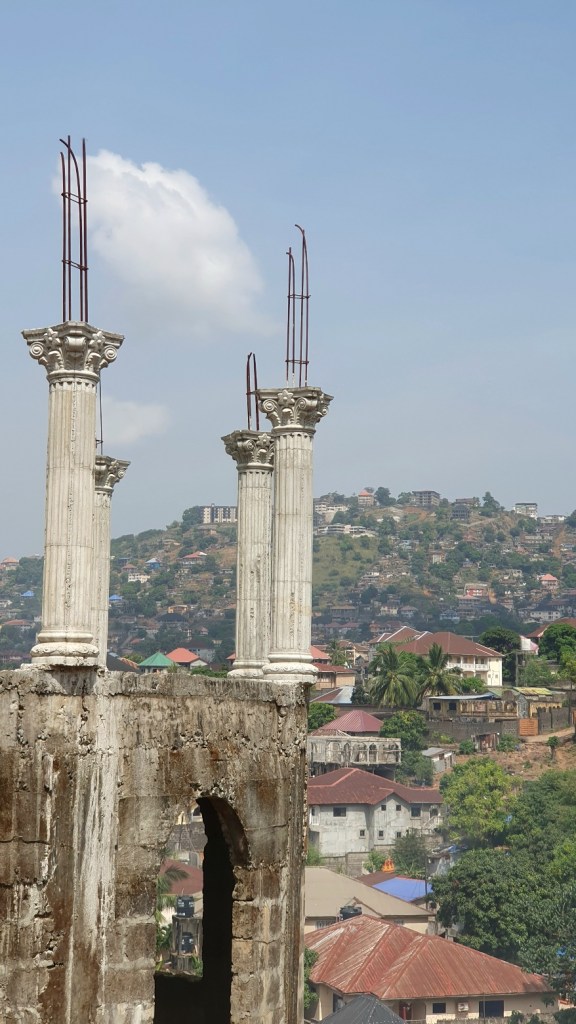
Dawn: we have made an expedition over to the next hill. We played chess with small magnetic pieces on a metal board in our palms and now my friend is sleeping in the shade and I watch the schoolkids in the valley below clap their hands in unison. We are far up the hill, among the last houses. Ahead the forest still lies uncut. The houses where people live are overwhelmingly shacks with rusted sheet metal roofs. Next to the shacks they are building multi-storied castles: huge houses with swanky cast concrete railings and billowing arches. Thin, muscular men carry the cement and the rocks up and down the steep hillsides, sweat glistening, feet slipping in flimsy plastic slippers. The road has long since turned into many winding tracks where not even a moto can pass. The clinks of somebody cutting rocks echo through the valley. The stream that runs by here has to be the same one that passes by our house further down.
There are no walks to be had in this part of Freetown; the steep hills and uneven, rocky roads turn every walk into a hike.
“It is so beautiful!” I have stop to take photos of the houses trickling up the hillsides every two steps. The red and blue roofs, the gray concrete with occasional bright yellow or pink flashing among the green foliage, the purple, pink or golden tint laid over by the distance and the time of day.
“Why? What do you find beautiful about it?” my friend asks. Yes, why? I think while I aim and zoom.
There is something about the lives laid out on display, how they are so open, on display both near and far. How, at the same time as I navigate though the maze-like roads of each neighborhood, I can see way over to the next hillside between the houses; how the space pours in through the gaps.
The music and the sermons and voices bounce between the hills; smoke rises as people are cooking; everything becomes everybody’s business and lives weave closely together.
And this is all growing and changing so rapidly, so dynamic with people pushing and sweating to erect all the big houses, the city creeping slowly and steadily further in and up the hills as people but plots of land, disregarding how steep it is and the lack of infrastructure, just up, up. There is something in that, something resilient and stubborn that awes me.
…
Another dawn: I have climbed up another hill on improvised steps: discarded concrete blocks and sand mounds shaped by feet that know the way, a few roots or maybe rocks to hold on to. Everything is shifted by the heavy rains; water has dug its own furrows, taking part in shaping and moving the ground. Auntie Adja told me about the devastating mudslide that took lives in the area just a few years ago. It happens when the roots that hold the ground in place are removed. With climate change the rains are only getting heavier, and with population growth, the city will keep on expanding and creeping up the hills, with people cutting the forest to make room.
I make my way up slowly, afraid to stumble on my slippers. I am passed by a girl carrying a yellow 25-liter water gallon on her head. She is limping slightly; one of her legs seems to be paralyzed. She doesn’t look down to know where to place her feet. She glances at me, steady with the weight balancing on her head. Lifts herself and the water up the rock and leaves me huffing behind her.
The trails run along the hillside, turn into unpredictable spirals, up and down. Some end in dead ends, others lead me through backyards where eyes of families turn to follow me. “Taking a walk” is not a thing here and my presence needs explanation.
“Opoto! Usai you de go?” Where are you going?
“That way,” I say and point ahead.
“Aaah.” They let me pass and I go on, searching for the track as I go.
The day has reached noon and I have found a road again. I decide to take the turn going up and follow a man walking in zig-zag; the only way to go up without practically lying on the road. Estates line the way now, where just some meters back were wooden cabins. Enormous spiders have made their nets between the power lines, swaying in the wind. I reach up and turn around; this was the whole point of it.
The houses fall beneath me like sugar cubes. Small dots of red, blue, white and yellow blur and mix together, howl down the hills until they’re flat and melt into one single body of a city. There I know is Lumley, the busy junction with its market, traffic jams and exhaust, people shouting prices and cars honking, yellow kekes hurry to fill gaps and arms point, usher, while bills slip wordlessely between fingers, fruits and fabrics stacked and ready, juices running in the gutters. But I can not see or hear any of that from here. Only the mellow, dry Harmattan breeze. My gaze rolls further down. There, still and without horizon, like a glistening hole in the world: a blur. The boundless blue haze of the ocean, quietly coming up to meet the city.
…
(This story told in pictures.)
 Hulkuv loom