Tima’s shouts and chatter and easy smile up by the junction; she decided to become our friend from the moment she saw us.
“Why haven’t you called?” she asks. She leans in close, eyes unyielding. My friend teaches her Swedish. She has her marching band performance next week. She works behind the little table selling attieke, spaghetti, fried fish. She serves me a plate.
The snacks are what feed me here: bomba-cakes, the cookies shaped like vulvas; kanye cakes, the triangular peanut butter-and toasted ice cakes; grilled cassava that we eat with fresh cucumber, mayo and salt; fresh oranges, papaya.
…
The different tracks to follow down or up, along the stream or across it. One takes me into the little church one evening but by the time I come there they have finished singing. Instead a lady is giving a sermon, shouting into the microphone and I am placed in the front row and stay for a few minutes just to be polite, though this is not what I came for.
Another road takes me up a hill, legs straining, and I find myself by the next junction and the bar run by Kadi’s mother’s sister. I have a cold beer: blue Star in a green glass bottle. I get invited to play Ludo. It is way too fast for me yet somehow I keep up, mind swimming, fuzzy after half a beer, loud laughter and taunting as the dice smash against the little board in plastic rattle. I come dead last the first round but manage second place the second. Kadi’s aunt looks tired and I ask her if the men are nice to her; her customers seem to be the local drunks, standing a little too close and talking a little too loud, even by local standards. She shrugs.
“They are nice,” she says.
…
We go into the city, roam the markets and supermarkets to look for Christmas gifts; come back loaded with color pencils, crayons, drawing pads. Mugs for the adults.
We go to the Ministry of Interior Affairs, sweat there and sweat at the bank and then we go to the Embassy of Ivory Coast and sweat some more. The ambassador comes in though it’s Christmas day and writes our visas on the spot while his son swirls around the room, gets hold of a pen and decorates his hands.
“So will you give me something? A Christmas gift?” the ambassador smiles and we smile too and joke and pretend to not understand what he means. The visas are stamped and signed.
Back in Lumley I push into one of the side roads where there is a café with the woman selling porridge on the side. Two Leones and I take the small hot plastic bag, bite the corner off and suck while I hang over the railing and look at the men playing checkers at the tables. They too are fast, banging the pieces down on the board. It always makes me laugh.
“Why do you do it like that?” I ask and mimic the way they slam the pieces down.
“To make him scared,” the guy closes to me replies with smile in his eyes.
“Does it work?” I ask his opponent. “Are you scared?” He laughs too.
“Yes,” he grins, slams his own piece down, twice, eating two pieces.
…
They spent the whole day cooking, Kadi and the girls. In the afternoon they bring us a heaped plate, a Christmas dinner: beans, sausage, attieke, spaghetti, chicken, salad, mayo… My friend lies on the floor in heat and food poisoning and so I go in for my half alone.
At night the power is out again. Since Adja left for the village over the holidays, the house has been more quiet. I don’t really know what to do with myself on this last night. Music is playing somewhere and I briefly consider going out, finding it, dancing with strangers. I have packed all my things, prepared my bike and carriage. I can charge my phone on the solar tomorrow.
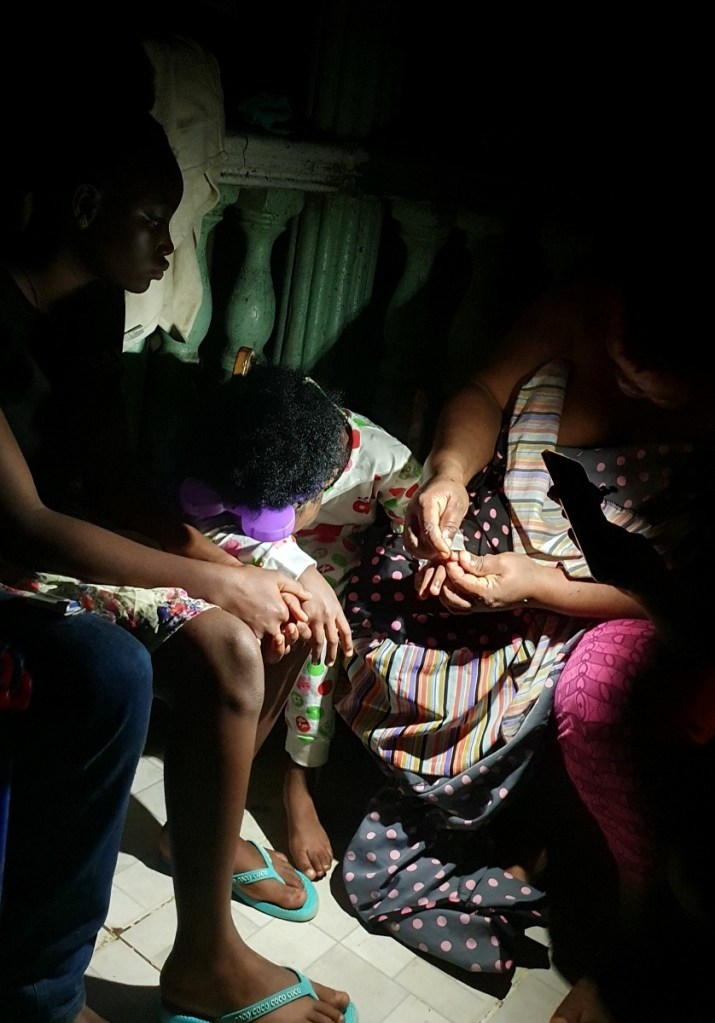
I move about the house. Weak light, whispers and the smell of body seeps in from the clinic. Kadi and the girls are gathered on the porch, doing something by torchlight; four heads close together.
“Margit push!” Esther demands.
“Noo, stap!” the whiny answer.
“Leffa,” Kadi’s voice is low, focused. She is trying to cut nails with a pair of clippers, unclear on whose hand. They haven’t noticed me looking at them. I lift my camera and snap them in that silence, pressed together on the chairs: dramatic silhouettes of three daughters and their mother around this single light. A family portrait of which I am not a part, but could be, if I wanted. Could step out and ask hello and somebody would give me a seat and I could add my head to the ones leaning over the light; engage, participate. It feels easy.
The thought warms me.
…
(This story told in pictures.)
 Hulkuv loom