If they cut down all the forest,
where will they go to cut the boys?
…
We bump along the forest trail, tightly packed together on the motorcycle; our bodies are pressed together between the stuff that is piled and strapped onto the moto, behind and on the sides, prodding our thighs and arching our backs. Behind us follows the second moto with you and the driver, just as packed. Forty kilometers takes two hours on this kind of road; this is the only way. My body is pressed in the middle, Mada in front, navigating the holes and rocks and sand and erosion, rubber boots scraping the ground through the trickier parts, and Mr Patrick behind.
We had to hurry to not miss the daylight. Now the sun is setting and as we descend into the valleys where the rows of massive, fern-grown oil palms block out the light, my skin goes chilly and moist with the mist. Pink and golden sky glimpse by in flashes. Small villages punctuate the forest, rooster crows and rising smoke signal their arrival up ahead and straw roofs point to the sky between the leaves.
“Eeee! Pomoji!” I hear, before the forest drops its curtain again.
The sun sets and we follow the feeble, yellow circle drawn by the headlight. No moon to help us. The trail is smaller now, the road even more difficult. But Mada drives on.
I don’t know exactly when we arrive in the village. The yellow circle starts bringing out walls from the pitch black; human-made angles and rough, patted clay. We stop. Dots of flashlights swing and wave around us, mumbles, shadows and silhouettes of lifting arms, spreading fingers, turning heads. Gravel grumbles. Bare feet lead us to a house and unlock and we try to understand the rooms as they come together in the shards of light; tiles in the salon, turn of a corridor, a room to the right and a room down the hall.
Which room do you want?
Cement crumbles on the walls, critters scurry away, just untouched by the torch. My abs, thighs and glutes ache from holding on to the moto.
With one loud baff after another our bags land and line up along one of the walls. Our bodies land in the beds, and with final clicks, the torches let the room fall into darkness.
…
The light cuts my eyes and every cell. When I move my muscles screetch like an old door.
“Wake up!”
“Come!”
We dress and we do as we are told, come out to the salon. There is shuffling outside, running feet and voices. Then the door swings open and people, people, people bring in the day. They introduce themselves: our host, another host, an elder with a knitted hat, lopsided; a man missing a leg. An older woman. Faces folding in deep wrinkles, toothless smiles and eager eyes.
I forget how everyone is related.
The room fills up.
Children flock to look in, their shaved heads stacked like bricks to fill every crack of the windows and the door. We sit and everybody leans in and looks at us and talks.
“Pomoji!”
“Boa!”
“What is you name?”
“Hello!”
Declarations.
My hands are grabbed and expectant eyes press their shine and smile into mine while something is supposed to come out of my mouth.
Mada comes. He is holding a tray with breakfast for us: hot water in a thermos, tea bags, sugar, white bread. He mumbles his good morning and puts the tray on the table.
“Pomoji, boa!” Absolutely unyielding eyes.
“Boa?” I try to reply.
“No, you say ‘bissie’!”
“OK, bissie.” The room is so tight now with bodies turning.
“A-haaa!” said vindictively, “Boa!”
“Bissie,” I comply.
“Yees! Ka-i-goo-ma!”
“Oh, OK.”
“Say ‘ka-i-goo-ma’!”
“Kaigoma.”
“A-haa!” The older man smiles, straightens his back and says something in Mende. The elder lady hurries close, bends down and locks me.
“Boa!” she commands. They all want a turn.
A small space occurs and I get up and fold and press my hips back to the hallway and into the room.
It’s too much.
I close the door.
We have been given rooms and they are elders. I should behave.
I lean on the wall to breathe.
I hear the voices and commotion from the salon where you are still. Little fingers move behind the frosted window and the frame starts filling up. Noses press against the glass, eyes search in to get a glimpse of me.
“Come!” someone shouts from the other room. “Come have your breakfast!”
“You will not eat?”
Breathe.
“Do you want to have a tour now? Or do you want to wait?”
The place my voice comes from is not its home.
“Can we wait small?” I call. I know already that we will be the tour, paraded ‘round the village in a sea of children.
…
The village is the last, last one on the forest road. No electricity, no phone connection. I came here to do farm work in exchange for house and board.
Most houses are built on a frame of bamboo, the gaps filled with straw-mixed clay. The roofs are thatched from palm leaves and have to be changed every two years to withstand the rains and wind. A few houses are made from clay that has been formed into bricks and fewer of those have plaster to smooth the outside surface.
The forest leans in over the village from every side. The trails squiggle out to cacao- and coffee plantations, tree nurseries, creeksides and farmlands. In the mornings people scatter to their lands, start pounding the mortars and hauling water. Everything grows here: rice, cassava, pineapples, mangoes, coconuts, papaya, peppers, tomatoes and aubergines, pumpkins, sesame and sweet potatoes, okra and beans. Palm nuts are harvested and boiled into palm oil, refined in big tubs dug into the ground. Bamboo and rattan gives baskets, fish traps and furniture. The creek brings fish and a current to wash clothes; the borehole donated from this or that NGO provides clean drinking water. Sieves rattle in rhythms as women shake off husks from the pounded rice grains.
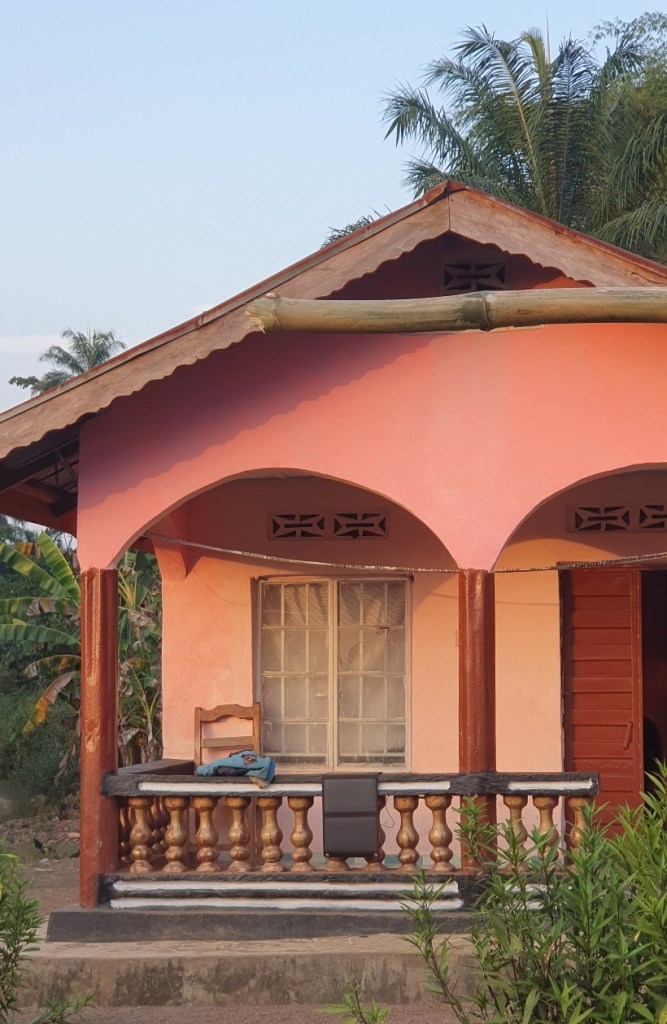
Ours is the best house, the only one painted; it is pink with a tiled porch and dark red pillars. The roof is sheet metal, the windows have glass panes. The floor in the salon is tiled and the walls are painted there, too. There is a small table, three rattan chairs and white curtains. Down the hall are four bedrooms. The walls there are bare concrete and the floors covered with a plastic mat. The latrine is a hole behind the house, shielded by flimsy sheet metal reaching up to my shoulders.
My host Mada has high cheekbones and attentive eyes that stay serious even through his careful and occasional smile. It is his farm I am here to work on. He makes rounds into town weekly on his moto, charged with produce from the village to sell on the markets, and returns loaded with fizzy drinks, biscuits, Maggi cubes and a variety of spirits packaged into small plastic wrappers that he sells for a few Leones. The liquors are highly appreciated by the bored teenage boys and the war veterans, even though it is a Muslim village.
Abie is Mada’s new wife. She has come from another village with her mother and sister. She is short, has wide eyes and a big, open smile. Her voice and her laughter are loud. Her little sister is just growing into a teenager, sprouting arms and legs in all directions, sometimes posing, twerking and pouting her mouth with attitude, other times skipping and shouting like any happy child. Abie’s mother is collected, straight back and eyes full of dignity.
At dawn Mada wakes me to walk through the forest to his farm. Mada first, then me, then Abie and her sister last. The track winds, we climb up and down hills, through cool cacao plantations and over cut trees acting as bridges over streams. Mada carries his cutlass, Abie and her sister each have something on their heads. My hands are free.
“Run here!” Mada instructs, “They bite!” And we run and leap over thick black lines of marching ants across the path. With a hand on the basin on her head and the other lifting the lapa around her waist, Abie is right behind me.
We pass a rice field with green stems swaying and we take our slippers off to plunge through black mud. We mount the last hill, the trail now rocky and dry. A little farm hut reaches its triangular roof up with grateful shade.
The sun beats our heads from above as we chase and follow the bleak-yellow beanstalks up the hill. We rattle the black sesame plants into the basins so the little seeds fall from their cradles, occasionally reach for the few red peppers and tomatoes that glimpse from the undergrowth. I slip and strain my feet to keep my balance on the rocky hill, sweating, but it doesn’t take long until we’ve filled our basins and they call me to come down. Abie ducks aside, plunges into a marshy ditch and tears up a handful of leaves. She looks up and smiles at me.
“Potato leaf,” she says. Today’s dinner.
Back at the farm hut Mada spreads white sacks on the ground.
“We will beat the rice now,” he says. The rice is yellow and dry, cut and sorted into bundles that look exactly like the perfect wheat bundles on old Soviet paintings. He unties and lets the stalks fall in a heap onto the weave. A little to the side, Abie is making her own pile. Her sister sits and watches, her legs in angles. Mada hands me a stick and shows me how to beat straight down into the center of the pile so the grains fall off the stem. I sit down next to him and we get to it. Next to us, Abie is taking care of her own pile, lifting her stick high and bringing it down with the force of her whole body. Sweat runs down her forehead and drips along her nose and chin.
Dust rises and we sneeze.
Rice grains fall.
Mada collects the beaten and deformed stems and throws them aside from time to time, opens new rice bundles and adds them to the pile.
“This is to make mattress,” he explains about the bent stems.
My palms blister. We beat. It takes just as long as it takes.
“Are you tired?” Mada asks me every five minutes. “Do you need to rest?”
“I am OK,” I say every time, and watch Abie’s sweat drip.
We scoop the rice grains into a big sack, fill it to the brim. We put the beans into a smaller sack, sort the peppers, the okra, sesame seeds, aubergines and the few tomatoes. Together, Abie and Mada heave the sack up onto Mada’s head while I watch; it has to be at least 20 kilos and he will carry it all the way back: over the tree trunks, up the hills and everything. Abie takes the smaller sack of beans and her little sister the one big pumpkin that we found. I am given the empty basins with the few vegetables rattling around.
“Tomorrow we will go to my new farm,” Mada says when we arrive back at his house half an hour later. He wipes the sweat from his brow with a finger.
“It is an hour of walking in the forest,” he says. “Can you do it?” I nod, give him a thumbs up, smile. The sun is setting. The last light falls purple over the houses and the strolling chickens. Abie doesn’t stop to rest but starts making a fire to prepare dinner. I head back to our house across the village, accompanied by the shouts of
“Oooy pomoji!”
“Boa!”
“Helloo-oo!”
I try to keep up and wave.
I return to the room and the noses and the little fingers come to crowd and press against the window.
…
“Boa!”
“Boa!!!”
“Bissie!”
“Kai-goo-ma!”
“Oy pomoji!”
“Boa!”
“Where are you going?”
Feet patter out to look at me while some stay to whisper and point from the bushes.
By the borehole everybody moves aside. I stand to wait my turn but my bucket is taken and promptly put under the stream of water while a little boy pumps.
“Let me take it for you!”
“Do you need to wash your clothes?”
“Let the women wash for you!”
“Boa!”
“Thank you,” I say. “I can take it.”
Necks crane and sieves stop in their rattle at my steps. Old men pause the trains of thought as I walk between the houses.
“Boa!”
“Yes, bissie,” I say.
“Kai-GOO-ma!” It is emphasized, they want me to SAY IT.
“BOA!!!”
“Where are you going?!”
“Pomojiiiii!!!”
I return to the house and decide to do my laundry on the back porch, where only ten-or-so people will come to look and shout.
…
I wonder if we are the only ones in the village to eat several meals per day.
Abie and Mada cook us the brown, wild rice; the one we have beaten at the farm. Green leaf stews with palm oil and fish; the potato leaves, or sometimes cassava leaves from the fields, and fish from the creek. My favorite meal is a thick, nutty paste made from roasted and pounded sesame seeds, rich and delicious. Or the slimy, gooey okra stew, deep green and running off the spoon in thin trail; sweet pumpkin sauce, heavy, boiled cassava or just rich, salty peppers in watery soup on the rice; the meals may look simple but every flavor is so dense with the whispers of the forest.
“Grub,” Mada calls it, and I wonder if an American volunteer has taught him that word.
…
It is night, and the silence is so beautiful and dense. There is nothing more natural in the world: when the light goes, sleep comes. Day turns over into night, with its own rules and manners of speech. The village is all but a few stray ember glows and mumbles and shuffling feet, but we have ventured out behind the house. We lit torches into the canopies and through the interwoven foliage and hanging vines, pairs of eyes glimmered back at us through the gaps between their leather-wings. We arrived at the school by the football field, peeked in through the windows and read the info posters on vaccinations, then sat to drift in thoughts on the stairs with the stars scattered and arching above us.
Then.
Three moving lights rip the calm on the edge of the field.
“Turn off the light,” I say and hope we are invisible and innocent. That we somehow can be left alone; remain free from eyes and hands and wants just this once.
Maybe they are going on another errand.
But there are no other errands. We are the only errand; we have gone outside the house and it is unforgivable.
They march straight up to us.
“What are you doing?!” All three are upset, the shoulders bulge in silhouettes behind the sharp lights from the torches. I recognize our house-host.
“You can not go out like this, alone!”
“Oh, why not?” We stay seated. I keep my voice calm. Try to sound innocently curious, place their anger out of proportion; we are no more than two hundred meters from the house.
“It is dangerous!”
“This is Africa!”
“This is not Europe! You can not just do what you want!”
“We just wanted to take a walk,” you say.
“You can not just go as you want!”
“This is the border with Liberia!”
“You need to tell someone so we can accompany you!” They usher us, herd us with their hands and voices, click their tongues at our capriciousness, grumble and depose us at the house.
Somebody stays sitting on the porch.
Back in the room I wail bitter tears into my palms, press the thin skin of my knuckles to my teeth to quiet my humiliation and frustration over the tiny room I have to breathe; the tight, barely existent space where no eyes bore into my skin. You stroke my back.
…
For almost a year, cycling, living, moving through Africa, I have been shouted at, told what to do, and in every way received attention for being white.
Give me money,
Hey, White!
I love you.
In some areas, as I would cycle through a village, everyone, everyone would come out to the road to look at me, chanting “white, white!” Smiling, waving, staring.
Most everybody has an idea about what it is like “Over There”, the place that is “my place”, but their ideas don’t fit around my body. People want me to do certain things, say certain things, be, act, behave and whatever in certain ways, to meet their idea of “White Person”.
For some reason, now, it is becoming too much; the body is too small, too weak. I tense in front of the eyes, pull back when somebody comes to touch, smile to the side hoping to redirect expectations. In the morning I rear back and huddle and cry behind Mada’s house, after one of his neighbors jumps out and shouts “good morning” at me too loud.
“What is it?” Mada asks when he finds me. His eyes are so sharp, almost afraid. I try to wipe the snot with my fists while the tears just keep on coming.
“I thought he would hit me,” I lie.
…
We walk out of the village to find internet connection. We hold up the screens searching for bars. A few kilometers down the road, the little arrows blink into being. We duck in between the bushes, watch out for ants and spread out fabrics to sit on. With the sun sifting down soft and golden and the palm leaves rustling above, we photograph our passports, crop out the bushes and adjust the white balance. Fill out forms for our visa applications.
…
The bare strip of moon is not enough to really draw light apart from shadow. Any person, lizard or spirit could be moving between the houses, invisible if silent enough. The ground, patted flat by soles of feet, is still and echo-less. Our rooms too, are quiet. The screens that we charge on my solar panel so we can amuse ourselves at night, light small rectangles of color between the concrete walls. Small bits of sound escape the earphones whenever the other has to lift out the bud, and dramatic pillars of shadow move when a torch is lit to find something from the bags on the floor.
I lie on my back. In so many other places, this exact moment is pierced by fires, shouts and colors exploding into the sky. People raising their glasses and kissing, getting drunk. Here, the clock slips unremarked from 23:59 to 00:01.
Then on.
Nobody looks and nothing changes.
“It is the most quiet New Year’s I’ve ever spent,” I mumble.
“It is nice,” you reply.
It is.
But I don’t want to be here.
…
Mada travels to Kenema for a few days and I go with Abie alone. We go to the farm, pick beans, beat rice in the heat. We fill the sack again. I assume she will leave it for Mada to take when he gets back, but she gestures me to hold on to the two corners to help her lift it up and place it on her head. My legs strain. She squats underneath and moves to come up under its center. Her small body sways as she adjusts, accommodates, becomes one with the weight. Her eyes stay on me and her smile is wide. A bead of sweat falls from her brow. She has rolled another lapa for me. As she looks on I place the roll on my head, take the basin with the beans and the tools and place it on top, right on the crown of my head. It is not too heavy.
“Will you be OK?” I ask her before she has a chance to ask me. That sack is so damn heavy. She just smiles.
“Leggo,” she says, and we set off.
I wonder if she feels like she has to prove something, being the new wife and new to the village where everyone else has grown up together.
Her hips sway and her legs march like a soldier’s. Down the rocky hill, through the mud and up and down, balance on the tree over the stream, avoid the rocks and ant trails, left and right through the forest. Abie marches in front, she sets the pace, finally doesn’t wait to pamper me. Just expects me to come along by now.
This woman would let me be strong.
I hold the basin with my hand but briefly, work my full body to adjust to the weight and balance, curve my feet and watch my step without moving my head.
The women here know their strength. They would not treat me like glass, like the men do. Not for long. They challenge me, bring me face to face with my clumsiness and weakness, laugh as I spill and fail and miss the rhythm of the sieve.
And then they let me try again.
There is a contempt in that, a glee at my weakness and inability.
But when I am rested I don’t mind that, because they also let me in and allow me to learn.
Even with my longer legs I have to make an effort to keep up with Abie. People trickle in and join us on the trail the closer we get to the village as the light turns golden over the forest. Plastic wrappers, small packages from liquors and cookies and different bags start littering the road; more and more the closer we get to the village, blown and trampled to the outskirts, packed into the sand and decomposing never.
Abie is drenched and I help her take the bag down in front of her house.
“Can I try?” I ask on a whim and she looks at me, puzzled. I point to the bag and then my head. I just want to feel the weight. She looks skeptical but I insist.
“Just one second! Only small!” I adjust the lapa and we lift the bag by the corners again. I bend my knees, get underneath and center myself under the weight, meet the it with my head like I saw her do. I feel it, push up with my legs slowly to rise.
She lets go.
The pressure on my skull is unbearable, despite the lapa, and I immediately twist something in my neck.
“Okay,” I grimace, “It’s OK! Down, down!”
The sack comes down. I laugh and rub my neck. I couldn’t even hold it, and she has just hiked through the forest for half an hour!
“Tomoro wi dey go bruk by di rivaside!” Abie says. “A de kam wek you!”
“OK,” I say, “yes.” She starts gathering up firewood to prepare our dinner, shouts orders to her little sister to bring different things, shouts evening greetings to the neighbors and waves me away to go to the house.
I wonder what she likes and what she dreams of.
…
We go down to the stream that carries off all the plastic wrappers and foaming soap, already echoing with women’s voices, but the cuts on my hands come up and I bleed over everything. Abie washes my few things along with the enormous pile of her family’s clothes. Later we go to weed a yellow field where the shallow roots release easily from the sand and the dry stalks crackle in our hands. The sun is hot from above as our machetes rise and fall. The river runs below and a group of young men are being rowdy on the other side of the shore. They see me in no time.
“Oy, pomoji!”
“Hello baby!”
“Hiii!”
“Baby! Come here!”
“Witeuman!”
I stay quiet and work through their shouts. Brown ground, dry root. Abie replies with shouts and smiles, makes them laugh and then turns to me.
“They are calling you!”
“I am not their baby,” I say.
Finally one starts wading over. He comes up the hill, then comes to stand by my side.
“Hellooo-oo,” he sings. “How are you?” He might be around twenty, tops; ten years too young to be catcalling me.
“Fine and you,” I reply without looking at him.
“Why you no reply when we call you?”
“Shouting ‘pomoji‘ is not a greeting,” I say.
“Aah.” He stays silent, hands hanging.
“So where are you from?”
“Estonia.”
“Australia?”
“Estonia.”
“Aah.”
It doesn’t tell him anything.
“So do you like our village?”
“Sure.” Abie works on nearby, ears sharp for every word.
“Let me help you,” he says.
“I’m OK,” I say.
“No, please.” He starts cutting furiously next to me with his machete. After a while he says good-bye and leaves to join his friends and their eyes again.
On our way back we stop by a big dead tree and Abie cuts into it, liberates thick branches, bundles them together with vine and lifts them onto her head, the wood hanging down far in front and behind her. I want nothing, only to be back at the house and hide in the room and not talk to or be seen by any fucking one. I think she can sense my mood. Maybe this is why she stops in the cacao grove to point at the fruits and the seedlings.
“Look,” she says, “this is cacao tree.”
Yes, I know it is cacao. You showed me the first day and everybody is repeating and explaining and pointing every single day, because even though you don’t consume it yourselves, you sell it to white people because we love the stuff.
I know you grow cacao, I fucking get it by now.
And suddenly I feel so tired, so falling-apart, so raw.
Then grateful;
she is trying.
…
The moon has grown full. Hands clap. Women’s voices ring over the village. A group moves slowly, beaded gourds rattle the rhythm with a little drum as voices sing and repeat the rolling melody, silver as the moon.
I slip between the shadows so sharp, join the procession behind the backs but in moments arms pull and embrace me into the center. Aunties smile and come to dance with me, laugh and cheer when I move to mirror the energy. We move from one quiet house to another. Sometimes they open a door and step inside, fill it with bodies and song and then file out again.
After a while they insist that I am tired and take me back to the house.
From the porch I can hear them moving around, circling the village again and again, singing to the light of the moon.
…
We go to Mada’s forest farm in a troop this time; me, Mada, Abie, Abie’s sister and a handful of the young men. All with their machetes in hand, plunging in high rubber boots along the trail, shouting and joking. Abie carries pots and all the ingredients for lunch. I am placed to walk ahead of the boys so they can comment on my ass or whatever they need to comment on. Abie walks last. I clench my teeth.
We will cut the trees down.
“Sierra Leone has more forest than people,” Mada has explained. “So we can cut.”
We spread out between the trunks on the steep slope. The forest floods with echoes, voices, metal hitting first against the wood, then eating inside the wood, repeating; insisting apart the fibers, softer and lighter and slightly moist under the bark. They pick at the careful flesh of the tree until something cracks, and with a rush the body breaks off and the giant falls. Leaves rustle, drag through other leaves; branches intertwined to be the canopy, now slipping like fingers. Golden sun comes in through the new hole. The birds are quiet as the trees turn into wood.
I cut the smaller sticks and vines with stems not wider than my wrists, trying to figure out the best angle for the cutlass to cut. The men move quickly up the hill, felling trees as thick as their torsos and thighs, chunks flying with every swing. They have tied their shirts around their heads to catch the sweat and the muscles play on their bare backs. They empty small bags of liquors and smoke cigarettes that Mada provides, dropping the wrappings on the forest floor.
We sit down for a break and wait for the food Abie is preparing.
“What is this?” I ask one of the boys. He is Mada’s cousin, I think. He is the youngest, maybe sixteen, sucking on a cigarette like the othes. He is sitting in front of me and I have noticed small lines of scars running in patterns from his neck and down his back, all the way to his waist. He smiles and looks away.
“It is something,” he says, and tosses the cigarette butt. The conversation continues in Mende. Abie brings us bowls of rice and stew. We eat, then cut some more.
…
“For the girls they cut the clitoris,” the town-boy tells me.
He has come out to visit his relatives and offer support to his sister in the ongoing rituals. He speaks good school-English but mumbles now; others are looking. I don’t know how much of the English they understand, but I can see the intense curiosity in their eyes; he is not supposed to betray the tribal secrets.
“The boys have rituals too,” he tells me. “I will turn now. Look at my neck but make like you’re not looking.”
He turns.
I look at Abie and smile.
My eyes graze the skin above his T-shirt collar. Short, straight lines run in parallel pairs down his neck.
The same ones I saw in the forest; short cuts from the neck and down the back, over the ribs and the knotted spine.
Hundreds of small lines.
“The boys go to the forest and we stay maybe one, three months,” town-boy tells me, turning back. “It’s only the boys and the men. It is to learn how to be a man.”
“Were you afraid?” I ask. It is all I can think to ask. The others’ eyes are still burning on us, not even bothering to pretend like they are not listening. His eyes dive down and to the side and he smiles himself into a distance.
“Sure,” he says. “But you don’t have a choice. Everyone does it. After, you are a man.”
At night, the women sing again.
…
The ceremonies run on for several days. I only see the girls from afar: five small figures, dressed in colorful fabrics and cloths hanging in strips from the wrists, chests and ankles. They are led through the village with cheers and song, surrounded by the older women. The faces are painted white with big black holes left for the eyes; the looks are blank.
Nurse Kadi told me how the state of Sierra Leone tries to put an end to female genital mutilation, but that people still go to the villages to do it; it is difficult to control in remote places like this, and people loyally stick to their cultures. December is ritual-season.
Kadi was advocating against it.
“The scar tissue makes it more difficult to give birth later,” she explained. “The vagina will tear more and it will be more painful and dangerous. I always tell the women not to do it, and not to make their daughters do it.”
I look around at the village women. I look at Abie, her mother. Her little sister’s cheerful, gloating face.
I wonder if they have cut her yet.
I wonder if she would smile like that if they had.
“Pomoij kam, kam!” the women smile and wave to me to dance. I wave and pass and smile to be polite, keep my heavy heart to myself with the judgements I am not allowed to feel, the voice that is not allowed to say
“Please,
please don’t cut the children.
I don’t want you to cut the children.”
…
“Let’s leave on the tenth,” you say. I look at the calendar. It is sooner than what we’ve agreed.
Could we do that?
“We can start walking to the border.”
I taste the thought;
leaving.
Giving up.
“Yes,” I say. “Let’s leave on the tenth.”
…
You are gone before I wake like we agreed and I stay with your un-said good-byes and everyone’s questions, but it doesn’t bother me at all. I watch as Mada packs our bags onto his moto, straps them tight with old bike tubes and rope. Everybody is gathered around and bustling. As if this was a big event.
“When are you coming back?”
“Take me to your country!” Loud laughter, ha-ha-ha.
Children crowd the porch, the two uncles take on the lead.
“Give me something,” one of them commands.
“Something?” For a moment I am taken aback. I had forgotten.
“Yes, money,” he says. “Give me money.”
You don’t even know where I am from or where I am going or how to say ‘hello’ in MY language.
“I no have it,” I say.
Mada doesn’t say much. Abie’s eyes are wet and I wonder why, or what I mean to her. Yesterday night she came over and taught us the women’s song:
“Ibrahima help me.”
I recorded her voice, suddenly low and tentative.
I wish I could bring her and her sister to wherever they want to go.
I wonder where she wants to go.
We pose for photos on the porch. The moto is packed and Mada is ready. I climb on, wedge between him and the bulk of luggage. Mada clicks in the gear and the speed sways us into balance, zagging slowly between the houses and over the creek, then faster through the tall grass and into the forest and away, away, away.
It is easy. I am sad, but it is the sadness of failure, the sadness of disappointment and the weight of the chock on my skin that will linger for months and turn my memories of this place into silence. I sit on the moto and hold on through the bumps, look ahead over Mada’s shoulder and let the village in the forest fall behind.
No more noses on my window.
I let it stay as it is and to do as it wants.
—
Writing this story almost a full year later still feels uneasy; I wrestle with shame, chock and questions of integrity. Is it even my place to tell the stories of the people, the rituals and the behaviors in this village?
I was deeply chocked and saddened to know about the female genital mutilation practiced here; that the beautiful women’s singing at night told of the upcoming cutting of the girls’ clitorises. Even thinking of the boys, held down on forest floors while men cut hundreds of lines into their backs made me sad. Despite the locals taking great care to conceal some of their rites from me, I felt as an accomplice.
I struggled with feelings of shame over my own behavior; between trying to be myself and trying to be polite, many times I was simply not nice. I was overwhelmed by people’s enthusiasm to welcome us, everybody’s approach to talk, touch and invite us, everybody’s smiles and immediate openness. I could often not reciprocate the energy, I got annoyed when several people talked to me at the same time, when people interrupted or repeated themselves, and the too few spaces I had to rest from all the attention. Language- and culture barriers of course played a big role, but I found myself often wishing that I was someone else, someone extrovert, someone more patient, more happy. I felt ashamed for being angry at people’s hospitality and struggled to set the boundaries of how much interaction was enough.
And then there was the harassment. Many times I was made deeply uncomfortable by the men of the village, and especially the young ones: their open catcalling, jeering, comments and stares.
So I don’t know if I should be telling this story or if I’m telling it right. A lot of other things happened; a lot of things were good. I don’t want to undermine the fact that it was a privilege to visit the village, but I also don’t know if I could ever set my foot there again. I want to believe and uphold that all cultures are important and should be allowed to exist, but I’ve learned that there are some that revolt and upset me, and these are not the places for me, and I thank my luck that I have the privilege to leave.
…
(This story told in pictures and video.)
 Hulkuv loom