I pull out the saddle post to brawl and wiggle the carriage off the bike. I feel small and quick and light, cycling without the bulk attached, even as I climb over the steep hills.
The border control is just a short ride out of town.
“Can I please cross over and just talk to the officers on the Guinea side?” I beg the officer in charge. His office is a small table and chair in a shack under the huge trees just by the river. A few motos lean against a tree. The other officers sitting in the shade and the man operating the wooden boat are the only people around. My guts are tangled with worry and the officer’s face is serious, yet his hand is soft when he gestures his colleague without a moment’s hesitation after hearing my dilemma.
“He will accompany you over,” he says. He nods to the boatman. The younger officer joins me. Stumbling our way down the stony shore, I notice how his shoes are impeccably polished.
On the Guinean side the men sit in a cluster under a mango tree. Military uniforms, border office uniforms, police uniforms. They lean over their phones and watch clips. Birds sing from the dense forest. A few youths start loading up goods in the boat as we get off.
We greet and the officers give us a seat. I spread out all the papers over my lap, pass them around, point at the dates and present the plea I had practiced on the way in my stuttering French. We have not received out visas yet but we have paid everything and our visas in Sierra Leone are ending tomorrow, please can me and my friend cross? We have the visa for Ivory Coast, we just need to cross Guinea.
The men listen and look at the papers. I take my time and speak slowly. From time to time come interruptions: laughter from the shore, a shouted question, a man who comes to get a vaccine; the main border official also doubles as a nurse. I welcome the pauses and the natural flow, take care to keep the stress out of my voice.
“You give vaccines here?” I ask as the officer rubs alcohol on the man’s arm.
“Yes, yellow fever.”
“Please, what can we do?” I ask when all the explanations are finished.
“You could go into Gueckedou,” says the officer, and the big military man next to him nods. It’s the nearest town.
“There is a migration office there. You will pass there and explain your situation. They will let you pass into Ivory Coast.”
Most of the men have gone back to watching clips on their phones. I can not believe it could be so easy.
“So we can just pass tomorrow, me and my friend?” I ask again.
“Yes, just come.” They fold back my papers and hand them to me, reassure me.
“OK,” I say. I hold my hand over my heart. “Thank you.”
So easy. I never imagined it could be easy.
I know borders as rigid and unbending, myself a little point of data, obedient and quiet; stamped into a ledger or scanned into the cloud.
Here, the birds are singing and I am a body with a problem who needs to cross from one side of the river to another.
I never thought that systems could be something to put under question, but it is Africa that has taught me to ask. She has invited me outside of my own imagination, to where other people live.
How naive and pretty and beautyful; an abundance of privilege.
A black me could never have.
“Were you able to speak to them?” asks the officer as the boat touches against the Sierra Leonian shore and me and my companion with the shiny shoes get off.
“Yes,” I smile. The sun is hot at noon now and my chest has melted into gratefulness. My feet still hover above the ground in the feeling of surrealism. I reach into my pocket.
“Don’t mind that,” says the officer, his hand extending to the boatman to pay for our trip.
“No, wait,” I say, but it is already done. “Can I give you something?”
“No,” he says. “Don’t worry. I’m glad you were able to solve it.” And he heads back to his shack while the man in the shiny shoes gets on his moto and all that’s left for me to do is to get on my bike.
The kindness, the incredible kindness.
The feeling keeps me flying on my way back, pushing into the pedals and smiling everybody I see on the road.
I arrive back dripping in sweat and still smiling. My friend is sitting on the porch to the hostel room.
“Good news,” I say. “We can cross tomorrow.”
“I have good news, too. The visas arrived.”
…
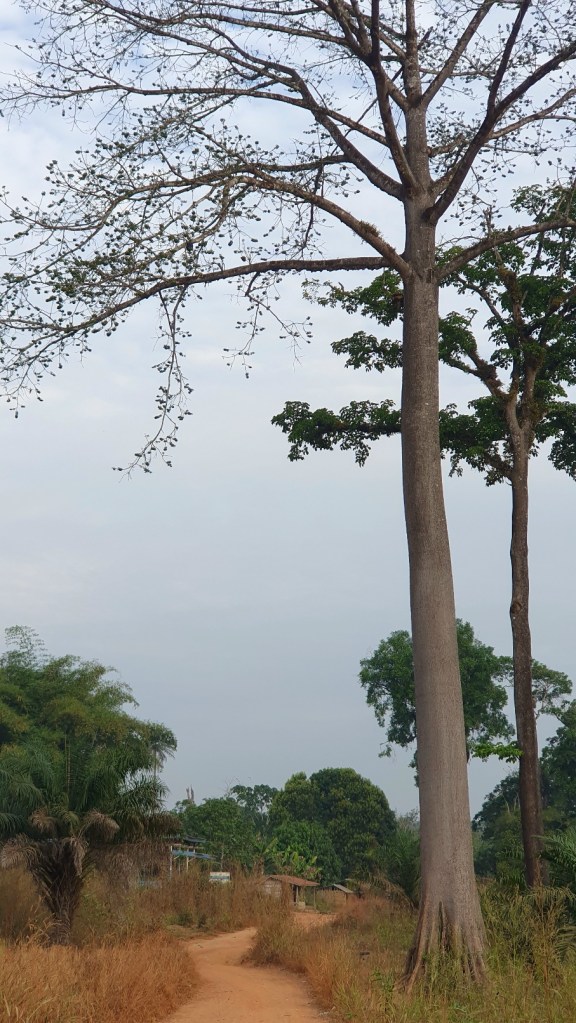
(This story told in pictures.)
 Hulkuv loom